What Confidentiality, Integrity and Availability Mean in Cybersecurity
Cybersecurity involves much more than keeping hackers out of computers and networks. Organizations also need to make sure that sensitive information remains private, that data is accurate and trustworthy, and that authorized people can access systems when they need them.
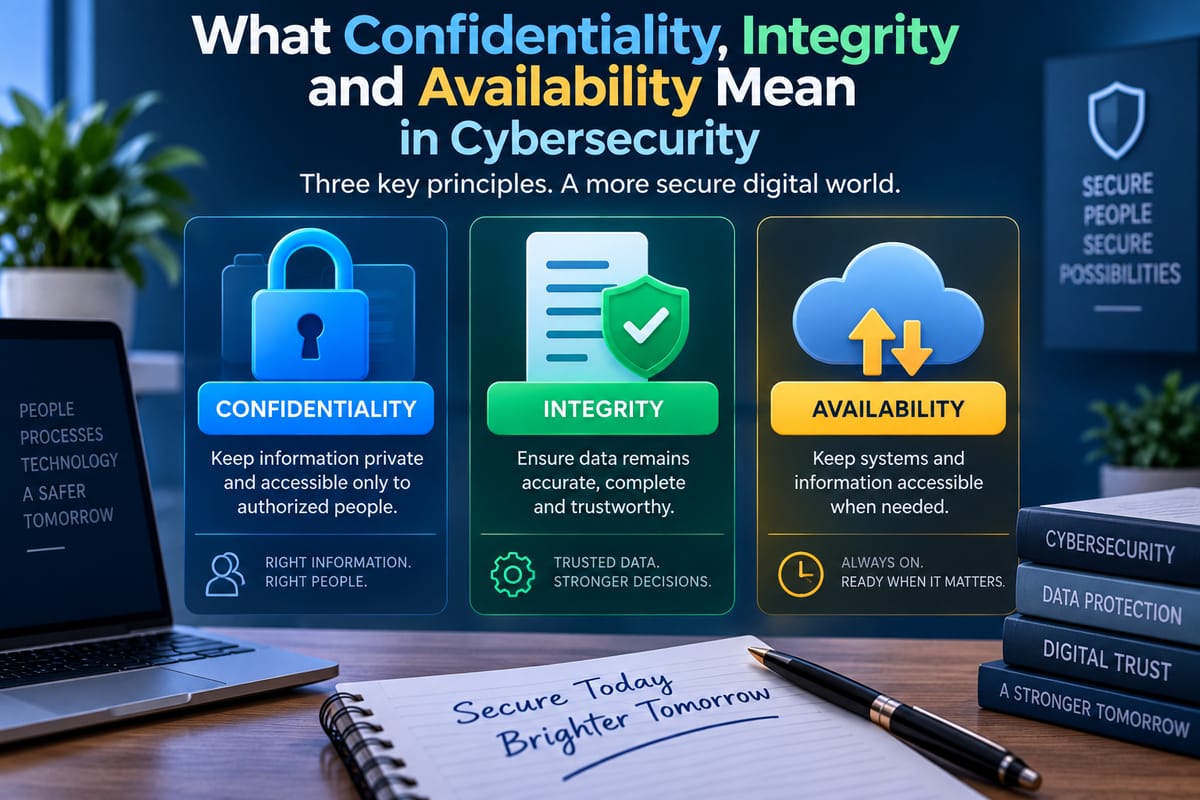
These three objectives are commonly described as confidentiality, integrity, and availability. Together, they form the foundation of the CIA triad, one of the most widely used concepts for understanding cybersecurity.
The three principles provide a simple way to think about what security is supposed to accomplish. Confidentiality focuses on preventing unauthorized disclosure, integrity focuses on preventing unauthorized or improper changes, and availability focuses on keeping systems and information accessible when required.
A strong cybersecurity strategy considers all three rather than focusing exclusively on preventing unauthorized access.
What Is the CIA Triad?
The CIA triad consists of three core cybersecurity objectives:
- Confidentiality — Information should only be accessible to authorized people and systems.
- Integrity — Information and systems should remain accurate, complete, and trustworthy.
- Availability — Authorized users should be able to access information and systems when they need them.
These objectives are interconnected.
For example, a company may have extremely strict access controls that protect confidential information, but if those controls prevent legitimate employees from accessing essential systems, availability suffers.
Similarly, a system might remain online and accessible but become unreliable if an attacker changes important data.
Cybersecurity therefore involves balancing multiple security requirements.
What Confidentiality Means in Cybersecurity
Confidentiality means protecting information from unauthorized access or disclosure.
The objective is to ensure that sensitive information is available only to people, applications, devices, or organizations that have appropriate permission.
Examples of confidential information can include:
- Customer records
- Passwords
- Financial information
- Medical information
- Employee records
- Business strategies
- Intellectual property
- Authentication credentials
- Private communications
- Government information
A confidentiality breach occurs when information is exposed to someone who should not have access to it.
For example, if an attacker steals a database containing customer information, the organization has experienced a confidentiality problem.
How Organizations Protect Confidentiality
Organizations use multiple controls to protect sensitive information.
Common measures include:
- Strong authentication
- Multi-factor authentication
- Access controls
- Encryption
- Password management
- Data classification
- Network segmentation
- Secure file sharing
- Privacy policies
- Employee security training
Access controls are particularly important because users should generally receive only the permissions they need to perform their responsibilities.
This principle is often called least privilege.
For example, an employee who needs to view customer records may not need permission to modify financial databases or access confidential executive documents.
Reducing unnecessary access can limit the amount of information exposed if an account is compromised.
Encryption Supports Confidentiality
Encryption is one of the most important technologies used to protect confidential information.
Encryption transforms readable information into a protected form that requires an appropriate key or mechanism to recover the original data.
It can help protect information:
- While stored on devices
- While being transmitted across networks
- During communication between systems
- In cloud environments
- Within databases
- In backups
The Complete Guide to Encryption and Cryptography provides broader information about the technologies and concepts behind encryption.
However, encryption is only one part of confidentiality. If an authorized account is compromised, an attacker may be able to access information through legitimate application functions even though the underlying data is encrypted at rest.
What Integrity Means in Cybersecurity
Integrity refers to maintaining the accuracy, consistency, completeness, and trustworthiness of information and systems.
Data integrity means information should not be improperly altered, deleted, corrupted, or manipulated.
For example, consider a financial database containing customer account balances.
If an unauthorized person changes an account balance, the information is no longer trustworthy even if the database remains accessible.
Integrity is therefore concerned with answering a different question from confidentiality:
Can we trust that this information has not been improperly changed?
Examples of Integrity Problems
Integrity can be compromised in many ways.
Examples include:
- An attacker modifying database records
- Malware changing system files
- An employee accidentally deleting information
- A malicious insider altering financial records
- A software error corrupting data
- An attacker changing website content
- Unauthorized modifications to configuration files
Not every integrity problem is caused by a cyberattack.
Accidental changes, software failures, hardware problems, and operational mistakes can also damage data integrity.
Cybersecurity programs therefore need controls that address both malicious and accidental changes.
How Organizations Protect Data Integrity
Organizations can use a range of controls to preserve integrity.
These may include:
- Access restrictions
- File permissions
- Version control
- Digital signatures
- Hashing
- Audit logs
- Change management
- Database controls
- Backup systems
- Integrity monitoring
- Approval processes
Logging is especially useful because it creates a record of important activities.
If a critical database record changes unexpectedly, an audit trail may help determine who or what made the change and when it occurred.
Hashing and Integrity
Hashing is another important concept related to integrity.
A hash function generates a value based on the contents of data. If the data changes, the resulting hash can also change.
This can allow systems to detect whether information has been modified.
For example, a software provider might publish a checksum for a downloadable file. A user can calculate the hash of the downloaded file and compare it with the published value.
If the values differ, the file may have been changed or corrupted.
Hashing and encryption are not the same thing. Encryption is designed to protect information from unauthorized disclosure and can generally be reversed with the appropriate key. Hashing is typically designed as a one-way transformation used for purposes such as integrity checking and password protection.
What Availability Means in Cybersecurity
Availability means that authorized users can access systems, applications, networks, and information when they need them.
A system can have excellent confidentiality and integrity controls but still fail its security objectives if legitimate users cannot access it.
Availability is especially important for organizations that rely on technology for daily operations.
Examples include:
- Online banking
- Healthcare systems
- E-commerce platforms
- Communication services
- Manufacturing systems
- Cloud applications
- Government services
- Business databases
If an essential system becomes unavailable, the consequences can include lost productivity, financial losses, interrupted services, and operational disruption.
What Can Affect Availability?
Availability can be disrupted by both cybersecurity incidents and ordinary technical failures.
Potential causes include:
- Distributed denial-of-service attacks
- Ransomware
- Hardware failures
- Software failures
- Power outages
- Network failures
- Natural disasters
- Accidental deletion
- Infrastructure problems
- Capacity limitations
This means availability is not simply an IT uptime issue.
It is also a cybersecurity and business continuity concern.
How Organizations Protect Availability
Organizations use several strategies to improve availability.
These can include:
- Redundant systems
- Data backups
- Disaster recovery plans
- Failover systems
- Multiple network connections
- Uninterruptible power supplies
- Load balancing
- Capacity planning
- System monitoring
- DDoS protection
- Business continuity planning
Redundancy is particularly important.
If one component fails and there is no alternative, the entire service may become unavailable.
A redundant architecture can allow another system or component to take over.
Backups Support Availability and Integrity
Backups can contribute to both availability and integrity.
If data is accidentally deleted or damaged by malware, a reliable backup may allow an organization to restore an earlier version.
For example, ransomware can encrypt files and prevent normal access. A protected backup may provide a way to recover those files without relying entirely on the compromised copies.
However, backups need to be protected themselves.
If an attacker can access and delete production backups, recovery may become much more difficult.
Organizations should therefore consider backup security, access controls, retention policies, and restoration testing.
The CIA Triad and Network Security
Networks play an important role in supporting all three elements of the CIA triad.
Network security controls can help prevent unauthorized access, detect suspicious activity, protect communications, and maintain reliable connectivity.
Firewalls, segmentation, intrusion detection, secure wireless configurations, access controls, and monitoring can all contribute to cybersecurity objectives.
The Complete Guide to Network Security provides broader information about the technologies and practices organizations can use to protect networks.
A network security failure can potentially affect confidentiality, integrity, and availability at the same time.
The CIA Triad and Data Security
Data security focuses directly on protecting information throughout its lifecycle.
Organizations need to consider data when it is:
- Created
- Stored
- Processed
- Transmitted
- Shared
- Archived
- Deleted
Controls can be designed around each stage.
For example, encryption may protect data during transmission, access controls may restrict who can view it, backups may support recovery, and secure deletion may reduce the risk associated with information that is no longer needed.
What Is Data Security and How Can Digital Information Be Protected? provides additional context on protecting digital information from unauthorized access, loss, alteration, and other threats.
Why Confidentiality Alone Is Not Enough
It can be tempting to think that cybersecurity is primarily about keeping information secret.
Confidentiality is certainly important, but it is only one part of the security picture.
Imagine a hospital database containing sensitive patient information.
If unauthorized people cannot access it, confidentiality is being protected.
But if medical records are incorrectly modified, integrity has been compromised.
If doctors and authorized staff cannot access the records during an emergency, availability has been compromised.
A secure system therefore needs to address all three objectives.
Why Integrity Matters in Everyday Systems
Integrity is especially important when organizations rely on information to make decisions.
Consider information such as:
- Bank balances
- Inventory levels
- Medical records
- Customer orders
- Payroll records
- Software code
- Legal documents
- Business reports
If information is inaccurate or has been manipulated, decisions based on that information can also become unreliable.
Integrity controls therefore help maintain confidence in digital systems.
Why Availability Matters to Businesses
For many businesses, technology is directly connected to revenue.
An online store that cannot process orders may lose sales.
A payment system that stops working may prevent transactions.
A logistics platform that becomes unavailable may disrupt deliveries.
An internal business application that goes offline may prevent employees from completing important tasks.
This is why availability needs to be considered when designing cybersecurity programs.
Security controls that are excessively restrictive or poorly configured can sometimes create availability problems of their own.
Balancing the Three Objectives
The CIA triad is useful partly because the three objectives can sometimes conflict.
For example, adding additional authentication steps can strengthen confidentiality and reduce unauthorized access. However, if the authentication process is poorly designed or unavailable, legitimate users may struggle to access essential systems.
Similarly, aggressive security controls may block legitimate traffic and affect availability.
Organizations therefore need to determine which security controls provide appropriate protection without unnecessarily disrupting legitimate operations.
The goal is not to maximize one principle at the expense of everything else.
How the CIA Triad Applies to a Small Business
The CIA triad is not limited to large corporations.
A small business may have important information and systems that require protection.
For example, a small retailer might need to protect:
- Customer contact information
- Payment information
- Employee records
- Supplier information
- Inventory data
- Accounting systems
- Website accounts
A basic cybersecurity program can address the three objectives through practical measures.
Confidentiality
Use strong passwords, multi-factor authentication, appropriate permissions, and encryption.
Integrity
Use backups, access controls, change tracking, and reliable software.
Availability
Maintain backups, update systems, protect network equipment, and prepare for outages.
The The Ultimate Guide to Business Cybersecurity provides a broader view of how businesses can organize their cybersecurity practices.
The CIA Triad Applies to Employees Too
Employees play a role in protecting all three objectives.
For confidentiality, employees should avoid sharing passwords or sending sensitive information to unauthorized recipients.
For integrity, employees should avoid making unauthorized changes to important records or systems.
For availability, employees should report technical problems, suspicious activity, or potential security incidents promptly.
Security awareness training can therefore connect technical policies with everyday employee behavior.
Common Threats Can Affect Multiple Objectives
Some cybersecurity incidents do not affect just one element of the CIA triad.
Ransomware provides a good example.
An attacker may encrypt an organization's files, making them unavailable to legitimate users.
At the same time, the attacker may modify or destroy information, affecting integrity.
If sensitive information is also stolen before encryption, confidentiality may be compromised as well.
This illustrates why organizations need layered security rather than a single defensive measure.
Using the CIA Triad to Assess Security Risks
The three principles can provide a useful framework for thinking about cybersecurity risks.
For each important system or type of information, organizations can ask:
Confidentiality
Who should be able to access this information?
What could happen if unauthorized people obtained it?
Integrity
How important is the accuracy of this information?
What would happen if someone changed it incorrectly?
Availability
Who needs access to the system?
What would happen if the system became unavailable?
These questions can help organizations identify which security controls are most important.
Security Requirements Can Differ by System
Not every system needs exactly the same balance of confidentiality, integrity, and availability.
For example, a public website may place a strong emphasis on availability and integrity.
A confidential employee database may place particularly strong emphasis on confidentiality.
A critical industrial control system may require extremely high availability and integrity.
The appropriate priorities depend on the organization's operations, risks, legal obligations, and the consequences of a security failure.
The CIA Triad Is a Starting Point, Not the Entire Security Strategy
Confidentiality, integrity, and availability provide a powerful framework, but they do not describe every aspect of cybersecurity.
Organizations may also need to consider:
- Authentication
- Accountability
- Privacy
- Non-repudiation
- Safety
- Resilience
- Compliance
- Risk management
These concepts can complement the CIA triad and provide a more complete view of organizational security.
A Practical Way to Remember the Three Principles
A simple way to remember the CIA triad is to ask three questions:
Confidentiality:
Who can see it?
Integrity:
Can I trust it?
Availability:
Can I access it when I need it?
These three questions can apply to almost any digital system.
Whether an organization is protecting customer information, managing a cloud application, operating a business network, or maintaining an internal database, the same basic principles remain relevant.
Building Security Around Confidentiality, Integrity and Availability
Cybersecurity becomes easier to understand when security objectives are connected to real-world consequences.
Confidentiality protects information from unauthorized disclosure. Integrity helps ensure that information and systems remain accurate and trustworthy. Availability helps ensure that authorized users can access the resources they depend on.
Together, these principles provide a foundation for designing security controls, evaluating risks, planning for incidents, and protecting digital operations.
A strong cybersecurity program does not simply ask whether attackers can get in. It also asks whether sensitive information can remain private, whether important data can be trusted, and whether critical systems will remain available when they are needed most.