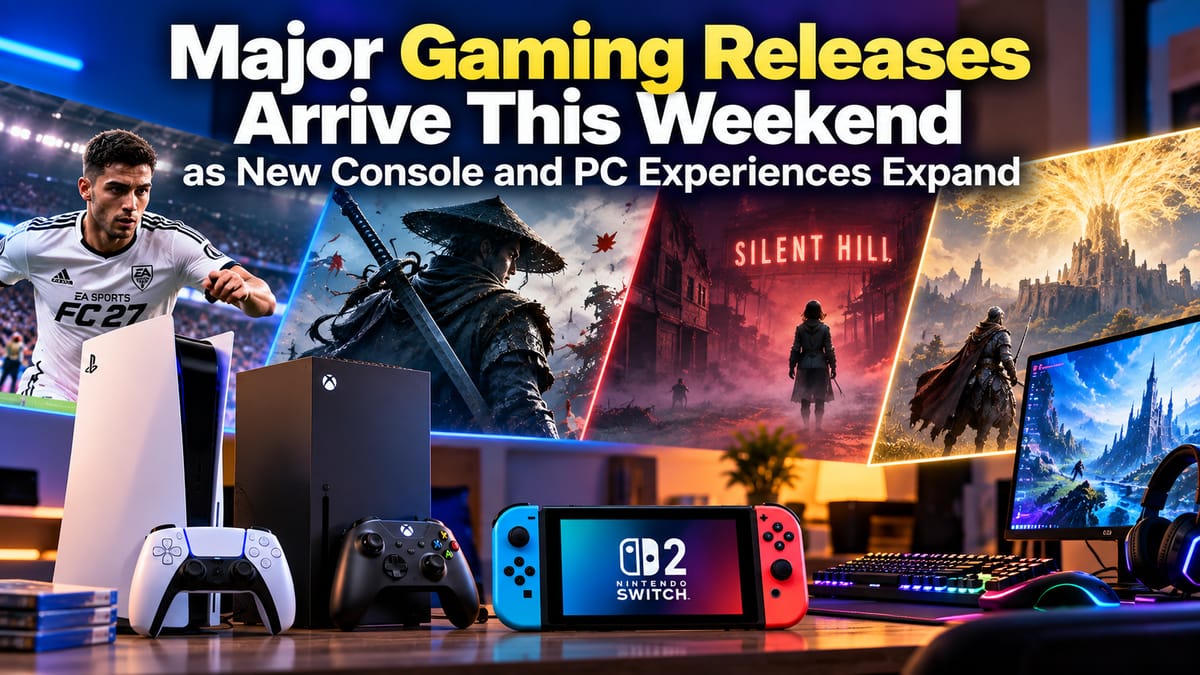
Major Gaming Releases Arrive This Weekend as New Console and PC Experiences Expand
The final weekend of September is bringing another wave of major gaming releases across PlayStation, Xbox, PC and Nintendo Switch 2, giving players plenty of new experiences to explore as the industry heads toward its busy end-of-year period.
September 25 marked the worldwide launch of EA Sports FC 27, while several other major titles arrived during the final days of the week. Games released earlier in the week, including Control Resonant, Silent Hill: Townfall, Dragon Quest XI S: Echoes of an Elusive Age – Definitive Edition and Shinobi: Art of Vengeance, are also helping create an unusually crowded period for players.
The timing is significant. The industry is moving into the final quarter of 2026, traditionally one of the busiest periods for new hardware, major software launches and holiday shopping.
For consumers, the result is a gaming landscape that increasingly spans traditional consoles, gaming PCs, handheld hardware and newer devices designed to make high-end games more portable.
EA Sports FC 27 Leads the Weekend Releases
One of the biggest releases arriving this weekend is EA Sports FC 27, which launched worldwide on September 25 across PlayStation, Xbox, PC and Nintendo Switch platforms, including Nintendo Switch 2.
The latest entry in EA's football franchise arrives with several changes aimed at expanding both gameplay and long-term engagement.
The game introduces new gameplay adjustments, an overhauled Career transfer market and additional systems for Ultimate Team. PC players also receive platform-specific improvements, while the introduction of The Grounds provides another space for players to interact with the game outside traditional matches.
For EA, the annual football release remains an important part of its sports-gaming strategy.
For players, however, the significance extends beyond one franchise. Sports games increasingly demonstrate how modern gaming combines annual releases with persistent online systems, seasonal content and communities that continue playing long after launch day.
A Busy Week Across PlayStation, Xbox and PC
EA Sports FC 27 is not arriving in isolation.
The days leading into the weekend brought several other notable releases. Control Resonant launched on September 24 for PC, PlayStation 5 and Xbox Series X|S, while Silent Hill: Townfall arrived on PC and PlayStation 5 on the same day. Nintendo Switch 2 also received titles including Dragon Quest XI S: Echoes of an Elusive Age – Definitive Edition and Shinobi: Art of Vengeance.
That concentration of releases gives players a broad range of genres to choose from.
Action-adventure fans can look toward Control Resonant, horror players have Silent Hill: Townfall, while role-playing fans can return to Dragon Quest XI S. Sports enthusiasts have EA Sports FC 27 as one of the weekend's most prominent options.
The variety also demonstrates how the modern gaming market has become increasingly fragmented across genres and platforms.
Nintendo Switch 2 Continues Building Its Library
Nintendo Switch 2 is playing a growing role in the 2026 release calendar.
The console has already received several major games throughout the year, and September has added titles ranging from Fire Emblem: Fortune's Weave to Dragon Quest XI S, Shinobi: Art of Vengeance and other established franchises.
Earlier in the year, Elden Ring: Tarnished Edition also brought FromSoftware's acclaimed action RPG to Nintendo's newer hardware.
The arrival of games such as the Elden Ring Tarnished Edition on Nintendo Switch 2 illustrates how console makers are increasingly relying on established franchises to expand the appeal of newer hardware.
That strategy can be particularly important during the early years of a console generation, when manufacturers need to build a large software library capable of attracting different types of players.
Portable Gaming Is Becoming More Sophisticated
The expansion of Nintendo Switch 2 is happening alongside a broader transformation in portable gaming.
For years, portable consoles generally offered experiences designed specifically around their hardware limitations. Modern handhelds are increasingly capable of running games that were once associated almost exclusively with desktop PCs and powerful home consoles.
The development of more capable processors, faster storage and improved displays has helped narrow that gap.
At the same time, devices such as Valve's Steam Frame are pushing the concept of portable and personal gaming hardware in new directions.
Valve's reservation system recently moved into its next stage, with first purchase emails being sent to customers as the company prepared to fulfill early reservations. The development adds another layer to the expanding market for dedicated PC gaming hardware.
The broader evolution of these products reflects how consumer gadgets and modern devices work and how increasingly powerful components are being placed into smaller and more specialized products.
PC Gaming Continues to Expand Beyond Traditional Desktops
PC gaming remains central to the release calendar, but the definition of a gaming PC is changing.
Traditional desktop computers remain important for players seeking maximum performance and customization. At the same time, gaming laptops, handheld PCs and other compact devices are making PC games accessible in places where a desktop system would be impractical.
This is changing expectations around what a gaming platform should be.
Players can increasingly move between desktop monitors, televisions, handheld screens and portable devices while remaining connected to the same digital ecosystems.
Cloud saves, cross-platform progression and digital storefronts have made that transition easier.
As a result, the distinction between console gaming and PC gaming is becoming less rigid than it once was.
Phantom Blade Zero Remains One of the Games to Watch
Not every important gaming development this weekend involves a release.
Phantom Blade Zero remains one of the major upcoming action games attracting attention from players interested in the next generation of large-scale releases.
The project has received attention through PlayStation presentations and gameplay showcases, highlighting its fast-paced combat and highly stylized visual direction.
The game's development also reflects the increasingly international nature of the modern gaming industry.
Chinese developers have become increasingly visible in the global market, producing projects designed for audiences far beyond their domestic markets.
The earlier Phantom Blade Zero State of Play coverage provides additional context on how the game has been presented to audiences.
Although Phantom Blade Zero is not part of this weekend's release lineup, its position on the broader 2026-2027 calendar shows that major gaming releases are no longer concentrated around the traditional Western publishers and platforms.
Gaming Hardware Is Becoming Part of the Experience
The latest release cycle also highlights how closely software and hardware are now connected.
A game's performance can depend on the processor, graphics hardware, memory, storage and display technology inside the device.
Console manufacturers can use exclusive software to demonstrate the capabilities of new hardware, while PC manufacturers compete through faster components and improved displays.
Handheld gaming adds another challenge because developers must balance performance against battery life, heat and physical size.
That makes modern gaming hardware more than a simple platform for software. Hardware design directly influences what developers can build and how players experience those games.
Why September Has Become So Busy
The crowded September calendar is part of a larger trend.
Game publishers often concentrate major releases during the second half of the year because the period leads into the holiday shopping season. However, the gaming industry has also become more comfortable spreading releases across digital storefronts and subscription services throughout the year.
September 2026 has already included major releases such as Marvel's Wolverine, Fire Emblem: Fortune's Weave, Dune: Awakening on consoles, Control Resonant, Silent Hill: Townfall and EA Sports FC 27.
More releases are scheduled for the final days of the month.
Minecraft Dungeons 2 and The Witcher 3: Wild Hunt Remastered are both scheduled for September 29, arriving across several major platforms.
That means the busy release cycle will continue into the following week rather than ending with the September 25 launches.
Digital Distribution Makes Launches More Flexible
Another reason gaming release calendars can become so crowded is the rise of digital distribution.
Players no longer need to wait for physical shipments before accessing many new games. Digital storefronts can make titles available almost immediately after their release times.
Developers can also continue updating games after launch.
Patches can fix technical problems, improve performance and add features. Online games can receive new content months or years after their initial release.
This has fundamentally changed the meaning of a game launch.
The release date is increasingly the beginning of a product's commercial and creative lifecycle rather than the point at which development completely ends.
Subscription Services Add Another Layer
Subscription services have also changed how consumers discover games.
Rather than purchasing every game individually, players can access catalogs through services such as Game Pass and PlayStation Plus.
Sony's September PlayStation Plus Game Catalog, for example, includes titles such as RuneScape: Dragonwilds, WWE 2K26, Ball x Pit and Date Everything!.
This model gives publishers another way to reach audiences while giving players more opportunities to try games they might otherwise overlook.
It also means the gaming market increasingly has two parallel economies: traditional premium releases and subscription-based access.
What the Weekend Says About Gaming's Direction
The latest release wave shows an industry that is expanding in several directions at once.
Major franchises continue to dominate the release calendar, but independent developers and new international studios are also producing increasingly ambitious projects.
At the same time, gaming hardware is becoming more diverse.
Players can choose from traditional consoles, powerful gaming PCs, laptops, handheld computers and hybrid systems such as the Nintendo Switch 2.
The result is a market where the same game can potentially reach players through several different types of hardware.
The Next Wave Is Already Taking Shape
September's final weekend may be busy, but it is only a transition point toward an even larger final quarter.
October already has several major releases scheduled, including Ace Combat 8: Wings of Theve, Gears of War: E-Day, Call of Duty: Modern Warfare 4 and Phantom Blade Zero.
November is set to bring another major wave, including GTA 6 on November 19, alongside other significant releases.
That schedule means consumers will continue facing a steady stream of new games across different platforms as 2026 moves toward its final months.
For players, the biggest change may be the sheer number of ways to experience those releases. A new game can now arrive simultaneously across consoles and PC, reach handheld hardware later, become part of a subscription catalog or evolve through years of digital updates.
Gaming is no longer defined by a single console generation or a single type of device. The current release cycle reflects a broader shift toward an interconnected ecosystem where software, hardware, online services and digital communities increasingly shape the experience together.