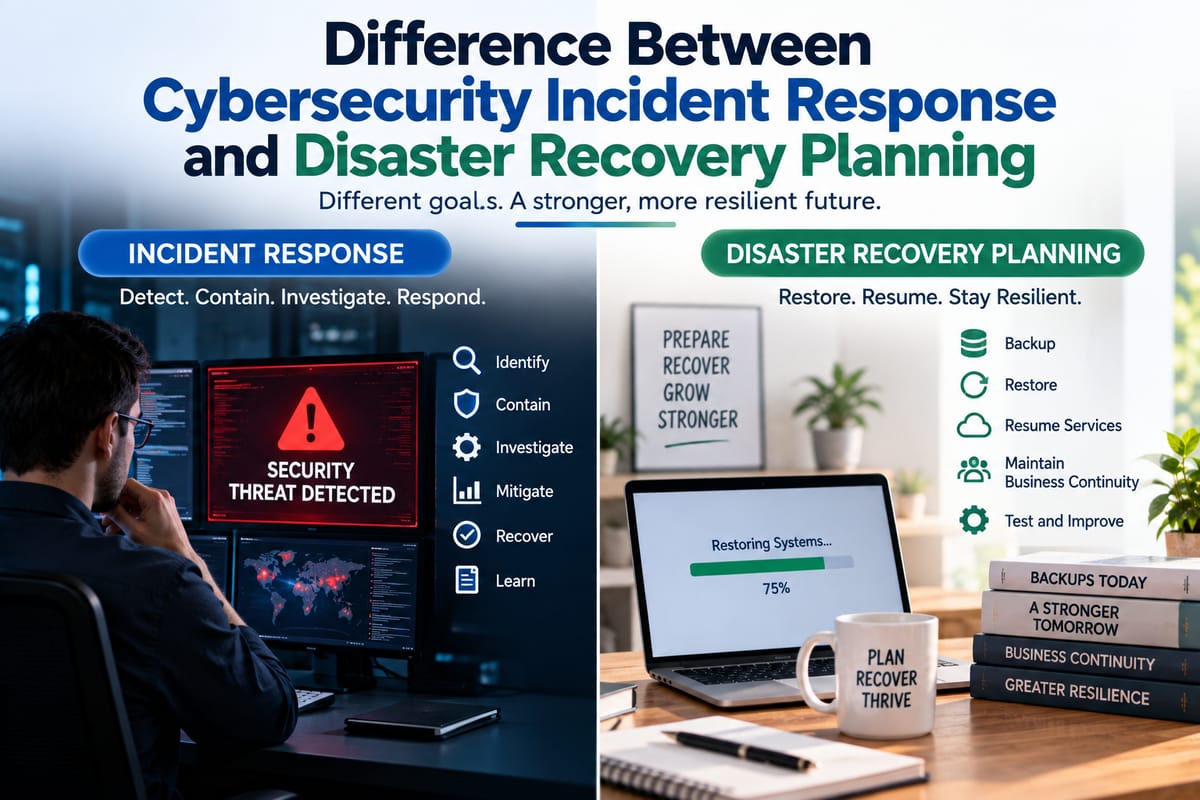
Difference Between Cybersecurity Incident Response and Disaster Recovery Planning
Cybersecurity incident response and disaster recovery planning are closely related parts of an organization's resilience strategy, but they serve different purposes.
When a company experiences ransomware, a data breach, system compromise, major outage, or another disruptive event, it needs to know both how to respond to the immediate incident and how to restore critical operations afterward. Confusing these two functions can lead to gaps in preparation, unclear responsibilities, and slower recovery.
Incident response focuses primarily on identifying, containing, investigating, and managing a security incident. Disaster recovery focuses on restoring technology, data, applications, and business services after a disruptive event.
Understanding where these processes overlap and where they differ can help organizations build a more coordinated approach to cybersecurity and business continuity.
What Is Cybersecurity Incident Response?
Cybersecurity incident response is the organized process an organization uses to detect, analyze, contain, and manage a cybersecurity incident.
An incident could involve:
- Malware infection
- Ransomware
- Phishing-related compromise
- Unauthorized account access
- Data theft
- Denial-of-service activity
- Compromised endpoints
- Insider-related security incidents
- Exploitation of a software vulnerability
The objective is to limit damage, stop the threat from spreading, preserve relevant evidence, and return affected systems to a secure state.
Organizations with a mature cybersecurity program typically establish an incident response process before an attack occurs. A broader understanding of business cybersecurity provides the foundation for deciding what systems, information, and processes need protection.
What Is Disaster Recovery Planning?
Disaster recovery planning focuses on restoring important IT systems and business technology after a disruptive event.
The disruption does not necessarily have to be caused by a cyberattack. Disaster recovery may be needed after:
- Hardware failure
- Data-center outages
- Natural disasters
- Power failures
- Major software failures
- Human error
- Ransomware
- Serious cybersecurity incidents
- Infrastructure damage
A disaster recovery plan identifies what needs to be restored, in what order, by whom, and using which resources.
For example, a company might establish procedures for restoring databases from backups, rebuilding servers, recovering cloud applications, replacing damaged hardware, or moving critical workloads to an alternative environment.
Cybersecurity Incident Response vs. Disaster Recovery
The simplest way to distinguish the two is to consider their primary questions.
| Cybersecurity incident response | Disaster recovery planning |
|---|---|
| What happened? | What needs to be restored? |
| Is there an active security threat? | How can critical services be brought back? |
| How do we contain the incident? | How do we recover systems and data? |
| How do we investigate the event? | What recovery resources are required? |
| How do we prevent further damage? | How quickly must each service return? |
| How do we preserve evidence? | How do we resume normal operations? |
Incident response is therefore heavily focused on managing the security event, while disaster recovery is focused on restoring operational capability.
The two processes often operate together during a serious cyberattack.
The Main Purpose of Incident Response
The immediate priority during a cybersecurity incident is to understand and control the situation.
A typical response may involve several stages.
Detection and Identification
The organization first needs to determine whether suspicious activity represents a genuine security incident.
Security alerts, employee reports, endpoint monitoring, authentication logs, network activity, and other sources can contribute to this process.
Analysis
Security teams investigate what happened and determine the potential scope of the incident.
They may need to establish:
- Which systems are affected
- Which accounts were compromised
- What information may have been accessed
- How the attacker or malware entered the environment
- Whether the threat is still active
- Whether other systems are at risk
Containment
Containment aims to prevent the incident from becoming more serious.
Depending on the situation, an organization may isolate affected devices, disable compromised accounts, block malicious activity, or restrict network access.
Eradication
Once the threat has been contained, security teams work to remove the underlying cause.
This could include eliminating malware, closing an exploited vulnerability, removing unauthorized accounts, changing credentials, or addressing compromised infrastructure.
Recovery and Monitoring
Affected systems can then be restored and monitored carefully to ensure the threat has been removed.
This stage overlaps with disaster recovery, but the security team still needs to determine whether restored systems are safe to return to normal operation.
A detailed explanation of these processes can be found in How Incident Response Handles Cybersecurity Events.
The Main Purpose of Disaster Recovery
Disaster recovery begins with a different concern: restoring the organization's ability to operate.
A disaster recovery plan typically identifies critical systems and establishes priorities for bringing them back online.
For example, a company might determine that:
- Identity and authentication services must be restored first.
- Core databases must be recovered next.
- Customer-facing applications should follow.
- Lower-priority internal systems can be restored afterward.
The exact order depends on the organization's operations.
A financial services company, online retailer, hospital, manufacturer, and small professional-services firm may have very different recovery priorities.
Recovery Time Objective and Recovery Point Objective
Two concepts are particularly important in disaster recovery planning: Recovery Time Objective (RTO) and Recovery Point Objective (RPO).
Recovery Time Objective
RTO describes how quickly a system or service needs to be restored after disruption.
For example, an organization might establish an RTO of four hours for a critical application.
That does not necessarily mean the system can be unavailable for exactly four hours without consequences. It represents the organization's target for recovery based on operational requirements.
Recovery Point Objective
RPO describes how much data loss the organization is prepared to tolerate, measured in time.
For example, an RPO of one hour means the recovery strategy is designed around the possibility of losing up to approximately one hour of recent data.
These objectives influence decisions about backup frequency, replication, infrastructure, recovery technologies, and costs.
Why Backups Matter to Both Processes
Backups are particularly important when cybersecurity incidents cause data destruction or make systems unavailable.
A reliable data backup strategy can provide organizations with a way to recover information after accidental deletion, hardware failure, ransomware, or other disruptive events.
However, having backups does not automatically guarantee successful recovery.
Organizations also need to consider:
- How frequently backups are created
- Where backups are stored
- Whether backups are protected from unauthorized access
- Whether backups are isolated from production systems
- How long backups are retained
- How quickly data can be restored
- Whether restoration procedures have been tested
Cybersecurity teams also need to consider whether attackers could compromise backup systems during an incident.
How Incident Response and Disaster Recovery Work Together
Although incident response and disaster recovery have different objectives, a major cybersecurity incident can require both.
Consider a ransomware attack that encrypts a company's production servers.
The incident response team may:
- Identify the ransomware
- Determine how the attackers gained access
- Isolate affected systems
- Disable compromised accounts
- Investigate the scope of the attack
- Remove malicious software
- Determine whether sensitive information was stolen
The disaster recovery team may:
- Identify unaffected recovery resources
- Restore critical infrastructure
- Recover data from secure backups
- Rebuild affected systems
- Prioritize essential applications
- Coordinate the return of business services
Neither process completely replaces the other.
Restoring an infected system without addressing the security problem could allow the threat to return. Conversely, containing an attack without a plan for restoring essential systems could leave the organization unable to operate.
Where Cybersecurity Risk Management Fits
Incident response and disaster recovery are also connected to broader cybersecurity risk management.
Risk management helps organizations identify potential threats, evaluate their potential impact, and determine which safeguards and response capabilities are necessary.
Understanding cybersecurity risk management can help organizations see why incident response and recovery planning should be based on the risks that matter most to their specific environment.
For example, a company that depends heavily on a single customer database may place significant emphasis on database availability and recovery.
Another organization might have greater exposure through employee accounts, cloud applications, intellectual property, or operational technology.
Risk assessment helps determine where preparation and investment should be concentrated.
Who Is Responsible for Incident Response and Disaster Recovery?
Responsibility can vary between organizations, but the teams involved are often different.
Incident Response Teams
Incident response may involve:
- Security analysts
- Security operations teams
- IT administrators
- Incident response specialists
- Digital forensics personnel
- Legal teams
- Privacy professionals
- Communications teams
- Executive leadership
Their focus is managing the security incident and limiting its consequences.
Disaster Recovery Teams
Disaster recovery may involve:
- IT infrastructure teams
- Cloud engineers
- System administrators
- Database administrators
- Business continuity teams
- Application owners
- Facilities personnel
- Senior management
Their focus is restoring essential technology and business services.
The responsibilities can overlap, particularly in smaller organizations where the same people may handle both security and recovery functions.
Communication Is Important During Both Processes
Technical response is only part of managing a major disruption.
Organizations may need to communicate with employees, customers, business partners, regulators, insurers, vendors, and other stakeholders.
Incident response communications may focus on the security event, affected systems, containment actions, and potential data exposure.
Disaster recovery communications may focus more heavily on service availability, expected restoration timelines, alternative procedures, and operational status.
Clear communication responsibilities should therefore be established before an emergency occurs.
Common Mistakes Organizations Make
Several problems can weaken the relationship between incident response and disaster recovery.
Treating Backups as a Complete Recovery Plan
Backups are essential, but recovery also requires tested procedures, appropriate infrastructure, defined responsibilities, and realistic restoration objectives.
Focusing Only on Prevention
Security controls can reduce risk, but no organization can assume that preventive measures will eliminate every possible incident.
Response and recovery capabilities are necessary layers of resilience.
Failing to Test the Plans
A plan that looks effective on paper may fail under real-world conditions.
Organizations should periodically test response and recovery procedures through exercises, simulations, and restoration tests.
Keeping Recovery and Security Teams Separate
Security teams and IT recovery teams may have different responsibilities, but serious incidents require coordination.
If one team restores systems without knowing what the other team has discovered, important security risks can be overlooked.
Ignoring Business Priorities
Not every system needs to be restored simultaneously.
Recovery priorities should reflect which applications, services, and information are essential to the organization's operations.
How Organizations Can Prepare for Both
A practical resilience strategy can bring incident response and disaster recovery together without treating them as the same process.
Organizations can:
- Identify critical systems and information.
- Assess cybersecurity and operational risks.
- Create a documented incident response plan.
- Create a separate but connected disaster recovery plan.
- Define RTOs and RPOs for critical services.
- Maintain secure and tested backups.
- Assign responsibilities to specific teams and individuals.
- Establish internal and external communication procedures.
- Test incident response and recovery processes regularly.
- Update plans as systems, threats, and business requirements change.
The goal is to create a coordinated process in which security teams know how to contain incidents and recovery teams know how to restore operations safely.
Building Resilience Beyond the Incident
Cybersecurity incident response and disaster recovery planning address different stages of organizational resilience.
Incident response is primarily concerned with detecting, analyzing, containing, investigating, and eliminating cybersecurity threats. Disaster recovery is primarily concerned with restoring systems, data, applications, and essential operations after disruption.
The distinction becomes especially important during major cyberattacks. A business may need to stop an attacker while simultaneously preparing to recover critical systems. Effective preparation therefore requires both capabilities, supported by secure backups, clear responsibilities, risk-based priorities, and regular testing.
When these processes are designed to work together, organizations have a clearer path from the first security alert through containment, restoration, and the eventual return to normal operations.