ChatGPT Ads and AI Commerce Expansion Create a New Search and Shopping Battleground
The competition to control how people discover information, products and services is moving into a new phase as artificial intelligence companies increasingly combine conversational search, advertising and shopping.
ChatGPT is no longer being positioned solely as a tool for answering questions. It is becoming a place where users can research products, compare options, discover businesses and, in some cases, complete purchases.
At the same time, OpenAI is expanding ChatGPT Ads and developing new advertising and commerce tools for businesses. In September 2026, the company introduced sponsored agents, new AI-powered advertising tools and integrations with Shopify and HubSpot. The developments bring advertising, customer interaction and commerce closer together inside the conversational AI experience.
The result is a rapidly developing market in which traditional search engines, online retailers, advertising platforms and AI assistants increasingly overlap.
ChatGPT Is Becoming More Than a Search Alternative
Traditional search generally begins with a query and produces a page of links, advertisements and other results.
Conversational AI changes the sequence.
A user can describe a goal in natural language, ask follow-up questions, refine preferences and compare alternatives without necessarily leaving the conversation.
That makes AI particularly relevant to searches where the user does not yet know exactly what they want.
Someone looking for a laptop, for example, may begin with a broad question about work and gaming computers. The conversation can then narrow the choices according to budget, screen size, performance requirements, portability and other preferences.
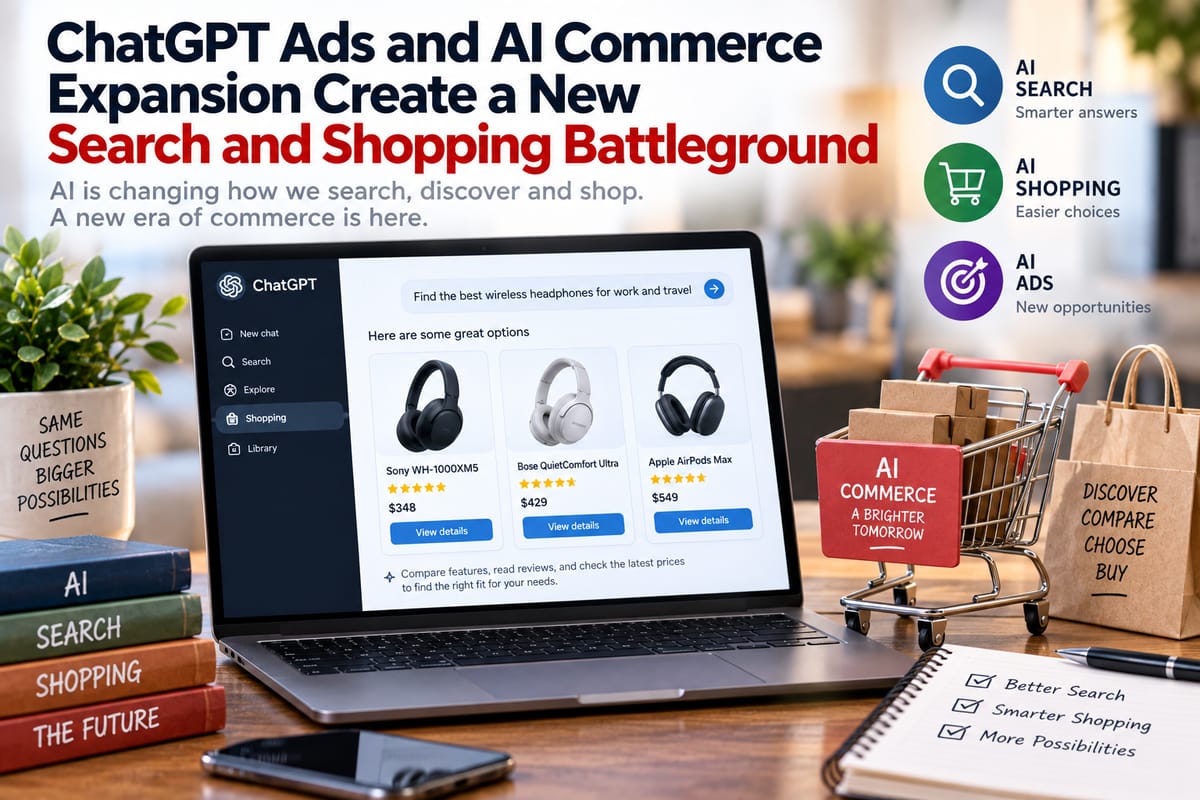
OpenAI has been developing ChatGPT's product-discovery capabilities around this type of interaction. Its shopping experience allows users to browse products visually, compare options and receive updated product information within the conversation.
This represents a significant change in how product discovery can work.
Instead of searching separately for reviews, product pages and comparison articles, consumers can increasingly ask an AI system to help organize the decision.
Advertising Is Moving Into the Conversation
The introduction of ChatGPT Ads adds another layer to this transformation.
OpenAI began testing ads in the United States in February 2026 and has since expanded the program into additional markets. The company says ads are designed to remain separate from ChatGPT's answers and that advertisers do not receive users' conversations.
By August, OpenAI said ChatGPT Ads had reached a $1 billion annualized revenue run rate, with tens of thousands of advertisers using the platform. The company was also expanding advertising access into Europe, India, the Middle East and North Africa.
That scale changes the significance of AI advertising.
The question is no longer simply whether advertisements can appear alongside AI-generated answers. It is whether conversational AI can become a major environment in which consumers discover products and businesses.
Sponsored Agents Push Advertising Further
OpenAI's September advertising announcement points toward an even more interactive model.
The company is testing Sponsored Agents, which allow a user to begin a conversation with a business-sponsored AI agent after interacting with an advertisement. OpenAI describes this as a way for businesses to participate directly in the AI conversation rather than simply displaying a conventional advertisement.
This creates a potentially important distinction between traditional advertising and AI advertising.
A conventional advertisement might attempt to generate a click.
A sponsored AI agent can potentially continue the interaction by answering questions, explaining products or helping a consumer explore a company's offerings.
For businesses, that could transform advertising from a relatively static message into the beginning of a conversation.
AI Commerce Is Moving Beyond Product Recommendations
The shopping side of the equation has been developing alongside advertising.
OpenAI introduced Instant Checkout in 2025, allowing eligible users in the United States to purchase certain products without leaving ChatGPT. The system was initially introduced with Etsy sellers and was designed to support additional merchants through the Agentic Commerce Protocol.
OpenAI has subsequently expanded product discovery and commerce capabilities.
The significance is that AI can potentially connect several stages of the consumer journey:
Discovery → Research → Comparison → Recommendation → Purchase
Traditional digital commerce often distributes those stages across different websites and services.
A shopper might discover a product through search, read reviews on another website, compare prices on a retailer's site and finally complete a purchase somewhere else.
An AI commerce system attempts to bring more of that process into one conversational environment.
Product Discovery and Advertising Are Not the Same Thing
One of the most important issues in this emerging market is the distinction between organic product results and paid advertising.
OpenAI says its product results are selected independently from advertisements. Its shopping documentation states that product results are not ads and are not influenced by OpenAI partnerships. Ads are presented separately.
That distinction matters because consumers need to understand whether a recommendation is being generated because it matches their stated requirements or because a company paid for promotional placement.
The separation also matters for the credibility of AI shopping.
If consumers cannot distinguish recommendations from advertisements, trust in AI-assisted purchasing could become more difficult to maintain.
The New Battleground Is About Intent
Search engines have historically competed for queries.
Retailers compete for transactions.
Advertising platforms compete for attention and conversions.
AI assistants can potentially operate across all three.
The most valuable part of a shopping conversation may not be the final purchase. It may be the moment when a consumer explains what they need.
Consider a user asking:
"I need a lightweight laptop for programming, travel and occasional gaming, and I want to spend less than $1,200."
That single request contains information about intent, budget, use case and preferences.
A conventional keyword query might contain only a few words.
A conversational AI system can potentially use the entire interaction to understand what the consumer is trying to accomplish.
That makes intent one of the most important assets in the emerging AI commerce market.
Businesses Will Need to Rethink Product Visibility
The rise of AI shopping could change how companies think about digital visibility.
For years, businesses have invested heavily in search-engine optimization, paid search, marketplace listings, product feeds and social-media advertising.
AI systems introduce another layer.
Products may increasingly need accurate descriptions, current prices, inventory information, specifications, images and structured product data that AI systems can interpret.
This does not necessarily make traditional SEO irrelevant.
Instead, it expands the number of systems through which a product needs to be discoverable.
Businesses may increasingly need to optimize for both traditional search engines and AI-powered discovery systems.
Online Shopping Could Become More Conversational
Traditional online shopping often begins with a category page.
A shopper chooses a category, applies filters and then examines products.
AI commerce can reverse the process.
The shopper can begin with a description of the problem they want to solve.
For example:
- "I need a laptop for college."
- "Find running shoes for long-distance training."
- "What should I buy for a small home office?"
- "Help me choose a television for a bright room."
- "Find a birthday gift for someone who loves photography."
The AI system can then use the conversation to narrow the possibilities.
This is particularly relevant to consumers who find traditional shopping filters confusing or who do not know the technical terminology associated with the product they need.
A practical Online Shopping Guide becomes increasingly relevant in this environment because consumers still need to understand pricing, product quality, seller reputation, return policies and other factors even when an AI helps narrow the choices.
AI Can Reduce the Number of Shopping Decisions
Shopping can involve dozens of small decisions.
Consumers may need to determine:
- Which products meet their requirements
- Which specifications actually matter
- Which brands are reliable
- Whether a price is reasonable
- Whether reviews are credible
- Whether a seller is trustworthy
- Whether a product will fit their particular use case
- Whether an alternative provides better value
AI can potentially reduce this cognitive workload.
Instead of asking consumers to independently compare dozens of specifications, an AI assistant can organize the information around the consumer's stated priorities.
That does not mean the AI's recommendation should automatically be accepted.
Consumers still need to verify important specifications, prices, availability, warranties and return conditions before making significant purchases.
Product Data Becomes More Important
AI commerce depends heavily on information.
If a product catalog contains outdated prices, inaccurate specifications or incorrect inventory information, an AI shopping experience can become unreliable.
This makes product-data management increasingly important for merchants.
OpenAI's Shopify integration, for example, allows merchants to connect product catalogs and commerce-event data to ChatGPT Ads Manager. The integration can synchronize inventory information and provide commerce data for advertising measurement and optimization.
This illustrates a broader shift.
The competitive advantage in AI commerce may increasingly depend not only on advertising budgets but also on the quality and freshness of the information businesses provide to AI systems.
Choosing the Right Product Still Requires Human Judgment
AI can make comparison easier, but consumers still need to determine whether a product actually meets their needs.
A recommendation may be technically relevant while still being unsuitable.
For example, the most powerful laptop may not be the best choice for someone who values battery life and portability. The cheapest running shoe may not be appropriate for someone with specific training requirements. The highest-rated appliance may not fit a particular kitchen.
That is why principles explained in The Complete Guide to Choosing the Right Products remain relevant even as AI takes a larger role in product discovery.
The technology can help organize information, but the consumer still defines the priorities.
AI Is Changing the Consumer Decision Journey
The broader significance of AI commerce is that it changes the sequence of decision-making.
A traditional consumer journey might look like this:
Search → Visit websites → Compare products → Read reviews → Visit retailer → Purchase
An AI-assisted journey could look more like:
Describe need → Ask questions → Refine requirements → Compare recommendations → Purchase
The second process potentially involves fewer websites and less manual research.
That could benefit consumers by reducing friction.
But it also creates a strategic challenge for websites that previously depended on search traffic.
If consumers receive a synthesized answer directly from an AI assistant, they may have less reason to visit the individual websites that supplied the underlying information.
What Happens to Traditional Search?
The expansion of AI shopping does not necessarily mean traditional search will disappear.
Search engines remain deeply integrated into the internet and continue to provide important functions, including navigation, local discovery, news, research and direct access to websites.
However, AI changes the competitive definition of search.
Instead of competing only to provide the best index of the web, companies are increasingly competing to become the interface through which users make decisions.
That distinction is important.
The most valuable destination may no longer be the website that provides the largest number of links. It may be the system that can understand the user's goal and help complete the task.
Advertising Could Become More Outcome-Oriented
OpenAI has already expanded the ways businesses can purchase ChatGPT Ads.
In May 2026, the company introduced self-service Ads Manager capabilities and cost-per-click bidding, alongside expanded campaign measurement. OpenAI said the changes were designed to make it easier for businesses to buy and manage campaigns as the advertising platform expanded.
More recently, the company's advertising tools have moved toward AI-assisted creative production, sponsored agents and commerce integrations.
This could encourage advertisers to think less about impressions alone and more about measurable outcomes.
If a consumer sees an advertisement, asks questions, interacts with a sponsored agent and eventually buys a product, the entire journey becomes part of the commercial experience.
That is fundamentally different from displaying a banner advertisement on a webpage.
Shopify and CRM Integrations Connect AI to Business Systems
OpenAI's September 2026 advertising expansion includes integrations with Shopify and HubSpot.
Shopify provides a connection to commerce infrastructure, including product catalogs and commerce-event information. HubSpot is being introduced as OpenAI's first CRM partner for ChatGPT Ads.
These integrations are important because AI commerce becomes more useful when it can interact with accurate business information.
A conversational assistant cannot effectively answer questions about product availability if it does not have current inventory information.
Likewise, an advertising platform cannot easily optimize campaigns for business outcomes without reliable measurement.
Connecting AI to existing commercial systems helps bridge that gap.
The Rise of AI Is Changing More Than Shopping
The commercial transformation is part of a much broader shift in how artificial intelligence is being incorporated into everyday activities.
How AI Is Changing Life explores the wider impact of AI across work, communication, education, services and everyday decision-making.
Commerce is simply one area where the technology is becoming particularly visible.
AI can now help people research destinations, compare products, plan purchases, summarize information and automate tasks.
As these capabilities become more sophisticated, the boundary between "search," "assistant" and "commerce platform" becomes less distinct.
A Larger Technology Shift Is Underway
The combination of conversational AI, advertising, product discovery and automated transactions represents a broader stage in the development of digital technology.
The Complete Guide to Emerging Technology and Innovation provides a wider context for understanding why AI is increasingly becoming an interface for interacting with digital services.
The important change is not simply that AI can recommend a product.
It is that AI can potentially participate throughout the process of deciding what to buy and how to buy it.
That gives AI companies a new position in the digital economy.
Privacy and Transparency Will Remain Important
As AI systems become more deeply involved in commerce, questions about privacy and transparency will become increasingly important.
Consumers need to understand what information is being used to personalize recommendations and advertisements.
Businesses need to understand what data is being shared with AI platforms and how it is being used.
OpenAI says ChatGPT Ads are separate from ChatGPT's answers and that advertisers do not receive users' conversations. Its advertising documentation also describes how ad selection can use conversation context and, when personalization is enabled, certain signals from a user's broader ChatGPT experience.
The distinction between conversational context, personalization and advertiser access will therefore remain an important part of the debate around AI commerce.
Traditional Retailers Are Also Responding
AI commerce does not operate in isolation.
Retailers are developing their own AI tools while also deciding how much access to give external AI agents.
Recent developments demonstrate the tension. Amazon, for example, has blocked Meta's AI shopping assistant Muse from accessing its marketplace, citing concerns about unauthorized access and its terms of use.
That dispute illustrates a fundamental question for the future of online shopping:
Who controls the customer relationship when an AI agent shops on behalf of the consumer?
A retailer traditionally controls the storefront, product recommendations, checkout process and customer data.
An AI assistant potentially sits between the consumer and that retailer.
The answer could reshape how online commerce operates.
The Future May Be an AI Shopping Layer
The emerging market is increasingly being built around an AI layer that sits between consumers and businesses.
Consumers provide their goals.
AI systems interpret those goals.
Product databases provide available options.
Advertisers promote products and services.
AI agents help consumers evaluate choices.
Retailers fulfill orders.
Payment systems complete transactions.
The technology does not necessarily eliminate existing businesses. Instead, it can change the role each business plays in the consumer journey.
Search engines, retailers, publishers, advertising networks and AI companies are therefore all entering a period of adjustment.
Why This New Battleground Matters
The expansion of ChatGPT Ads and AI commerce signals a broader shift in the economics of the internet.
For years, search engines served as the primary gateway between consumers and businesses online. Advertising monetized that gateway, while retailers competed to convert visitors into customers.
AI assistants are now attempting to occupy a much larger portion of that journey.
They can answer the initial question, understand the user's preferences, compare products, surface commercial options and potentially facilitate the transaction.
OpenAI's recent moves—ranging from a $1 billion annualized ChatGPT Ads run rate to sponsored agents, Shopify integration and increasingly sophisticated product discovery—show how quickly the commercial side of conversational AI is developing.
The emerging battleground is therefore not simply AI versus traditional search.
It is a competition over who becomes the primary interface for human decisions online.
Search, advertising and shopping are increasingly converging inside AI systems, and businesses that want to remain visible will have to adapt to a world where consumers may no longer begin their buying journey with a search box or a retailer's homepage.
They may simply start by asking an AI what they should buy.