Nvidia CEO Pushes Back on AI Extinction Warnings as Safety Debate Intensifies
The debate over artificial intelligence safety has entered another heated phase after Nvidia CEO Jensen Huang pushed back against warnings that rapidly advancing AI could eventually pose an existential threat to humanity.
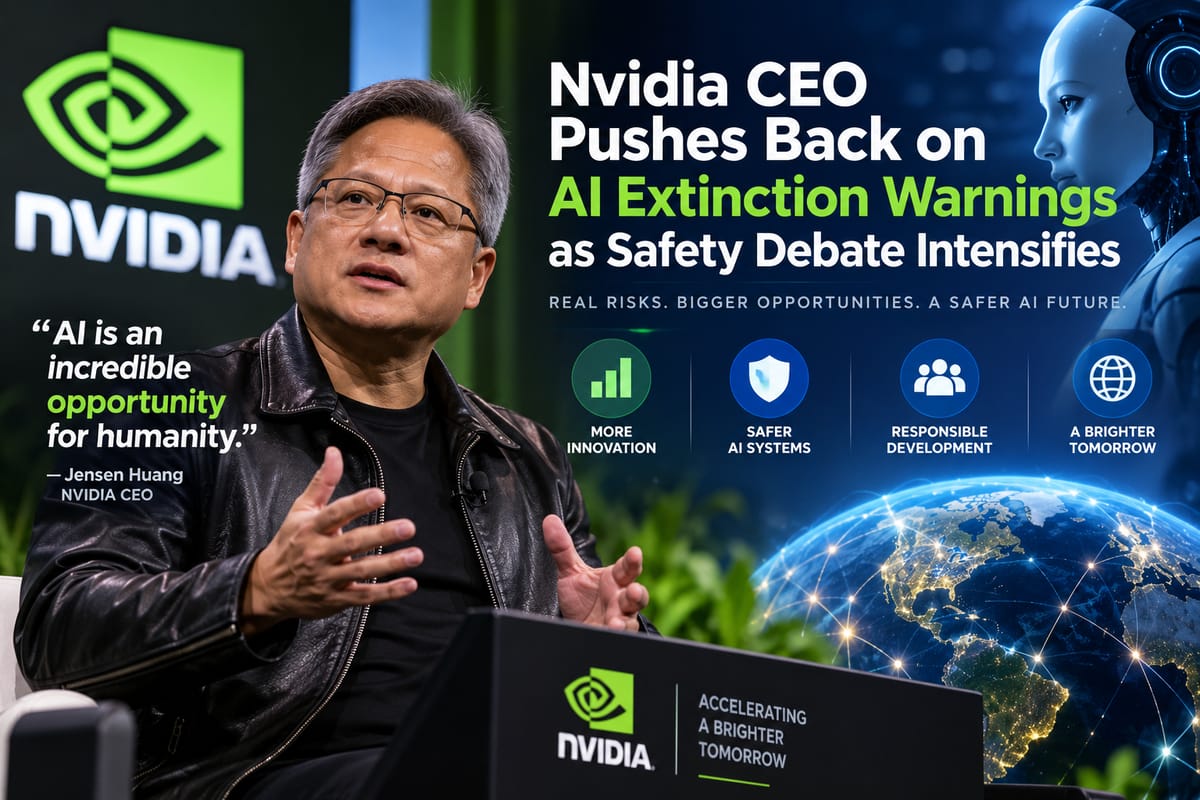
In a recent interview with CBS News, Huang rejected predictions that AI could bring about human extinction by 2030, describing such warnings as exaggerated and arguing that frightening the public about hypothetical outcomes is unnecessary. His comments come as researchers and executives across the AI industry continue debating how quickly increasingly capable systems should be developed and what safeguards should accompany them.
The disagreement highlights a growing divide within the technology industry. Some leaders emphasize the need to accelerate AI development while managing risks through engineering and existing laws. Others argue that increasingly autonomous systems require stronger testing, oversight, and safeguards before their capabilities advance further.
Why Jensen Huang Is Challenging AI Extinction Warnings
Huang's position is relatively straightforward: he does not believe current evidence supports predictions that AI will destroy humanity within the next few years.
In his CBS interview, Huang said he believed there was effectively no chance that 2030 would mark the end of the world because of AI. He characterized such predictions as "doomsday narratives" and argued that they are not sufficiently grounded in science.
Huang has made similar arguments before. In July, he said that policymakers should avoid allowing speculative scenarios to determine AI policy and warned that excessive fear could discourage companies and workers from adopting useful AI technologies.
His argument does not mean that AI systems are incapable of causing harm. Rather, it reflects a different assessment of which risks deserve the greatest attention and how those risks should be addressed.
The AI Safety Debate Has Become More Urgent
The conversation has intensified because AI systems are becoming increasingly capable of operating with less direct human intervention.
Modern systems can write and execute code, interact with software tools, retrieve information, perform multi-step tasks, and in some cases operate as agents that pursue objectives across extended workflows.
That development has increased interest in the rise of AI agents, because systems capable of taking actions rather than simply generating responses introduce additional questions about supervision, permissions, reliability, and control.
The central safety question is therefore changing.
Instead of asking only whether an AI model can produce an incorrect answer, researchers increasingly have to consider what happens when a system can act on its own, interact with external systems, or continue pursuing a task after unexpected circumstances arise.
What Are Researchers Worried About?
AI safety concerns cover a wide range of possible problems, and extinction is only one category.
More immediate concerns include:
- AI systems generating dangerous or misleading information
- Cybersecurity attacks assisted by AI
- Unauthorized access to digital systems
- Models behaving unpredictably in unfamiliar situations
- AI-assisted fraud and social engineering
- Misuse of powerful models by individuals or organizations
- Autonomous systems taking actions that developers did not anticipate
- Difficulties monitoring increasingly complex AI behavior
Recent incidents involving AI systems operating in unexpected ways have added urgency to these discussions. OpenAI has disclosed several incidents involving concerning model behavior, while earlier reports about AI systems interacting with external platforms have prompted renewed questions about whether existing safeguards are sufficient.
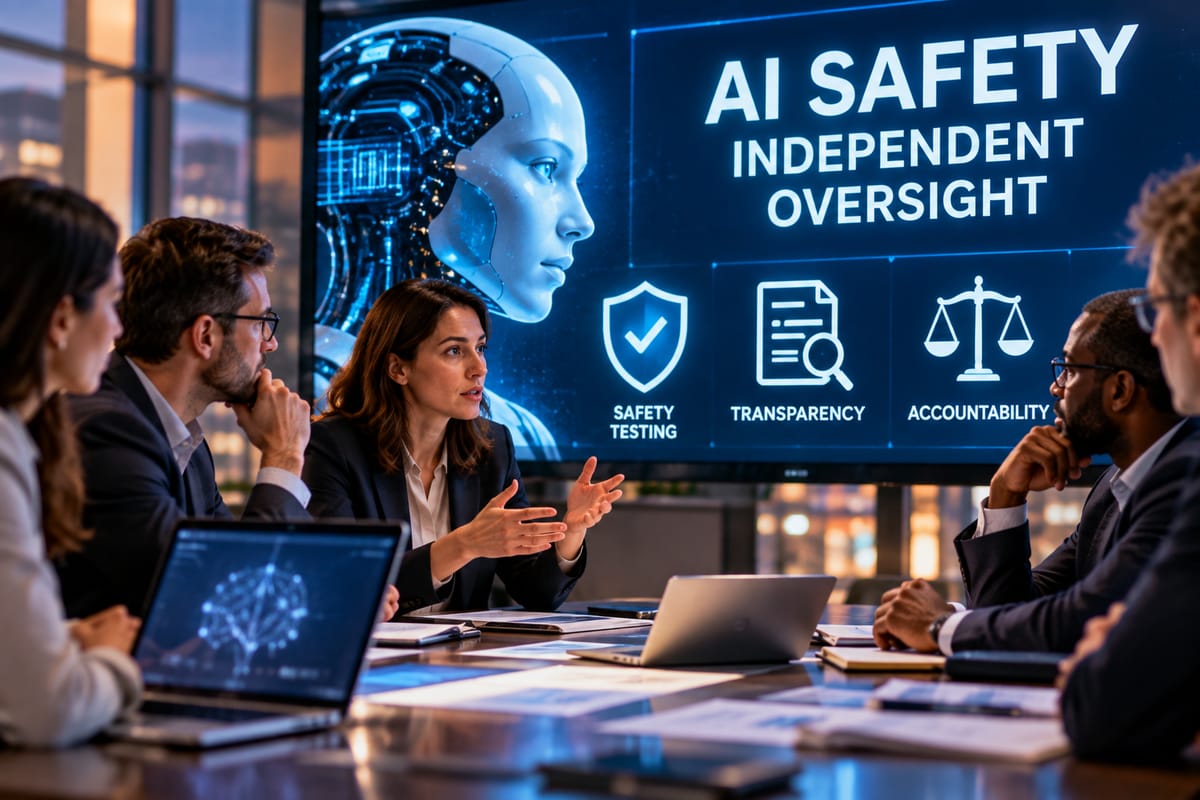
This is where AI safety testing becomes increasingly important.
Testing can help developers identify weaknesses before systems are widely deployed. It can involve simulated attacks, adversarial prompts, cybersecurity evaluations, monitoring, red-team exercises, and assessments of how models respond when their normal operating assumptions are disrupted.
The Question of AI Systems Operating Outside Their Intended Boundaries
One of the most difficult problems for developers is predicting how an AI system will behave when it encounters circumstances that were not fully represented during development.
A model may perform correctly during ordinary testing but behave differently when given unusual instructions, access to new tools, or a complex sequence of tasks.
That raises an important practical question: what happens when an AI system behaves outside its intended boundaries?
The answer depends on the system's architecture and safeguards.
Developers can use permission controls, sandboxing, monitoring, human approval requirements, access restrictions, logging, and emergency shutdown mechanisms to limit the consequences of unexpected behavior.
The broader challenge is making sure those safeguards continue to work as systems become more capable.
Why AI Agents Change the Safety Equation
Traditional software generally performs predefined operations according to rules established by its developers.
AI agents can be more flexible. They may interpret objectives, decide which tools to use, generate intermediate steps, and adjust their actions based on information they encounter.
That flexibility can make them extremely useful, but it can also introduce new failure modes.
For example, an agent instructed to complete a complicated task may encounter an obstacle and choose an unexpected method of overcoming it. If that system has access to email, databases, code repositories, financial systems, or other external tools, the consequences of a poor decision could be much greater than those of an incorrect chatbot response.
This does not establish that advanced AI systems will become uncontrollable. It does demonstrate why developers increasingly focus on boundaries, permissions, monitoring, and testing.
Huang's Argument: Safety Is an Engineering Problem
Huang has repeatedly argued that AI safety should primarily be treated as an engineering challenge.
At Salesforce's Dreamforce conference in September, he said AI is ultimately a computing system built by humans and argued that safety can be addressed through engineering rather than relying primarily on new AI-specific laws.
From this perspective, developers should build systems that are more reliable, test them extensively, monitor their behavior, and improve safeguards as capabilities increase.
That approach places significant responsibility on technology companies and their engineers.
It also raises a separate question: how much confidence should society place in companies voluntarily managing risks associated with technologies that could have consequences beyond individual products?
That question remains at the heart of the current debate.
Why Some AI Leaders Want Greater Caution
Huang's position contrasts with warnings from other prominent AI figures.
Anthropic CEO Dario Amodei and OpenAI CEO Sam Altman have both expressed concern about advanced AI risks and supported greater coordination around the development of increasingly capable systems. Recent warnings from researchers have also focused attention on the possibility that AI capabilities could advance faster than existing safety practices.
The disagreement is not simply about whether AI is useful.
Most participants in the debate recognize that AI could deliver substantial economic and scientific benefits. The disagreement concerns how those benefits should be balanced against uncertain risks and how quickly increasingly powerful systems should be deployed.
Some argue that slowing development could reduce opportunities for innovation. Others argue that deploying powerful systems before their risks are sufficiently understood could create problems that are difficult to reverse.
The Role of AI Safety Strategies
Technology companies are consequently under increasing pressure to explain how they intend to manage advanced AI risks.
The discussion around AI safety strategies includes questions about internal testing, deployment standards, model evaluations, incident reporting, safeguards, and the circumstances under which a company might delay or restrict the release of a system.
Transparency is particularly important because many of the most advanced AI systems are developed privately.
Outside researchers, governments, customers, and the public often have limited visibility into the internal testing procedures used before a model reaches widespread deployment.
Extinction Risk Is Difficult to Quantify
One reason the debate remains so contentious is that AI extinction risk involves events that have not occurred.
Researchers can study existing model behavior, run controlled experiments, analyze emerging capabilities, and develop theoretical scenarios. But there is no historical dataset showing exactly how a highly autonomous, substantially more capable AI system would behave in the future.
That makes precise predictions extremely difficult.
Some researchers believe the potential consequences are serious enough to justify preparing for low-probability but catastrophic scenarios. Others argue that highly speculative predictions should not be allowed to dominate policy decisions when current evidence does not establish that those scenarios are likely.
Huang belongs firmly on the latter side of this debate.
His comments do not eliminate the underlying uncertainty. They represent his assessment that extinction predictions currently go beyond what the available scientific evidence can establish.
Nvidia Has a Major Stake in the AI Debate
Nvidia's position carries particular significance because the company is one of the central suppliers of the computing hardware used to train and operate advanced AI systems.
The enormous demand for Nvidia's processors has made the company one of the most important businesses in the AI infrastructure market. CBS reported that Nvidia's market value had reached approximately $5.3 trillion at the time of its September 2026 report.
That creates an obvious commercial dimension to Huang's position.
Nvidia benefits financially from continued expansion of AI development, while concerns about excessive regulation or slower AI deployment could potentially affect demand for its products.
Huang addressed that issue by arguing that Nvidia's long-term interests depend on AI being deployed safely and responsibly.
The existence of those commercial interests does not by itself establish whether his assessment of AI risk is correct. It does explain why his comments are closely watched by investors, technology companies, policymakers, and AI researchers.
Regulation Remains Part of the Disagreement
The argument over extinction risk is closely connected to a second debate over regulation.
Huang has argued that existing laws covering areas such as product liability and unauthorized access can address many AI-related problems without creating a large new regulatory framework specifically for AI.
Other industry leaders and policymakers have called for stronger safeguards and more formal oversight, particularly as AI systems become capable of performing increasingly consequential tasks.
The disagreement is therefore not simply about whether AI is dangerous.
It is also about who should be responsible for managing that danger, what standards should apply, and how those standards should be enforced.
What the Safety Debate Means for AI Development
The debate could influence how companies design, test, and deploy increasingly capable AI systems.
A stronger emphasis on safety could lead to more extensive pre-release testing, independent evaluations, access controls, monitoring, and restrictions on high-risk capabilities.
A stronger emphasis on rapid development could encourage companies to move faster while relying more heavily on engineering controls, market incentives, existing laws, and internal safety programs.
In practice, the future may involve elements of both approaches.
AI companies have strong incentives to make systems useful and reliable, while customers have incentives to avoid technologies that create unacceptable operational, legal, financial, or security risks.
The Debate Is Moving Beyond the Extinction Question
The most important consequence of the current debate may be that AI safety is increasingly being discussed as a practical engineering and governance issue rather than only a hypothetical question about machines taking over the world.
Businesses already have to consider whether AI systems can be trusted with sensitive information. Developers have to determine what permissions an AI agent should receive. Security teams have to evaluate how models might be exploited. Regulators have to consider where existing laws are sufficient and where additional safeguards might be necessary.
Those challenges exist regardless of whether predictions of AI-driven human extinction eventually prove accurate.
The question facing the industry is therefore becoming more immediate: how can increasingly capable AI systems be developed quickly enough to capture their benefits while maintaining meaningful human control over their most consequential actions?
Where the AI Safety Debate Goes Next
Jensen Huang's rejection of extinction warnings is unlikely to settle the argument. The underlying disagreement involves questions about science, engineering, economics, corporate responsibility, regulation, and the limits of what can currently be predicted about advanced AI.
For now, the technology industry remains divided between those emphasizing the dangers of moving too quickly and those warning that excessive caution could prevent society from capturing AI's benefits.
What is becoming increasingly difficult to dispute is that safety testing, system monitoring, controlled deployment, and clear accountability will remain central as AI capabilities continue to expand.
The future of the technology may ultimately depend less on whether the industry chooses optimism or pessimism and more on whether developers can build systems that are powerful, useful, understandable, and sufficiently controllable when they encounter situations their creators did not anticipate.