How Middleware Connects Applications and Manages Communication Between Business Systems
Modern businesses rarely rely on a single software application. A company might use one system for accounting, another for customer relationship management, a separate platform for inventory, cloud applications for collaboration, and specialized tools for sales, marketing, or operations.
Getting all these systems to communicate effectively can be challenging. Different applications may use different data formats, programming languages, databases, communication protocols, and security requirements.
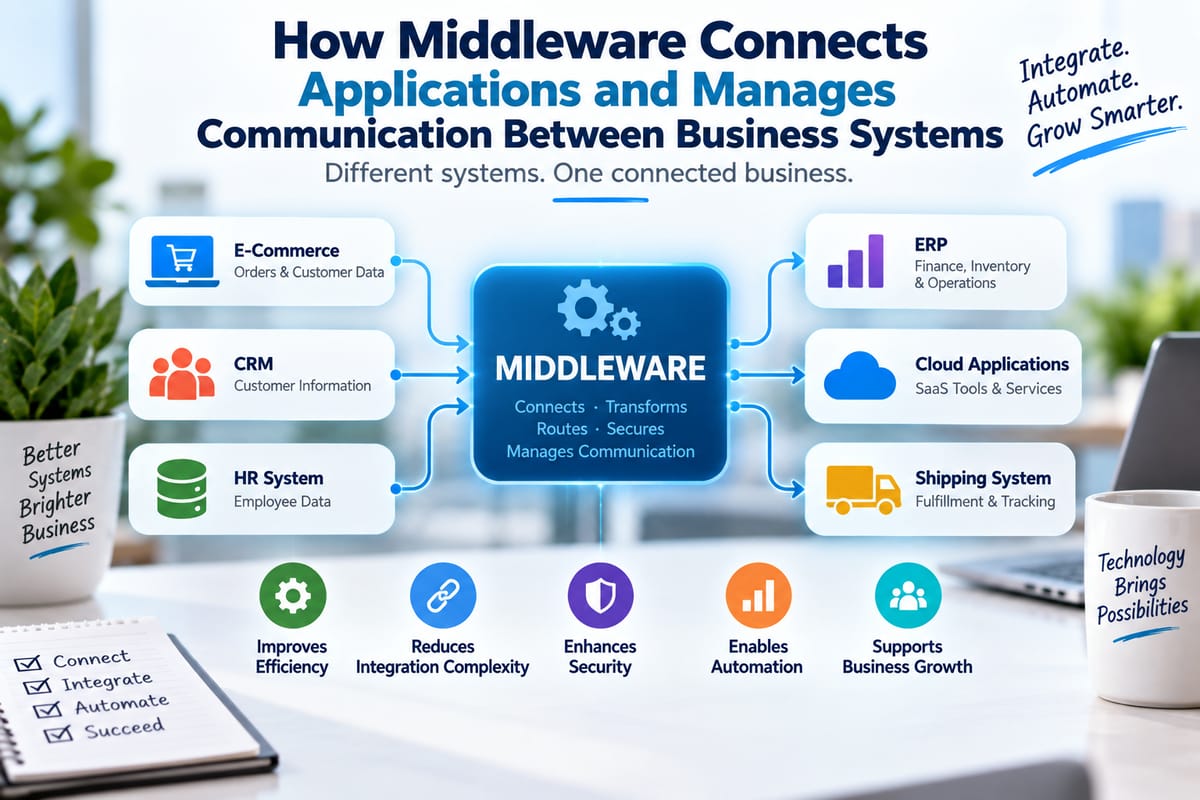
Middleware helps solve this problem by providing a layer between applications and systems. It can receive information from one application, process or transform it, and deliver it to another system in a format that the receiving application can understand.
This makes middleware an important part of modern business technology infrastructure and a key component of application integration.
What Is Middleware?
Middleware is software that sits between applications, services, databases, operating systems, or other technology components and helps them communicate.
Instead of requiring every application to establish a direct connection with every other application, middleware can provide a shared communication layer.
For example, imagine a company that uses:
- An e-commerce platform for online orders
- An inventory management system
- An accounting application
- A customer relationship management system
- A shipping platform
When a customer places an order, information may need to move through several of these systems.
Middleware can help coordinate that communication so that an order entered into one application can trigger the appropriate actions in other systems.
For organizations managing many applications, understanding the broader Complete Guide to Business Software can provide useful context for why integration becomes increasingly important as technology environments grow.
Why Businesses Need Middleware
Without an integration layer, organizations can end up with a complicated network of direct connections.
Suppose five applications all need to communicate with one another. Connecting every system directly can require numerous individual integrations.
As more applications are added, the number of potential connections increases rapidly.
Middleware provides an alternative approach by creating a common layer through which applications can exchange information.
This can make an organization's technology environment easier to manage, especially when applications are frequently added, replaced, upgraded, or moved to the cloud.
How Middleware Connects Applications
Middleware typically acts as an intermediary between different systems.
A simplified communication process might look like this:
- Application A generates information.
- Middleware receives the information.
- The middleware validates or processes the data.
- Data may be transformed into another format.
- Middleware routes the information to the appropriate destination.
- Application B receives and processes the information.
- The middleware may record the transaction or report an error if communication fails.
The process can happen automatically and, depending on the architecture, almost instantaneously.
This allows applications to work together without necessarily requiring them to understand the internal architecture of one another.
Middleware and APIs
APIs are one of the most common technologies used to connect modern applications.
An API provides a defined way for software systems to request information or perform actions. Middleware can use APIs to communicate with applications while managing the flow of information between them.
For example, middleware could call an inventory system's API to check whether a product is available after receiving an order from an e-commerce platform.
The relationship between these technologies is important, but middleware and APIs are not identical.
An API defines how systems can communicate, while middleware can provide broader capabilities for managing, transforming, routing, monitoring, and coordinating that communication.
Businesses and developers can explore the relationship further in the APIs and Integrations Guide for Developers.
Data Transformation
Different applications do not always store or exchange information in the same format.
One system might use JSON, another might rely on XML, while an older application could use a proprietary data structure.
Middleware can transform information as it moves between systems.
For example, an order might contain:
- Customer identification
- Product information
- Quantity
- Price
- Shipping details
- Payment information
Middleware can map these fields from the structure used by one application to the structure expected by another.
This reduces the need to modify every application simply because another system uses a different data format.
Message Routing
Middleware can also determine where information should go.
A business transaction may need to reach several destinations.
For example, when an order is completed, the information might need to be sent to:
- Inventory management
- Accounting
- Customer relationship management
- Warehouse systems
- Shipping software
- Business analytics platforms
Middleware can route messages according to predefined rules.
This makes it possible to automate complex workflows without requiring users to manually enter the same information into several systems.
Message Queues and Asynchronous Communication
Not every system needs to communicate immediately.
Middleware can use message queues to temporarily store messages until the receiving application is ready to process them.
This approach is known as asynchronous communication.
For example, an online store might receive hundreds of orders within a short period. Rather than requiring every downstream system to process each request at precisely the same moment, messages can be placed into queues and processed according to system capacity.
This can help applications handle temporary spikes in demand and reduce dependencies between systems.
Synchronous Communication
Middleware can also support synchronous communication.
In this model, one system sends a request and waits for a response before continuing.
For example, a checkout application might need to confirm inventory availability before completing an order.
The application sends a request, middleware passes it to the inventory system, and the inventory system returns a response.
Synchronous communication can be useful when an immediate answer is required, although it can create stronger dependencies between systems.
Middleware and Enterprise Resource Planning Systems
Enterprise resource planning systems bring together important business functions such as finance, procurement, inventory, manufacturing, human resources, and other operations.
Because ERP platforms often need information from numerous applications, middleware can play an important role in connecting them to the rest of an organization's technology environment.
For example, a business may connect its ERP platform with:
- E-commerce systems
- Customer relationship management software
- Payroll platforms
- Supplier systems
- Warehouse applications
- Business intelligence tools
The ERP Technology Explained guide provides additional context on how ERP platforms support interconnected business operations.
Middleware and Cloud Applications
The shift toward cloud computing has increased the importance of integration.
Organizations frequently use a combination of cloud applications, traditional on-premises systems, SaaS platforms, mobile applications, and specialized services.
These systems may operate in different environments while still needing to exchange information.
Middleware can provide a common integration layer that connects these technologies.
For example, a business could connect an on-premises financial system with a cloud-based customer platform through middleware.
Cloud integration is particularly relevant as businesses adopt more SaaS applications. The Complete Guide to Cloud Software and SaaS explains the broader role of cloud-based software in modern organizations.
Security and Authentication
Business systems frequently exchange sensitive information, making security an important part of middleware architecture.
Middleware can help enforce authentication and authorization rules when applications communicate.
Depending on the system, security mechanisms can include:
- API keys
- OAuth
- Access tokens
- Certificates
- Role-based permissions
- Encryption
- Secure communication protocols
Centralizing some integration controls can make it easier for organizations to monitor and manage communication between applications.
However, middleware itself must be properly secured. A central integration layer can become an important security boundary, meaning weaknesses in it could affect multiple connected systems.
Error Handling
Systems do not always work perfectly.
An application may be temporarily unavailable, a network connection may fail, data may contain invalid values, or an API may return an error.
Middleware can help manage these situations.
Depending on its design, it may:
- Detect failed requests
- Retry operations
- Place failed messages into an error queue
- Record error details
- Alert administrators
- Prevent invalid information from reaching another system
- Resume processing after an interruption
Good error handling can prevent a temporary problem in one application from becoming a larger business disruption.
Monitoring and Observability
As the number of integrations increases, businesses need visibility into what is happening between systems.
Middleware platforms can provide monitoring capabilities that show whether messages were successfully delivered and processed.
Useful monitoring information can include:
- Message volume
- Processing times
- Failed transactions
- API response times
- Queue sizes
- Integration availability
- Error rates
This information can help technology teams identify problems before they significantly affect business operations.
Middleware Can Reduce Integration Complexity
One of the biggest advantages of middleware is reducing the complexity associated with connecting applications.
Without a shared integration layer, each application may need to understand the communication requirements of multiple other systems.
Middleware can instead provide standardized interfaces and common integration services.
This can make the technology environment more modular.
When one application is replaced, the organization may only need to modify the relevant integration rather than rebuilding every connection across the entire technology environment.
Middleware and Legacy Systems
Many businesses still depend on older applications that were developed before modern APIs and cloud platforms became common.
Replacing these systems can be expensive, risky, or impractical.
Middleware can provide a bridge between legacy technology and newer applications.
For example, a modern cloud application could exchange information with an older database or business system through an integration layer.
This allows organizations to modernize parts of their technology environment without necessarily replacing every existing system at once.
Middleware and Business Automation
Integration and automation often work together.
When applications can reliably exchange information, businesses can automate workflows that previously required manual intervention.
Consider a customer placing an order online.
Middleware could help trigger a sequence in which:
- The order is received.
- Customer information is updated.
- Inventory is reduced.
- Payment information is recorded.
- An invoice is generated.
- A warehouse receives fulfillment instructions.
- Shipping information is created.
- The customer receives an order notification.
The user may experience this as a single transaction, while multiple systems are communicating behind the scenes.
Common Types of Middleware
Middleware is not one specific type of software. It describes a broad category of technologies.
Common forms include:
API Middleware
API middleware manages communication between applications through APIs. It can provide capabilities such as authentication, routing, rate limiting, monitoring, and transformation.
Message-Oriented Middleware
Message-oriented middleware allows applications to exchange messages through queues or other messaging mechanisms.
This is useful when applications need reliable communication without being available at exactly the same time.
Enterprise Service Bus
An enterprise service bus, or ESB, provides a centralized approach to integrating multiple enterprise applications.
It can handle routing, transformation, communication protocols, and other integration tasks.
Integration Platforms
Integration platforms provide tools for connecting applications and services, often through reusable connectors and visual workflows.
These platforms can simplify integration for organizations that need to connect many SaaS applications and business systems.
Database Middleware
Database middleware can provide a communication layer between applications and database systems, helping applications interact with data sources without directly managing every underlying connection detail.
Challenges of Using Middleware
Although middleware can simplify integration, it also introduces its own challenges.
A poorly designed integration layer can become complicated and difficult to maintain. If too many responsibilities are concentrated in one system, changes can become difficult to manage.
Other challenges include:
- Integration complexity
- Performance bottlenecks
- Security risks
- Difficult troubleshooting
- Vendor dependence
- Maintenance requirements
- Data consistency problems
- Increasing infrastructure costs
Businesses therefore need to design middleware carefully rather than assuming that adding an integration platform will automatically solve every technology problem.
What Makes a Good Middleware Architecture?
A strong middleware architecture should reflect the organization's applications, data flows, security requirements, and long-term technology strategy.
Important considerations include:
- Scalability: Can the system handle growing transaction volumes?
- Reliability: Can it continue operating when individual systems experience problems?
- Security: Are communications and credentials properly protected?
- Observability: Can technology teams identify failures quickly?
- Flexibility: Can new applications be connected without major redesign?
- Maintainability: Can integrations be updated without creating unnecessary complexity?
- Performance: Can information move between systems quickly enough for business requirements?
The answers will differ depending on the organization and its technology environment.
Middleware in Modern Business Systems
As businesses adopt more applications, the ability to connect those applications becomes increasingly important.
A company might have dozens or hundreds of software systems, each serving a specific function. The value of those systems can depend partly on whether information can move between them reliably.
Middleware provides the communication layer that helps make this possible.
It can connect cloud and on-premises applications, transform data, route messages, support APIs, manage errors, improve visibility, and enable automated workflows.
Connecting the Pieces of a Digital Business
Modern businesses increasingly operate as networks of connected applications rather than isolated software programs.
Middleware helps turn those individual systems into a more coordinated technology environment. It can allow an order entered in one application to update inventory somewhere else, trigger financial processes, inform a customer relationship system, and start fulfillment activities without requiring employees to repeatedly enter the same information.
As organizations continue adopting cloud platforms, SaaS applications, APIs, ERP systems, and specialized business software, integration becomes an increasingly important part of technology planning.
Middleware does not eliminate the complexity of modern business technology, but it can provide the infrastructure needed to manage communication between the many systems that keep an organization running.