How Businesses Measure and Improve the Quality, Accuracy, Completeness and Consistency of Data
Data has become one of the most important resources in modern business. Companies use customer records, financial information, inventory data, operational metrics, employee records, sales information, and countless other datasets to make decisions and run everyday processes.
But having large amounts of data does not automatically create value.
Data must be reliable enough to support the decisions and processes that depend on it. If customer records contain incorrect addresses, product databases contain missing information, or different systems report conflicting figures, employees may spend valuable time correcting problems instead of using data to move the business forward.
For this reason, businesses increasingly focus on four fundamental dimensions of data quality: accuracy, completeness, consistency, and overall quality. Measuring these characteristics and improving them requires a combination of clear standards, reliable processes, appropriate technology, and ongoing monitoring.
What Is Data Quality?
Data quality describes how suitable data is for the purpose for which a business intends to use it.
High-quality data is generally:
- Accurate
- Complete
- Consistent
- Valid
- Timely
- Relevant
- Reliable
- Uniquely represented where appropriate
The importance of these characteristics varies depending on the business process.
For example, an outdated customer phone number may be a serious problem for a customer-service team but less important for a historical sales analysis. Similarly, a missing product description could be critical for an e-commerce operation but irrelevant to a financial calculation.
This means businesses should define data quality according to actual business requirements rather than treating every field as equally important.
The broader principles involved are explored in The Complete Guide to Business Data Management.
Why Data Quality Matters
Poor-quality data can affect nearly every part of an organization.
Employees may make decisions based on incorrect information, automated systems may process transactions incorrectly, and reports may provide an inaccurate picture of business performance.
Data problems can contribute to:
- Incorrect customer communications
- Financial reporting errors
- Duplicate records
- Failed transactions
- Inventory problems
- Poor forecasting
- Inefficient operations
- Compliance difficulties
- Wasted employee time
- Inaccurate analytics
The cost is not always immediately visible. Employees may spend hours manually checking records, reconciling spreadsheets, or correcting information without the organization formally classifying that work as a data-quality problem.
Measuring Data Accuracy
Accuracy refers to whether data correctly represents the real-world information it is intended to describe.
For example, if a customer's address in a database does not match the customer's actual address, the record is inaccurate.
Businesses can measure accuracy by comparing stored information against a trusted reference.
Depending on the dataset, this might involve comparing:
- Customer contact information with verified customer records
- Product information with official product specifications
- Financial records with source transactions
- Employee information with authoritative HR records
- Inventory records with physical inventory counts
Accuracy measurements should focus on important fields rather than attempting to verify every piece of information manually.
Using Accuracy Rates
A business can create an accuracy rate by measuring how many tested records contain correct information.
For example, if 980 out of 1,000 reviewed customer records contain accurate addresses, the address accuracy rate would be 98%.
This type of measurement allows businesses to establish a baseline and monitor whether data quality is improving.
The measurement can become more useful when broken down by:
- Department
- Data source
- System
- Geographic region
- Customer segment
- Product category
- Data field
- Time period
This can reveal where accuracy problems originate.
Measuring Data Completeness
Completeness refers to whether the required information is present.
A customer record might contain a name and email address but have no telephone number. If the phone number is required for a particular business process, the record is incomplete.
Businesses can measure completeness by determining how frequently required fields contain usable values.
A simple completeness calculation can be expressed as:
Completeness rate = completed required fields ÷ total required fields × 100
For example, if 9,500 of 10,000 required fields contain valid information, the completeness rate is 95%.
Organizations can establish different completeness targets for different datasets because not every field is equally important.
Required Fields Should Be Clearly Defined
Businesses cannot accurately measure completeness if they have not established which information is actually required.
A customer database might contain dozens of fields, but perhaps only a handful are essential for processing an order.
Organizations should therefore distinguish between:
- Required fields
- Optional fields
- Conditionally required fields
- Historical fields
- Fields that are no longer used
This prevents teams from interpreting every blank field as a data-quality failure.
Measuring Data Consistency
Consistency refers to whether the same information is represented in compatible ways across systems and records.
For example, one system might identify a customer as "Acme Corporation," while another uses "ACME Corp." These values may refer to the same organization even though the formatting differs.
More serious problems occur when two systems contain conflicting information.
For example:
- CRM says a customer has 500 employees.
- Sales database says the customer has 750 employees.
- Reporting system says the customer has 1,000 employees.
A business needs a method for determining which information is authoritative.
Establishing a Single Source of Truth
One way businesses improve consistency is by establishing authoritative sources for important information.
For example:
- HR may be authoritative for employee information.
- Finance may be authoritative for accounting records.
- Product management may own official product information.
- Customer systems may maintain approved customer profiles.
Other systems can then consume information from these authoritative sources rather than independently maintaining conflicting versions.
This approach does not necessarily mean every business needs one physical database. It means the organization should know which source is responsible for particular information.
Data Validation Rules
Validation rules can prevent many data-quality problems before they enter a system.
A validation rule might require:
- A valid email format
- A positive product quantity
- A recognized country code
- A valid date
- A required customer identifier
- A permitted category
- A specific number of characters
For example, an order system could reject a transaction if the quantity field contains text instead of a number.
Preventing incorrect information at the point of entry is often more efficient than discovering and repairing the problem later.
Standardizing Data Formats
Data consistency can also improve when businesses establish standardized formats.
Dates are a common example.
One system might represent a date as:
2026-09-22
Another might use:
22/09/2026
And another might use:
September 22, 2026
All three may represent the same date, but inconsistent formats can create problems when systems exchange or analyze the information.
Standardization can apply to:
- Dates
- Currency
- Addresses
- Country names
- Product categories
- Units of measurement
- Customer identifiers
- Phone numbers
Clear standards reduce ambiguity and make data easier to integrate.
Identifying Duplicate Records
Duplicate records can reduce both accuracy and consistency.
A customer may accidentally appear multiple times because they registered through different channels or because employees entered the information manually.
For example:
- Jane Smith
- J. Smith
- Jane A. Smith
could potentially represent the same person.
Duplicate detection systems can compare identifying attributes and assign a probability that two records refer to the same entity.
Businesses can then merge records carefully rather than deleting information automatically.
Data Matching and Deduplication
Deduplication involves identifying and resolving records that represent the same real-world entity.
Matching can use combinations of:
- Names
- Addresses
- Email addresses
- Telephone numbers
- Customer IDs
- Business registration information
- Transaction history
Exact matching works well when identifiers are reliable. More sophisticated systems can use fuzzy matching when spelling, formatting, or other information varies.
The objective is to create a cleaner representation of customers, products, suppliers, or other entities without accidentally combining different entities.
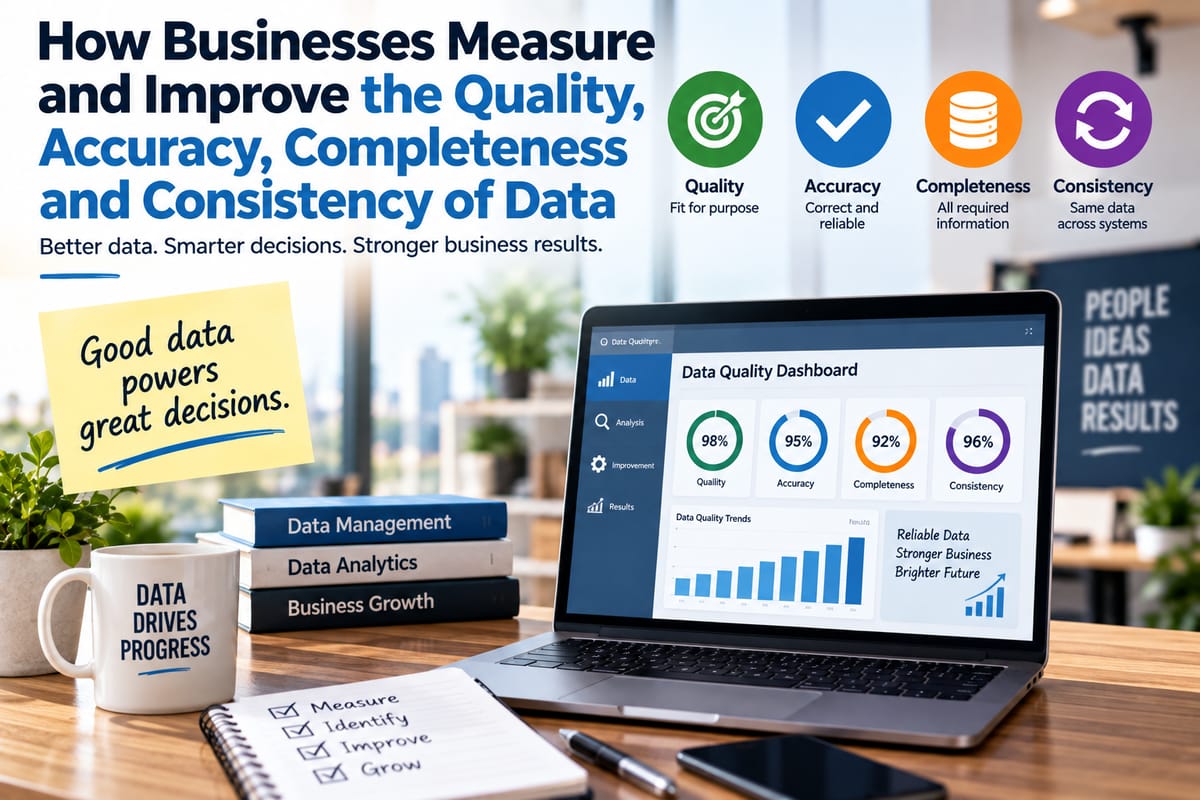
Data Quality Dashboards
Businesses can use dashboards to monitor data quality over time.
A data-quality dashboard might display:
| Metric | Current Rate | Target | Status |
|---|---|---|---|
| Accuracy | 97% | 98% | Needs improvement |
| Completeness | 95% | 95% | On target |
| Consistency | 96% | 98% | Needs improvement |
| Duplicate rate | 2% | <1% | Needs improvement |
| Validation failures | 1.5% | <1% | Needs improvement |
The specific metrics and targets should reflect the organization's priorities.
Dashboards are especially useful because data quality can deteriorate gradually. Monitoring allows teams to identify problems before they become major operational issues.
Data Profiling Helps Find Problems
Data profiling is the process of examining datasets to understand their structure, contents, patterns, and potential problems.
A profiling exercise can reveal:
- Missing values
- Duplicate records
- Unusual values
- Invalid formats
- Unexpected categories
- Outliers
- Conflicting records
- Distribution changes
Profiling can be performed before a new dataset is integrated into a system or periodically on existing data.
It is particularly useful when businesses inherit data from older systems or acquire information from external sources.
Monitoring Data Quality at the Source
Fixing bad data after it reaches a central database can be expensive.
A more effective strategy is often to improve the process that creates the data in the first place.
For example, if employees repeatedly enter incomplete customer information, the business could redesign the data-entry process to require important fields.
Possible improvements include:
- Better forms
- Required fields
- Dropdown menus
- Automated validation
- Address verification
- Duplicate warnings
- Clear instructions
- User training
Improving the source process can reduce the volume of problems reaching downstream systems.
Data Governance Creates Accountability
Data governance establishes policies, responsibilities, standards, and processes for managing business data.
A governance program can define:
- Who owns each dataset
- Who can access information
- Which standards apply
- How data should be created
- How quality is measured
- How errors are corrected
- How long information is retained
- How sensitive information is protected
Without ownership, data-quality problems can become everyone's responsibility and therefore no one's responsibility.
Assigning data owners creates clearer accountability.
Data Stewards Can Manage Quality
Some organizations use data stewards to oversee specific datasets or subject areas.
A data steward may monitor quality, investigate problems, coordinate corrections, maintain definitions, and communicate requirements to technical and business teams.
For example, a customer-data steward might oversee:
- Customer identifiers
- Contact information
- Account classifications
- Duplicate records
- Data definitions
- Quality metrics
This creates a bridge between business users and technology teams.
Creating Data Quality Rules
Organizations can formalize quality requirements through data-quality rules.
A rule might state:
Every active customer must have a unique customer identifier.
Another might state:
Every completed order must contain a valid product identifier.
Additional rules could address:
- Required fields
- Valid ranges
- Permitted values
- Uniqueness
- Relationships between fields
- Cross-system consistency
Automated systems can then test records against these rules.
Using Data Analytics to Identify Quality Problems
Analytics can reveal patterns that are difficult to see through manual inspection.
For example, a business may discover that error rates increase dramatically after data is imported from a particular source.
Analysts might also identify unusual changes in:
- Customer counts
- Product volumes
- Revenue
- Transaction frequency
- Missing values
- Geographic distributions
The broader role of analytics is covered in The Complete Guide to Data Analytics for Business.
Data analytics can therefore serve not only as a way to interpret business information but also as a tool for identifying problems with the information itself.
Data Warehouses Can Improve Analytical Consistency
Businesses often collect data from many operational systems.
A data warehouse can provide a centralized environment for organizing information used for reporting and analytics.
The role of these systems is explained in What Is a Data Warehouse for Business?.
A well-designed data warehouse can apply consistent definitions and transformations to information before it reaches analytical reports.
However, moving data into a warehouse does not automatically make it high quality. Poor source data can still produce poor analytical results.
Data-quality controls remain necessary throughout the process.
Database Design Affects Data Quality
The way databases are designed can influence the quality of the information stored in them.
Good database design can help enforce:
- Unique identifiers
- Required values
- Relationships
- Data types
- Valid ranges
- Referential integrity
For organizations reviewing their database architecture, the Complete Guide to Database Software provides broader context on how database systems store and manage structured information.
Database controls can prevent certain problems automatically, reducing the amount of manual cleanup required.
Referential Integrity Matters
Businesses often maintain relationships between different datasets.
For example, an order may be associated with a customer and several products.
If an order references a customer ID that does not exist in the customer database, the relationship is broken.
Referential integrity rules help prevent these inconsistencies.
They can ensure that:
- Orders reference valid customers
- Transactions reference valid accounts
- Products reference valid categories
- Employees reference valid departments
Maintaining these relationships is essential for reliable reporting and operational processes.
Measuring Timeliness
Although accuracy, completeness, and consistency receive considerable attention, timeliness is another important aspect of data quality.
Information can be accurate but still be unsuitable if it is too old.
For example, an inventory report from three weeks ago may accurately describe inventory at the time it was generated, but it may be useless for today's purchasing decision.
Businesses can measure:
- Data refresh frequency
- Processing delays
- Time between source creation and availability
- Percentage of records updated within required periods
The appropriate target depends on how quickly the business process changes.
Defining Data Quality Scores
Some organizations combine multiple measurements into an overall data-quality score.
For example, a business might create a weighted score based on:
- Accuracy
- Completeness
- Consistency
- Timeliness
- Validity
- Uniqueness
However, a single score should not hide serious problems in individual dimensions.
A dataset could achieve a high overall score while still containing unacceptable errors in a critical field.
Businesses should therefore use overall scores as summaries while retaining detailed measurements underneath.
Prioritizing Critical Data
Not every data problem deserves the same response.
A missing optional marketing field may have little impact, while an incorrect bank-account number could create serious financial consequences.
Businesses can classify data according to its importance.
For example:
Critical Data
Information required for financial, legal, safety, or essential operational processes.
Important Data
Information that significantly affects business operations or decision-making.
General Data
Information with relatively limited consequences if an error occurs.
Prioritizing critical data allows organizations to direct resources toward the problems that matter most.
Automating Data Quality Checks
Manual data-quality reviews can become expensive as datasets grow.
Automation can continuously test information against predefined rules.
Automated checks can identify:
- Missing fields
- Invalid values
- Duplicate records
- Unexpected changes
- Broken relationships
- Format violations
- Conflicting information
Alerts can then be sent to data owners when thresholds are exceeded.
This transforms data quality from an occasional cleanup exercise into an ongoing operational process.
Root-Cause Analysis Is Better Than Repeated Cleanup
Repeatedly correcting the same data problem without addressing its source creates unnecessary work.
Suppose a business discovers that thousands of customer records are missing postal codes every month.
Employees could manually add the missing information each month, but a better approach would be to determine why the postal codes are missing.
The root cause might be:
- A poorly designed registration form
- An integration problem
- A missing validation rule
- An employee training issue
- A third-party data source
- A software configuration problem
Fixing the underlying cause can prevent the same problem from recurring.
Data Quality Requires Collaboration
Data quality is not exclusively an IT responsibility.
Business teams understand how information is used, while technical teams understand databases, integrations, applications, and infrastructure.
Both perspectives are necessary.
Finance employees may understand what makes financial information reliable. Sales teams may understand which customer fields matter. Technology teams may understand how information moves between systems.
Bringing these groups together helps create practical data-quality standards.
Training Employees Can Prevent Errors
Human data entry remains an important source of data-quality problems.
Employees may enter information incorrectly because:
- Instructions are unclear
- Forms are confusing
- Standards are inconsistent
- Systems make errors easy
- Training is insufficient
- Employees do not understand why certain fields matter
Training should therefore explain both how data should be entered and why quality matters.
Simple improvements to user interfaces and instructions can sometimes prevent more errors than complex downstream cleanup systems.
Establishing Data Quality Targets
A business should establish realistic quality targets based on its needs.
For example:
- Customer IDs: 100% unique
- Required financial fields: 99.9% complete
- Product categories: 99% valid
- Critical customer contact information: 98% accurate
- Duplicate customer records: below 1%
Targets should be reviewed periodically.
A target that is appropriate for one process may be unnecessarily strict or insufficient for another.
Creating a Continuous Improvement Cycle
Data quality should not be treated as a one-time project.
A sustainable process can follow a continuous cycle:
- Define standards.
- Measure current quality.
- Identify problems.
- Prioritize important issues.
- Find root causes.
- Correct the underlying processes.
- Validate the improvements.
- Monitor results continuously.
- Update standards as business needs change.
This approach helps organizations maintain quality as systems, customers, products, and processes evolve.
Common Data Quality Mistakes
Businesses can undermine their data-quality efforts by making several common mistakes.
Treating All Data as Equally Important
Critical information should generally receive more attention than low-impact fields.
Measuring Without Taking Action
Dashboards and reports are useful only when organizations respond to the problems they reveal.
Relying Entirely on Manual Cleanup
Manual corrections can become expensive and may fail to address recurring causes.
Ignoring Source Systems
Downstream cleanup cannot compensate indefinitely for poor data-entry and collection processes.
Failing to Define Ownership
Without clear responsibility, recurring data-quality problems can remain unresolved.
Creating Standards Without Business Input
Technical standards may not reflect how information is actually used.
Focusing Only on Accuracy
Accurate data can still be incomplete, outdated, duplicated, or inconsistent.
A Practical Framework for Improving Data Quality
Businesses can build a practical improvement program by working through several stages.
1. Identify Important Data
Determine which datasets and fields are essential to operations and decision-making.
2. Define Quality Dimensions
Establish what accuracy, completeness, consistency, validity, and timeliness mean for each dataset.
3. Establish Baselines
Measure the current state before making changes.
4. Set Targets
Create realistic quality thresholds based on business requirements.
5. Identify Root Causes
Investigate why errors and missing information occur.
6. Improve Data Collection
Use better forms, validation, training, and system controls.
7. Standardize Information
Create common definitions and formats across systems.
8. Assign Ownership
Give specific teams or individuals responsibility for important datasets.
9. Automate Monitoring
Use software to detect quality problems continuously.
10. Review and Improve
Regularly reassess whether the standards and processes remain appropriate.
Turning Reliable Data Into a Business Asset
High-quality data does not happen simply because a company owns sophisticated databases or analytics software. It requires deliberate standards, clear ownership, reliable collection processes, validation, monitoring, and continuous improvement.
Accuracy ensures that information reflects reality. Completeness ensures that important information is not missing. Consistency helps different systems and teams work from compatible information. Timeliness ensures that data remains useful when decisions need to be made.
When these qualities are managed together, businesses can reduce errors, improve operational efficiency, strengthen reporting, and create greater confidence in the information used throughout the organization.
The ultimate goal is not to create data that is perfect in every possible respect. It is to create data that is reliable enough, timely enough, and well-managed enough to support the decisions and processes that matter most to the business.