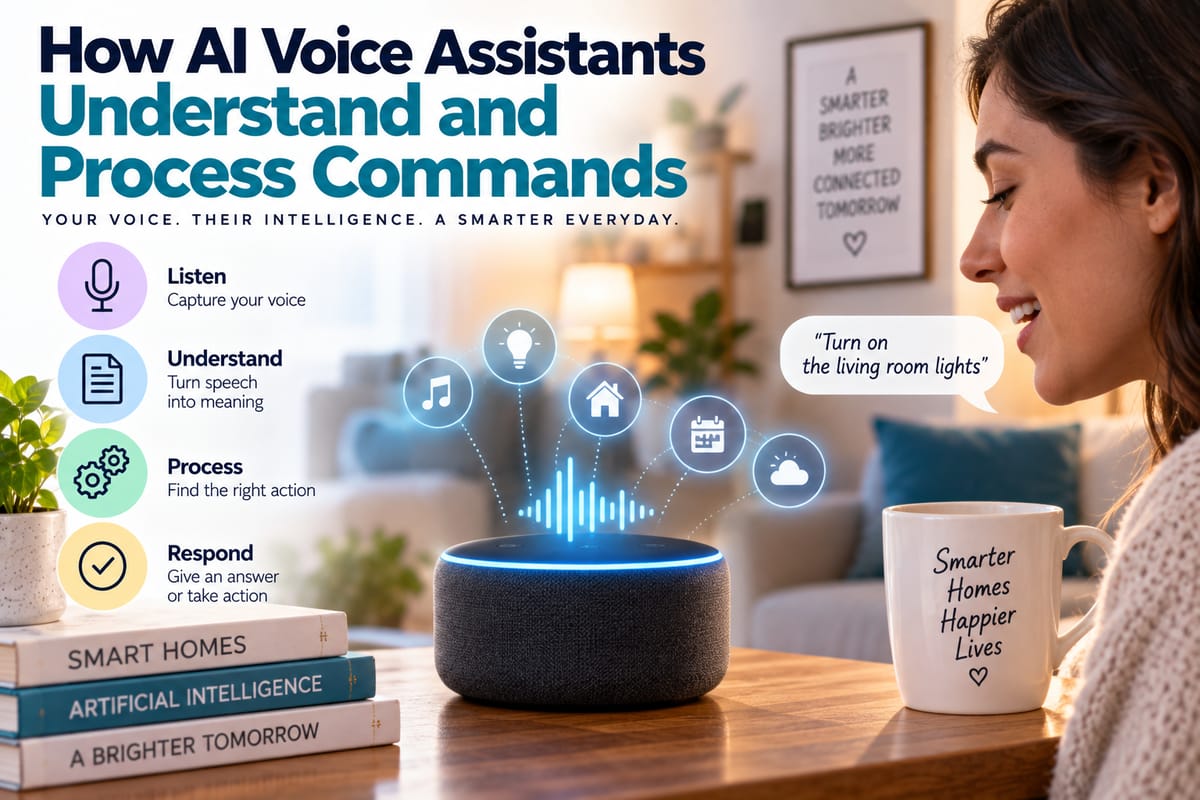
How AI Voice Assistants Understand and Process Commands
AI voice assistants have changed the way people interact with technology. Instead of tapping menus, typing searches, or navigating through multiple settings, users can simply speak a request and receive a response or trigger an action.
Commands such as “Set a reminder for tomorrow,” “Play some music,” or “Turn off the lights” may sound simple, but a voice assistant has to perform several complex steps before it can respond appropriately. It needs to capture spoken audio, identify words, understand the meaning behind them, determine what the user wants, and then select an appropriate action.
Modern voice assistants combine speech recognition, natural language processing, machine learning, cloud computing, and increasingly artificial intelligence to make this process possible.
What Is an AI Voice Assistant?
An AI voice assistant is software designed to interact with users through spoken language.
The assistant listens to a user's voice, converts speech into information that software can process, interprets the request, and produces an answer or performs an action.
Depending on the system, a voice assistant may be able to:
- Answer questions
- Set reminders and alarms
- Control smart-home devices
- Send messages
- Make calls
- Play music or videos
- Provide weather information
- Search for information
- Manage calendars
- Launch applications
- Control compatible devices
The technology behind these capabilities is part of a much broader transformation in everyday computing. The growing role of AI in ordinary activities is explored in How AI Is Changing Life.
The First Step Is Detecting the Voice
Before an assistant can understand a command, it needs to recognize that someone is speaking to it.
Many voice assistants use a wake word or activation phrase. The device continuously monitors audio for a specific pattern without necessarily sending every surrounding conversation to a remote server.
Once the activation phrase is detected, the system begins processing the following speech as a potential command.
Modern systems may use specialized hardware and software designed to detect speech efficiently while reducing unnecessary processing.
Speech Recognition Converts Audio Into Words
Human speech is an audio signal, but software needs to transform that signal into information it can analyze.
Automatic speech recognition, commonly called ASR, converts spoken language into text or another machine-readable representation.
The system analyzes characteristics of the audio, including changes in sound frequency, timing, pronunciation, and patterns associated with language.
For example, when someone says:
“Set an alarm for seven tomorrow morning.”
The speech-recognition system attempts to identify the individual words and their sequence.
The accuracy of this process can be affected by background noise, accents, microphone quality, speaking speed, pronunciation, and people talking simultaneously.
Why Speech Recognition Is Difficult
Human speech is highly variable.
Two people can say the same sentence with different accents, speeds, tones, or pronunciations. Someone may also speak quietly, loudly, or while standing far away from the microphone.
Background sounds create another challenge. Music, television programs, traffic, household appliances, and conversations can all interfere with the audio signal.
AI-powered speech recognition systems are trained using large quantities of speech data so they can identify patterns across different speakers and environments.
This allows modern assistants to handle a much wider variety of voices than early voice-command systems.
Natural Language Processing Helps Interpret Meaning
Recognizing the words is only part of the problem.
The assistant also needs to understand what those words mean in context.
This is where natural language processing, or NLP, becomes important.
Consider the command:
“Remind me to call John at six.”
The system needs to identify several pieces of information:
- The user wants a reminder.
- The reminder concerns calling John.
- The relevant time is six o'clock.
- The requested action should occur in the future.
The assistant therefore needs to analyze the structure and meaning of the sentence rather than simply matching individual words.
Intent Recognition Determines What the User Wants
Voice assistants commonly use intent recognition to determine the purpose behind a command.
The phrase “Play jazz music” has a different intent from “Set a timer for ten minutes,” even though both are spoken commands.
The assistant needs to classify the request and determine which capability should handle it.
Possible intents can include:
- Playing media
- Setting alarms
- Creating reminders
- Searching for information
- Controlling smart devices
- Sending communications
- Checking schedules
- Navigating to a location
Correct intent recognition is essential because a system can accurately transcribe every word and still perform the wrong action if it misunderstands the request.
Context Makes Conversations More Natural
Older voice interfaces often treated each command as an isolated instruction. Modern AI assistants are increasingly designed to use conversational context.
For example, a user might first ask:
“Who directed the movie Inception?”
Then follow with:
“What other movies did he make?”
A more advanced assistant needs to understand that “he” refers to the director mentioned in the previous exchange.
Context can also help resolve ambiguous commands.
If someone says, “Play that song again,” the assistant needs information about what was previously playing.
Maintaining context makes interactions feel more like conversations rather than a series of disconnected commands.
AI Helps Handle Different Ways of Asking the Same Thing
People rarely use identical wording every time they make a request.
A user might say:
- “What's the weather today?”
- “Will it rain today?”
- “Do I need an umbrella?”
- “What's today's forecast?”
These commands have different wording but may involve related information.
Machine-learning systems can identify similarities between different expressions and determine the likely intention behind them.
This flexibility is one reason AI voice assistants can handle natural language more effectively than systems based exclusively on fixed commands.
The Assistant May Need to Combine Multiple Sources
Some commands require information from more than one system.
For example, a user might ask:
“What time is my next meeting?”
The assistant may need to understand the request, access a calendar, identify the next scheduled event, interpret the time zone, and formulate a response.
Other requests may involve weather services, music platforms, navigation systems, smart-home equipment, or other applications.
This makes modern voice assistants less like standalone programs and more like interfaces connecting different digital services.
Voice Assistants Can Control Other Devices
One of the most practical applications of voice technology is device control.
A voice assistant can potentially communicate with compatible:
- Smart lights
- Thermostats
- Televisions
- Speakers
- Security systems
- Appliances
- Cameras
- Streaming devices
A command such as “Turn off the bedroom lights” requires the assistant to recognize the intended action, identify the correct device, and send the appropriate instruction.
This illustrates how voice interfaces can act as a bridge between people and connected technology.
Screens Are Becoming Part of Voice Assistant Experiences
Voice assistants are no longer limited to speakers and smartphones.
They are increasingly being integrated into televisions, cars, appliances, computers, and other devices with displays.
For example, Amazon Makes Alexa Free on Fire TV as AI Assistant Expands to Millions of Screens illustrates how voice-based AI can become part of screen-based entertainment environments.
A display gives an assistant another way to communicate information. Instead of only speaking a response, the system can potentially show images, lists, controls, recommendations, or other visual information.
Voice Assistants and Apps Work Together
Many actions performed by voice assistants depend on applications and services operating behind the scenes.
A user may ask an assistant to order something, play a particular piece of content, manage a task, or communicate with someone. The assistant may need to interact with an application capable of completing that request.
This makes apps an important part of the broader voice ecosystem. A Complete Guide to Apps provides useful context for understanding how software applications deliver the services that users increasingly access through conversational interfaces.
AI Models Are Making Voice Interactions More Flexible
Traditional voice assistants often relied heavily on predefined commands and relatively narrow intent categories.
Generative AI and large language models are changing what assistants can potentially understand.
Instead of requiring users to phrase a request in a particular way, newer systems can analyze more natural conversations and determine what the user is trying to accomplish.
This can allow an assistant to handle longer instructions, follow-up questions, summaries, explanations, and more complicated combinations of tasks.
However, greater flexibility also introduces challenges involving accuracy, privacy, security, and reliability.
Voice Assistants Are Moving Toward AI Agents
A conventional assistant might respond to a command by performing one predefined action.
An AI agent can potentially take a more complex goal and determine a sequence of actions required to complete it.
For example, instead of simply setting a reminder, a more advanced system could potentially organize several related tasks, gather information, compare options, and interact with multiple applications.
The growing development of these systems is discussed in How AI Agents Are Taking Over More Tasks.
The distinction is important because it represents a shift from voice assistants that primarily respond to commands toward systems that can potentially execute multi-step workflows.
Personalization Can Improve Responses
AI assistants can become more useful when they understand relevant user preferences and context.
For example, a system might learn preferred music services, frequently used devices, common locations, calendar patterns, or preferred ways of receiving information.
Personalization can reduce the amount of information a user needs to provide with every command.
However, personalization also creates privacy considerations. The more information an assistant retains about a person, the more important it becomes to protect that information and provide meaningful controls over how it is stored and used.
Privacy Is an Important Part of Voice Technology
Voice assistants operate in environments where conversations may occur near microphones.
This creates legitimate questions about how voice data is processed, stored, transmitted, and protected.
Depending on the system and the specific feature being used, some processing may occur locally on the device while other tasks may rely on remote servers.
Users should understand the privacy settings available on their devices and services. They should also consider which permissions they grant to voice-enabled applications and connected devices.
Convenience and privacy therefore remain important considerations as voice interfaces become more deeply integrated into everyday technology.
What Happens When a Voice Assistant Gets a Command Wrong?
Voice recognition is not perfect.
An assistant may misunderstand a word, misidentify a person's name, interpret a command incorrectly, or fail to understand the user's intention.
Errors can occur because of accents, background noise, ambiguous language, unusual names, incomplete context, or limitations in the underlying model.
Good systems attempt to reduce these errors through better speech recognition, contextual understanding, confirmation prompts, and improved language models.
In situations involving sensitive or consequential actions, requiring confirmation can provide an additional layer of protection.
Why Voice Interfaces Could Become More Important
Voice is one of several ways people interact with technology, alongside touchscreens, keyboards, cameras, gestures, and other interfaces.
Its major advantage is that it can allow people to interact with devices while their hands or attention are occupied elsewhere.
Someone cooking can ask for a timer. A driver can request navigation instructions. A person with limited mobility can use voice commands to control compatible devices.
As AI systems become better at understanding natural language, voice interaction could become less about issuing isolated commands and more about having ongoing conversations with digital systems.
The Future of Voice-Controlled Technology
AI voice assistants are evolving from simple speech-command systems into increasingly sophisticated interfaces capable of understanding context, connecting applications, controlling devices, and potentially completing multi-step tasks.
The basic process remains a combination of listening, recognizing speech, interpreting language, identifying intent, accessing information or services, and generating an appropriate response. What is changing is the sophistication of each stage.
As AI models become more capable, voice assistants may increasingly function as general-purpose interfaces between people and the digital world. The most significant development may not be that computers can understand individual spoken commands, but that people can increasingly describe what they want in ordinary language and let software determine how to help make it happen.