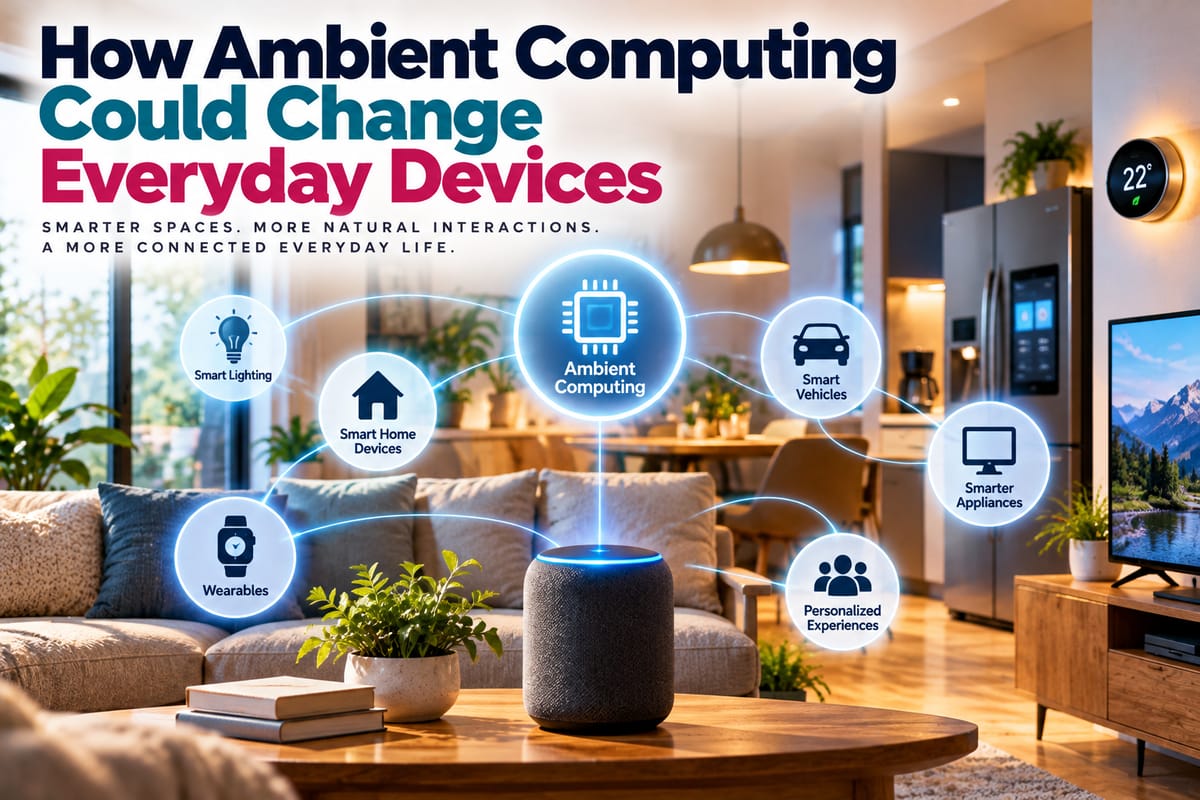
How Ambient Computing Could Change Everyday Devices
Computing has traditionally required people to interact directly with a device. We open an app, press a button, issue a command, or sit in front of a computer to make something happen.
Ambient computing represents a different approach. Instead of requiring constant attention, computing capabilities can become embedded into the spaces and devices people already use. Sensors, connectivity, artificial intelligence, and automation can work in the background, allowing technology to respond to context with less deliberate interaction.
This could change everything from household appliances and vehicles to smartphones, wearable devices, workplaces, and public spaces.
What Is Ambient Computing?
Ambient computing describes a technology environment in which computing capabilities are integrated into everyday surroundings and devices rather than concentrated in a single computer or smartphone.
The idea is that technology can become more aware of context and respond accordingly.
For example, an ambient system might recognize that someone has entered a room, detect the temperature, understand that a particular person is present, and adjust lighting or climate settings automatically.
Instead of thinking, "I need to open an app and change the temperature," the environment can handle the adjustment based on predefined preferences or learned patterns.
Ambient computing is closely related to broader developments in emerging technology and innovation, particularly artificial intelligence, sensors, wireless connectivity, edge computing, and automation.
How Ambient Computing Differs From Traditional Computing
Traditional computing generally depends on explicit interaction.
A person might:
- Open a smartphone application
- Click a button
- Type a command
- Search for information
- Adjust a device manually
- Start a software process
Ambient computing attempts to reduce some of these steps.
Devices can collect information about their surroundings and use software to determine what action may be appropriate.
The technology does not necessarily eliminate interfaces. Instead, it can make interaction more subtle and distributed.
Voice commands, gestures, sensors, wearable devices, location information, and automated routines can all become parts of the computing environment.
The Role of the Internet of Things
The growth of ambient computing is closely connected to the Internet of Things, or IoT.
The Internet of Things refers broadly to physical objects equipped with sensors, connectivity, processing capabilities, or other technologies that allow them to collect and exchange data.
Smart thermostats, connected lighting, security cameras, wearable devices, appliances, vehicles, and industrial equipment can all participate in connected environments.
Ambient computing can build on this connected foundation by adding greater awareness, automation, and intelligence.
Instead of simply allowing devices to communicate, the goal can be to create environments where those devices work together in ways that require less manual coordination.
How Ambient Devices Collect Information
Ambient systems depend on information about the environment and the people interacting with it.
Different devices may use different types of sensors, including:
- Motion sensors
- Cameras
- Microphones
- Temperature sensors
- Light sensors
- Location systems
- Proximity sensors
- Accelerometers
- Environmental sensors
These sensors can provide information about what is happening around a device.
For example, a motion sensor might detect that someone has entered a room, while a light sensor measures brightness. A connected thermostat can measure temperature, and a wearable device can collect information about movement.
The way Internet of Things devices collect, exchange and process data provides an important foundation for understanding how these connected systems operate.
Artificial Intelligence Makes Ambient Computing More Adaptive
Sensors alone do not necessarily make a system intelligent.
Artificial intelligence can help interpret information and identify patterns.
For example, a smart home might learn that a household typically lowers the temperature at a certain time of day. An AI-enabled system could potentially use that pattern to automate the adjustment.
Similarly, a wearable device might combine information from multiple sensors to identify activity patterns.
The combination of sensing, connectivity, computing, and AI can allow devices to respond to context rather than simply execute isolated commands.
Ambient Computing in the Home
The home is one of the environments where ambient computing could become particularly visible.
Connected lights, thermostats, appliances, speakers, security systems, televisions, and other devices can already communicate through home networks.
Ambient computing could make these systems more coordinated.
For example, entering a home could trigger a sequence of personalized actions:
- Connected locks identify an authorized user.
- Interior lights adjust automatically.
- The thermostat responds to the home's current conditions.
- A preferred music system becomes available.
- Household appliances continue previously scheduled tasks.
- Security settings adjust according to the household's routines.
The complete guide to building an intelligent home provides broader context for how connected technologies can work together within a home environment.
Ambient Lighting and Environmental Controls
Lighting and climate systems are natural candidates for ambient automation.
Instead of manually adjusting lights throughout the day, sensors can detect occupancy and environmental conditions.
A system might dim lights when natural sunlight is sufficient or turn them off when a room becomes empty.
Heating and cooling systems can similarly use temperature sensors, schedules, occupancy information, and other data to make adjustments.
These systems could potentially make buildings more convenient while also reducing unnecessary energy use when designed and configured effectively.
Smartphones Could Become Less Central
Smartphones currently act as control centers for many connected devices.
People use them to control lights, thermostats, cameras, entertainment systems, vehicles, and other products.
Ambient computing could reduce the need to constantly reach for a phone.
Instead of opening an application to perform every task, people may interact with devices through voice, gestures, wearable interfaces, or automated systems.
The smartphone would not necessarily disappear. It could become one part of a broader computing environment rather than the primary interface for every interaction.
Wearable Devices Could Become More Important
Wearables are well suited to ambient computing because they remain close to the person using them.
Smartwatches, earbuds, fitness trackers, smart glasses, and other wearable technologies can collect information and provide feedback without requiring a person to hold a traditional computing device.
Future wearable systems could potentially provide more contextual assistance.
For example, smart glasses could display relevant information based on a person's surroundings, while wireless earbuds could provide notifications or information without requiring a screen.
The challenge will be making these interactions useful without becoming distracting.
Smart Vehicles and Ambient Computing
Vehicles are increasingly becoming connected computing environments.
Modern vehicles can include cameras, radar, navigation systems, microphones, sensors, wireless connectivity, driver-assistance technologies, and entertainment systems.
Ambient computing could allow these systems to coordinate more effectively.
A vehicle could potentially recognize a driver's preferences, adjust cabin settings, provide contextual navigation information, and communicate with connected devices around the driver.
As vehicles become more software-driven, the boundary between transportation and computing may become increasingly difficult to separate.
Workplaces Could Become More Responsive
Ambient computing could also change offices and other workplaces.
Sensors can monitor occupancy, environmental conditions, equipment status, and room usage.
A meeting room could automatically recognize that it is being used and adjust lighting, temperature, displays, or conferencing equipment.
Office systems could potentially identify underused spaces and provide information that helps organizations manage facilities more efficiently.
However, workplace applications raise important questions about privacy and employee monitoring. Systems designed to improve buildings should distinguish between collecting environmental information and continuously monitoring individuals.
Retail Environments May Become More Interactive
Retail stores can also use connected sensors and computing systems to understand how spaces are being used.
Ambient technology could potentially help with inventory management, navigation, product information, checkout systems, and personalized experiences.
For example, a store could use sensors to determine which products are available and help customers locate them.
However, customer tracking introduces significant privacy considerations. People may reasonably expect to understand when information about their movements or preferences is being collected and how it is being used.
Healthcare Applications
Healthcare is another area where ambient computing could have significant implications.
Connected sensors and wearable devices can collect information about movement, environmental conditions, and other measurable factors.
In some settings, ambient systems could reduce the amount of manual data entry required from healthcare professionals.
Voice technologies and intelligent documentation systems could potentially help capture information during interactions, while connected devices could provide continuous data streams for appropriate monitoring.
Healthcare applications require particularly careful handling of privacy, security, accuracy, and human oversight.
The Importance of Edge Computing
Not every piece of information collected by an ambient system needs to travel to a distant cloud server.
Edge computing allows some processing to happen closer to where data is generated.
This can potentially reduce latency and limit the amount of information that needs to leave a local device or network.
For ambient computing, fast responses can be important. A device that needs to react immediately to a sensor event may benefit from processing information locally rather than waiting for a remote service.
Edge processing can also become part of a broader privacy strategy when sensitive information can be analyzed locally instead of being transmitted unnecessarily.
Privacy Becomes More Important
The convenience of ambient computing depends on devices knowing more about their surroundings.
That creates an important trade-off.
An environment may need information about who is present, what is happening, and what users prefer in order to provide personalized automation.
But collecting more information can also create greater privacy risks.
Important questions include:
- What information is being collected?
- Why is it being collected?
- Where is it stored?
- Who can access it?
- How long is it retained?
- Can users delete it?
- Can people disable specific sensors?
- Is information shared with other services?
Ambient computing will need to address these questions if it becomes increasingly integrated into everyday environments.
Security Challenges
Connected environments create more potential points of attack.
A single smart device may seem relatively harmless, but a large network of connected devices can create a complex security environment.
Weak passwords, outdated software, insecure connections, poor device configuration, and vulnerable third-party services can all create risks.
Security therefore needs to be considered throughout the lifecycle of an ambient system, from product design and installation to software updates and eventual disposal.
The Challenge of Too Much Automation
Automation can make technology easier to use, but too much automation can also become frustrating.
People may not want every decision made automatically.
An intelligent home that constantly changes settings without understanding user preferences could become inconvenient rather than helpful.
Good ambient systems should therefore provide appropriate levels of control.
Users may want certain actions to be automatic while retaining manual control over others.
The ability to understand why an automated action occurred can also be important when something unexpected happens.
Interoperability Will Matter
Ambient computing is unlikely to depend on one company's products alone.
Homes, workplaces, vehicles, and other environments often contain devices from different manufacturers.
For these systems to work effectively, devices need reliable ways to communicate and exchange information.
Interoperability can reduce the problem of having many isolated smart devices that each require a separate application or ecosystem.
Open standards and compatible platforms may therefore play an important role in the development of more seamless ambient environments.
Ambient Computing Could Make Technology Less Visible
One of the most interesting aspects of ambient computing is that successful technology may become less noticeable.
People may not think about the individual sensors, processors, wireless connections, or AI systems operating around them.
Instead, technology could become part of the environment itself.
Lights could respond automatically. Appliances could coordinate schedules. Vehicles could anticipate routine preferences. Wearables could provide information without requiring a phone.
The computing would still be present, but the interaction could become more natural and less screen-dependent.
What the Future Could Look Like
Ambient computing could gradually change the relationship between people and everyday devices.
Rather than treating every product as an independent gadget, homes, vehicles, workplaces, and public environments could function as interconnected computing systems.
The technology could make everyday interactions more contextual, automated, and personalized.
At the same time, privacy, security, interoperability, reliability, and user control will remain important considerations. The most useful ambient environments are likely to be those that provide convenience without making people feel that they have surrendered control over their surroundings.
As sensors become smaller, connectivity becomes more widespread, and AI becomes more capable, computing may increasingly move from screens into the environments where everyday life already takes place.