**How Robotics Could Become Part of Everyday Gadgets
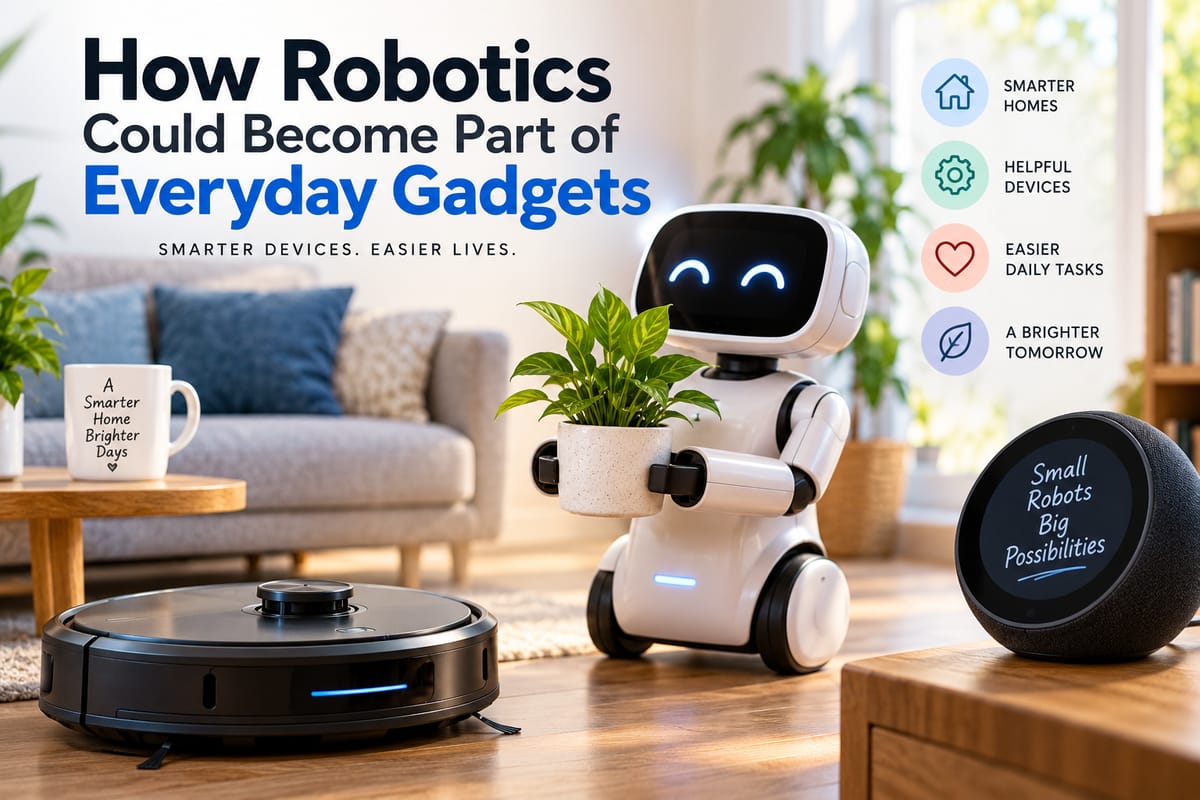
Robotics is often associated with industrial machines, warehouse systems, autonomous vehicles and humanoid robots. Yet the technology is gradually moving toward something much more familiar: everyday consumer gadgets.
The next generation of gadgets may not simply respond to a button press or voice command. Instead, some could sense their surroundings, make decisions, move independently and physically interact with objects around them.
This could change what people expect from devices such as home appliances, personal electronics, security systems and entertainment products.
Rather than treating robotics as a separate category of technology, manufacturers may increasingly build robotic capabilities directly into the gadgets people already use.
What Makes a Gadget Robotic?
A conventional gadget usually performs a defined function when a person provides an instruction. A robotic gadget adds another layer: it can perceive its environment and use that information to take physical action.
A robotic system typically combines several capabilities:
- Sensors to detect objects, movement, temperature, sound or other conditions
- Processors and software to interpret information
- Actuators and motors to create physical movement
- Connectivity to communicate with other devices or cloud services
- Control systems to determine how the device should respond
A smart speaker, for example, can recognize a voice command but normally remains in one location. A robotic version could potentially move around a room, locate a person, inspect an area or physically manipulate an object.
The distinction is not always absolute, but physical interaction and autonomous behavior are important characteristics of robotics.
Readers looking for a broader explanation of how today's devices fit into the technology landscape can explore What Are Consumer Gadgets and How Do Modern Gadgets Work?.
Why Robotics Could Move Into Ordinary Gadgets
Several technological developments are making robotic features more practical.
Sensors are becoming smaller and more capable. Processors can perform increasingly sophisticated calculations in compact devices. Artificial intelligence can help systems interpret images, speech and environmental information, while wireless connectivity allows gadgets to coordinate with other devices.
At the same time, consumers are becoming accustomed to products that automate routine tasks.
Robot vacuum cleaners are an early example. They can navigate rooms, detect obstacles and automatically clean floors without requiring constant human control.
Future gadgets could extend this concept beyond cleaning. Instead of creating one specialized robot for every task, manufacturers could integrate limited robotic movement into products designed for multiple everyday functions.
Robotic Features Could Appear in Home Appliances
The home is one of the most obvious places for robotic gadgets to develop.
Kitchen appliances could eventually use motors, cameras and sensors to perform more physical tasks. A smart countertop device might move ingredients, adjust its position or assist with preparation. Refrigerators could potentially use robotic mechanisms to organize selected contents or bring frequently used items within reach.
Other appliances could become more autonomous as well.
A laundry system might identify garments and help sort them. A household storage system could move objects between compartments. Smart furniture could adjust its configuration based on how a room is being used.
These ideas remain more advanced than the robotic appliances currently common in homes, but they illustrate how robotics could become embedded into familiar products rather than appearing only as standalone machines.
Personal Electronics Could Become More Physical
Phones, tablets and computers have traditionally been passive objects. They display information, process commands and communicate with other systems, but they generally do not move themselves around the environment.
That could change.
A future personal device might have a small motorized base that allows it to follow its owner around a room. A tablet could reposition itself for better viewing. A camera could independently track a person and adjust its position without requiring a tripod.
Even accessories could become robotic.
Headphones, cameras, displays and charging devices might automatically reposition themselves based on where the user is located or what they are doing.
The goal would not necessarily be to turn every device into a miniature robot. Instead, manufacturers could add just enough movement and autonomy to make particular products more useful.
Cameras Could Become Autonomous Assistants
Cameras already contain sophisticated sensors and software for focusing, stabilization and subject tracking.
Adding more robotic capabilities could allow them to physically move as well as digitally adjust their settings.
A home camera might reposition itself when it detects activity in a particular part of a room. A personal camera could follow someone during exercise, cooking or a presentation. A small video device could automatically adjust its position to maintain an appropriate viewing angle.
This could make autonomous cameras useful for people who regularly create video content, participate in remote meetings or monitor spaces.
However, the increased autonomy would also make privacy controls particularly important. A device capable of moving independently and observing its surroundings needs clear indicators, permissions and user controls.
Robotic Gadgets Could Assist With Accessibility
Robotics could have applications beyond convenience.
Devices capable of controlled physical movement could potentially help people interact with their surroundings when certain tasks are difficult to perform manually.
For example, a robotic gadget might retrieve a lightweight object, reposition a screen, open a compartment or bring an item closer to a user.
The usefulness of such systems would depend heavily on their reliability, safety and affordability. A device intended to assist with physical tasks must be predictable enough that users can trust it.
This makes accessibility an important potential area for consumer robotics development.
Entertainment Devices Could Move Around the Room
Entertainment technology could also gain robotic capabilities.
Imagine a display that automatically moves closer when someone is watching from another part of a room, or a camera that follows a family member during a video call. Speakers could potentially reposition themselves to optimize sound for different listening locations.
Gaming systems may offer even more possibilities.
Instead of interacting only through a screen, players could eventually use physical robotic accessories that move objects, respond to gameplay or create changes in the surrounding environment.
These applications would combine traditional consumer electronics with mechanical systems in ways that make technology more interactive.
Security Gadgets Could Become More Autonomous
Home security products are already heavily dependent on sensors, cameras and connected software.
Robotic movement could add another capability.
A security device might patrol a defined indoor area, reposition its camera when something unusual is detected or move toward a location where a sensor has registered activity.
Such systems could potentially provide broader coverage than fixed cameras.
At the same time, autonomous movement creates additional safety and privacy considerations. Users would need to know where a device is allowed to travel, what it can observe and how it responds to unexpected situations.
Strong access controls and transparent settings would become increasingly important as robotic gadgets gain independence.
The Role of Artificial Intelligence
Robotics becomes considerably more useful when a machine can interpret its environment rather than simply follow a fixed sequence of movements.
Artificial intelligence can help a robotic gadget recognize objects, understand spoken instructions, identify patterns and select appropriate actions.
For example, a future household robot might receive an instruction such as "bring me the charger" and need to identify which charger is being requested, locate it and navigate around obstacles.
That requires much more than a motor and a remote-control interface.
AI therefore has the potential to serve as the decision-making layer connecting sensors, software and physical movement.
The broader development of robotics and consumer applications is explored in The Complete Guide to Robotics and Consumer Robots.
Small Robots May Be More Practical Than Humanoid Robots
Public discussions about robotics often focus on human-shaped machines. Humanoid robots may eventually have roles in homes and workplaces, but everyday gadgets do not necessarily need a human form.
A small motorized camera, moving display stand or autonomous kitchen device could solve a specific problem without attempting to replicate the human body.
This may make specialized robotic gadgets easier to design and manufacture.
Instead of asking whether every household needs a humanoid robot, manufacturers can ask a more practical question: Would adding controlled movement and autonomy make this particular product more useful?
That approach could produce many different forms of robotic technology.
Battery Life Will Remain a Major Challenge
Movement requires energy.
A gadget that uses motors continuously can consume considerably more power than a stationary electronic device. Batteries therefore become an important limitation for portable robotic products.
Manufacturers will need to balance movement, processing power, sensor use and battery capacity.
Automatic charging could help. A robotic gadget might return to a charging station when its battery becomes low, much like some robotic vacuum cleaners already do.
Improvements in battery technology and energy-efficient motors could also make more mobile devices practical over time.
Safety Will Matter More as Gadgets Move
A stationary gadget can still create safety risks, but a moving gadget introduces additional ones.
A robotic device operating in a home must account for people, pets, furniture, stairs, fragile objects and other obstacles. It needs ways to stop or change direction when conditions are unexpected.
Physical safety will therefore need to be designed into the product from the beginning.
Manufacturers may also need to establish limits on speed, force and operating areas. Users should have straightforward ways to stop a device immediately when necessary.
Privacy Could Become a Bigger Issue
Robotic gadgets may require more sensors than conventional products.
Cameras, microphones, proximity sensors and other systems could allow devices to understand their surroundings. Those capabilities could make gadgets more useful, but they also increase the amount of environmental information that a device can collect.
Consumers may therefore pay greater attention to questions such as:
- What can the device see or hear?
- Where is information processed?
- Is data stored locally or remotely?
- Who can access the device?
- Can sensors be disabled?
- How long is collected information retained?
Privacy protections will become increasingly important if robotic gadgets become common throughout homes.
Interoperability Could Shape the Future
A home may eventually contain several devices capable of sensing and moving independently.
If those products operate in isolation, their usefulness could be limited. If they can communicate safely with one another, however, they could coordinate tasks.
A security camera could alert another device to activity. A household assistant could communicate with appliances. A smart display could interact with a robotic stand or charging system.
This creates a broader ecosystem in which robotics becomes one layer of connected home technology.
It also makes compatibility and security more important. Consumers may not want every robotic device tied permanently to one manufacturer's ecosystem.
Robotics Could Change What Consumers Expect From Gadgets
For decades, consumer electronics have largely become smaller, faster and more connected.
Robotics adds another dimension: movement.
A future gadget may not simply provide information or execute a digital command. It may physically reposition itself, retrieve something, adjust its orientation or interact with another device.
That could change the definition of a gadget itself.
The device sitting on a desk today might become a mobile assistant tomorrow, while products that currently seem unrelated to robotics could acquire small autonomous features.
The broader implications of emerging technologies for consumer devices are discussed in How Future Technology Will Change Gadgets.
What Everyday Robotic Gadgets Could Look Like
The most realistic future may not involve homes filled with humanoid robots.
Instead, robotics could appear gradually through specialized products:
- Self-positioning cameras
- Mobile smart displays
- Autonomous charging devices
- Robotic kitchen assistants
- Moving security cameras
- Smart storage systems
- Robotic furniture components
- Personal mobility accessories
- Interactive educational devices
- Small household task robots
Many of these products could initially perform only one or two physical tasks.
Over time, improvements in AI, sensors, batteries, motors and software could allow them to handle more complex situations.
The Future of Robotics May Be Built Into Familiar Objects
Robotics does not have to arrive as a dramatic replacement for existing gadgets. It could emerge incrementally, with manufacturers adding movement and autonomy to products people already understand.
A camera may learn to move. A display may learn where to position itself. An appliance may learn when to act. A household gadget may eventually recognize an object and physically interact with it.
This gradual transition could make robotics feel less like a separate technological category and more like a standard feature of consumer electronics.
As sensors become smaller, AI becomes more capable and mechanical systems become more affordable, the boundary between a smart gadget and a robot may become increasingly difficult to define. The result could be a generation of everyday devices that do more than compute, communicate and respond—they sense, move and act in the physical world.