How Businesses Measure ERP Implementation Success
Implementing an enterprise resource planning system can be one of the most significant technology projects a business undertakes. An ERP platform can connect finance, procurement, inventory, manufacturing, sales, human resources, and other functions, but installing the software is only the beginning.
The real question is whether the implementation improves the way the organization operates.
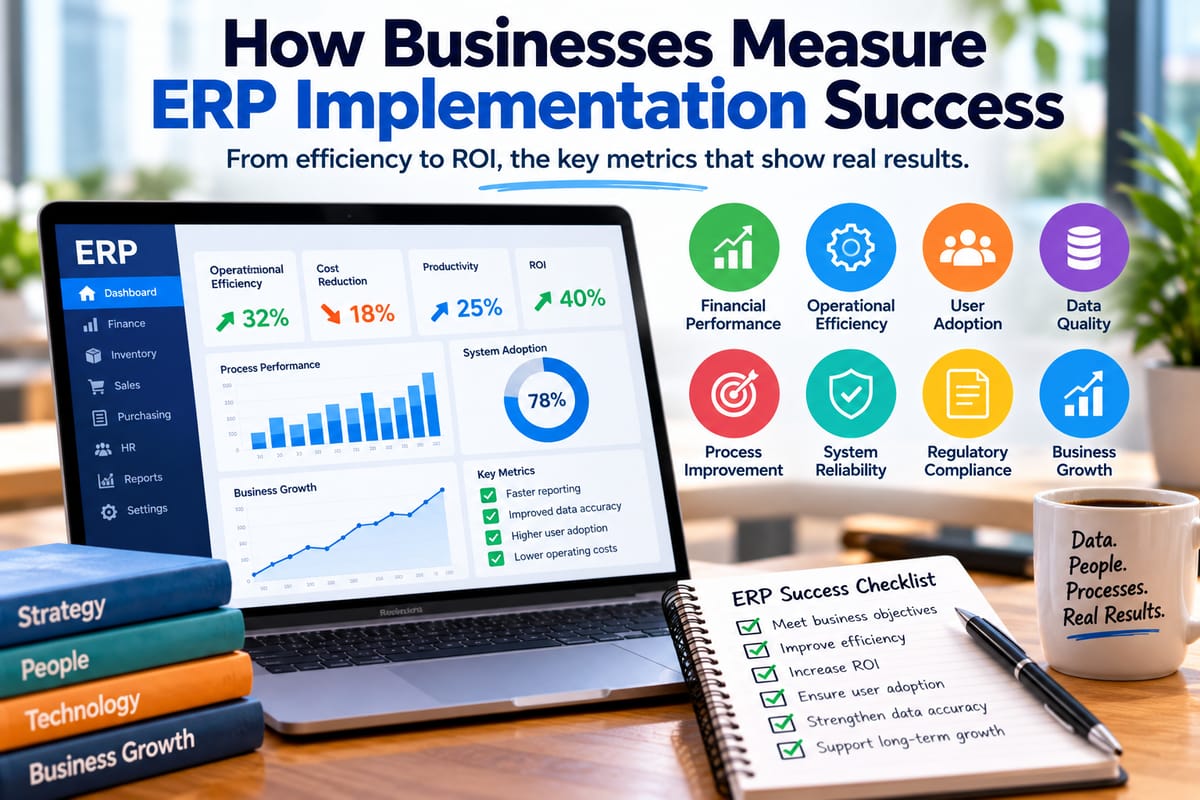
Businesses can measure ERP implementation success by examining financial performance, operational efficiency, user adoption, data quality, process improvements, system reliability, and progress toward strategic goals. The right measurements depend on what the organization wanted the ERP project to accomplish in the first place.
Understanding the broader role of business applications can also provide useful context. The Complete Guide to Business Software explores how different software systems support modern organizations.
What Does ERP Implementation Success Mean?
ERP implementation success does not simply mean that the software has been installed and employees can log in.
A successful implementation should help the organization achieve measurable improvements compared with its previous processes.
Depending on the project, success might involve:
- Reducing manual data entry
- Improving financial reporting
- Increasing inventory accuracy
- Shortening order-processing times
- Improving visibility across departments
- Reducing operating costs
- Standardizing business processes
- Improving compliance and controls
- Giving employees better access to information
- Supporting future business growth
The specific objectives should be established before implementation begins so that performance can be measured afterward.
Start With the Original Business Objectives
One of the most useful ways to measure ERP success is to compare actual results with the goals established during planning.
For example, a company might implement an ERP system because its existing processes produce frequent inventory errors.
In that case, simply measuring whether the ERP system went live on schedule would not provide a complete picture of success.
A more meaningful measurement would be whether inventory accuracy improved after implementation.
Similarly, if the original goal was to reduce the time required to produce financial reports, the business should measure reporting time before and after implementation.
Understanding ERP Technology
ERP systems are designed to bring multiple business functions into a more integrated environment.
Instead of maintaining completely separate systems for finance, inventory, purchasing, sales, and other activities, an ERP platform can provide shared data and connected workflows.
The ERP Technology Explained guide provides additional background on how ERP systems support business operations.
Because ERP implementations affect many departments, success should generally be evaluated across the organization rather than from the perspective of the technology department alone.
Measuring Implementation Against the Original Timeline
Project schedule is one of the simplest metrics to track.
Businesses can compare the actual implementation timeline with the original project plan.
Useful measurements include:
- Planned go-live date
- Actual go-live date
- Duration of implementation
- Delays by project phase
- Milestones completed on schedule
- Time required to stabilize the system after launch
A project that launches late is not automatically unsuccessful. Complex implementations can encounter legitimate changes in scope or unexpected technical challenges.
However, significant schedule deviations should be understood because they can affect project costs and business operations.
Measuring Implementation Costs
ERP projects can involve substantial costs.
Expenses may include:
- Software licenses or subscriptions
- Consulting services
- Implementation services
- Data migration
- System integration
- Custom development
- Employee training
- Internal project staff
- Hardware or infrastructure
- Ongoing support
Businesses should compare actual spending with the approved project budget.
A useful analysis should also distinguish between one-time implementation costs and recurring operating expenses.
A project that exceeds its original budget may still produce substantial business benefits, while a project delivered under budget may provide limited value if it fails to solve the organization's underlying problems.
Measuring Return on Investment
Return on investment, or ROI, is often used to evaluate whether an ERP project produced sufficient financial value relative to its cost.
Potential sources of financial benefit include:
- Lower administrative costs
- Reduced inventory carrying costs
- Fewer data-entry errors
- Faster order processing
- Reduced overtime
- Improved purchasing
- Lower technology maintenance costs
- Better use of working capital
- Increased productivity
Calculating ROI requires a clear baseline.
If a business does not know how much a process cost before the ERP implementation, it becomes much harder to determine whether the new system produced measurable savings.
Measuring Employee Productivity
ERP systems can affect how employees perform everyday tasks.
A business can measure whether employees spend less time on repetitive activities or whether certain workflows require fewer manual steps.
Examples include measuring:
- Time required to enter an order
- Time required to process an invoice
- Time required to approve purchases
- Time required to generate reports
- Number of manual data-entry steps
- Time spent reconciling information between systems
Productivity measurements should focus on meaningful business processes rather than simply counting how many features employees use.
Measuring User Adoption
An ERP system cannot deliver its intended benefits if employees avoid using it or develop unofficial workarounds.
User adoption is therefore a critical success indicator.
Businesses can examine:
- Percentage of employees actively using the system
- Frequency of system usage
- Completion of required workflows
- Use of key ERP functions
- Number of users relying on spreadsheets instead
- Number of support requests
- Training completion rates
High login numbers alone do not prove successful adoption. Employees may log into a system without using its capabilities effectively.
Why Employee Feedback Matters
Quantitative measurements provide important information, but employee feedback can reveal problems that numbers may not immediately show.
Employees can identify issues such as:
- Confusing workflows
- Missing functionality
- Excessive steps
- Poor system performance
- Difficult reporting tools
- Inadequate training
- Problems with data
- Integration failures
Surveys, interviews, support-ticket analysis, and departmental reviews can provide useful qualitative information.
Feedback is particularly valuable during the period immediately after implementation, when employees are still adapting to new processes.
Measuring Data Quality
One of the major reasons organizations implement ERP systems is to improve access to reliable business information.
Businesses should therefore measure data quality after implementation.
Relevant indicators can include:
- Duplicate records
- Missing information
- Incorrect customer records
- Inventory discrepancies
- Invalid product data
- Inconsistent financial information
- Data synchronization failures
Poor data quality can undermine the benefits of an otherwise well-designed ERP system.
A successful implementation should establish processes for maintaining data accuracy rather than treating data migration as a one-time task.
Measuring Financial Reporting Improvements
ERP systems can significantly change financial reporting processes.
Before implementation, finance teams may need to collect information manually from multiple systems and spreadsheets.
After implementation, integrated financial data can potentially make reporting more consistent and efficient.
Businesses can measure:
- Time required to close financial periods
- Time required to produce management reports
- Number of manual reconciliations
- Number of reporting errors
- Time required to consolidate business units
- Availability of real-time financial information
Shorter reporting cycles can be particularly valuable because management can receive important information sooner.
Measuring Inventory Performance
For businesses that hold physical inventory, ERP systems can have a major impact on inventory management.
Useful metrics include:
- Inventory accuracy
- Stockout frequency
- Excess inventory
- Inventory turnover
- Order fulfillment rates
- Picking accuracy
- Warehouse processing times
- Forecast accuracy
The appropriate measurements depend on the organization's business model.
A manufacturer may focus heavily on production materials and work-in-progress, while a retailer may emphasize stock availability and order fulfillment.
Measuring Order-to-Cash Performance
ERP implementations can improve the processes connecting customer orders to payment.
The order-to-cash cycle can involve sales orders, inventory availability, fulfillment, invoicing, payment collection, and accounting.
Businesses can measure:
- Order-processing time
- Invoice processing time
- Billing accuracy
- Days sales outstanding
- Order fulfillment rates
- Payment collection times
- Number of billing errors
Improvements in these areas can demonstrate that the ERP system is helping connect previously fragmented processes.
Measuring Procure-to-Pay Performance
Procurement is another area where ERP systems can create measurable changes.
A business can examine the time and cost involved in purchasing goods and services.
Potential metrics include:
- Purchase-order processing time
- Approval time
- Invoice matching accuracy
- Supplier payment cycle time
- Procurement costs
- Maverick spending
- Number of manual purchase processes
Integrated procurement data can also provide greater visibility into supplier spending and purchasing patterns.
Measuring System Reliability
An ERP platform needs to be available when employees need it.
Businesses can monitor:
- System uptime
- Downtime
- Application response times
- Integration failures
- Database performance
- Number of critical incidents
- Average time to resolve incidents
Frequent outages or slow performance can reduce employee productivity even if the ERP system provides extensive functionality.
Measuring Integration Performance
Modern ERP platforms rarely operate completely by themselves.
They may connect with:
- Customer relationship management systems
- E-commerce platforms
- Payroll applications
- Banking systems
- Warehouse management software
- Business intelligence platforms
- Supplier systems
- Manufacturing equipment
Businesses should therefore measure whether these integrations work reliably.
Important indicators include failed transactions, synchronization delays, duplicate records, API errors, and manual intervention requirements.
Measuring Process Standardization
ERP implementations often involve efforts to standardize business processes.
Before implementation, different departments or locations may perform the same task in different ways.
After implementation, organizations may establish common workflows and approval procedures.
Businesses can measure:
- Percentage of processes using standardized workflows
- Number of manual exceptions
- Number of duplicate processes
- Differences between business units
- Compliance with approved procedures
Standardization can make organizations easier to manage as they expand.
Measuring Compliance and Internal Controls
ERP systems can also affect governance and internal controls.
Businesses can examine whether the system improves:
- Approval workflows
- Segregation of duties
- Audit trails
- Access controls
- Financial controls
- Documentation
- Regulatory reporting
A system that makes transactions easier to trace and approvals easier to manage can provide value that is not immediately visible in revenue or cost figures.
Measuring Customer Experience
ERP implementation can indirectly affect customers.
Improved inventory visibility can reduce delays. Better order processing can improve delivery times. More accurate billing can reduce customer service problems.
Possible customer-related metrics include:
- Order fulfillment time
- On-time delivery
- Order accuracy
- Returns caused by processing errors
- Customer complaints
- Response times
- Product availability
These measurements help connect internal technology improvements with external business outcomes.
Measuring Employee Training Effectiveness
Training is often treated as a project milestone, but completion alone does not demonstrate effectiveness.
A better approach is to determine whether employees can perform the tasks they need to complete.
Businesses can measure:
- Training completion
- Assessment results
- Support requests after training
- Workflow errors
- Time required to complete common tasks
- Employee confidence with key processes
Additional training may be necessary when users continue to struggle with important workflows.
Measuring Support Requirements
Support demand can provide another indication of ERP stability and usability.
Immediately after launch, support requests may increase as employees learn the new system.
Over time, however, businesses generally want recurring issues to decline.
Useful indicators include:
- Number of support tickets
- Average resolution time
- Number of recurring incidents
- Number of critical issues
- Requests for system customization
- Help-desk workload
A steady decline in repetitive support problems can indicate that employees and support teams are becoming more comfortable with the system.
Measuring Business Agility
An ERP system can also be evaluated based on how easily the organization can respond to change.
For example, can the business quickly:
- Add a new product?
- Open a new location?
- Add another business unit?
- Change an approval workflow?
- Introduce a new sales channel?
- Connect another application?
- Generate a new management report?
The ability to make these changes without extensive custom development or manual work can become an important measure of long-term ERP value.
Comparing Results With a Baseline
ERP measurements become much more useful when businesses establish a baseline before implementation.
Suppose a company takes an average of five days to process an invoice before introducing its new ERP system.
After implementation, the average falls to two days.
The company can now demonstrate a measurable change.
Without the original baseline, it may only be able to say that the new system appears faster.
Baseline measurements should ideally cover the major processes the ERP project is intended to improve.
Measuring Software Value Beyond ROI
Financial return is important, but it is not the only measure of technology value.
The How Businesses Measure Software Value guide provides broader context for evaluating business software based on financial, operational, and strategic outcomes.
For an ERP project, value may include better decision-making, improved visibility, stronger controls, easier scalability, and more consistent processes.
Some of these benefits can be difficult to express in a single financial number.
Measuring Results Over Time
ERP implementation should not be evaluated only immediately after launch.
Some benefits take months or years to appear.
Employees may need time to become comfortable with new workflows. Data quality may improve gradually. Management may discover new ways to use reporting capabilities.
Businesses can therefore establish measurement periods such as:
- 30 days after launch
- 90 days after launch
- Six months after launch
- One year after launch
Longer-term reviews can determine whether early improvements have been sustained.
The Importance of Change Management
Technology alone does not guarantee successful transformation.
Employees need to understand why processes are changing, what is expected of them, and how the new system affects their responsibilities.
Change management can include:
- Communication
- Training
- Departmental champions
- Process documentation
- Feedback mechanisms
- Leadership support
- Post-launch assistance
If adoption remains low, businesses may need to investigate whether the underlying issue is technology, training, process design, or organizational resistance.
Measuring the Total Cost of Ownership
ERP success should also be evaluated beyond the initial implementation.
An ERP system can generate recurring costs for:
- Software subscriptions
- Infrastructure
- Support
- Upgrades
- Security
- Customization
- Integration maintenance
- Additional user licenses
- Training
These costs contribute to the system's total cost of ownership.
A business should compare these ongoing expenses with the benefits the ERP system continues to provide.
How Digital Transformation Fits Into ERP Success
ERP implementation is often part of a larger digital transformation strategy.
Organizations may use the project to redesign processes, improve data management, connect applications, and create a stronger technology foundation.
The How Businesses Plan Digital Transformation Projects guide provides additional context on how organizations can approach broader technology transformation.
An ERP system should therefore be evaluated not only as a software purchase but also as part of the organization's wider operating model.
Common Mistakes When Measuring ERP Success
Businesses can make measurement less useful by focusing on the wrong indicators.
Measuring Only Whether the System Went Live
A successful launch is an important milestone, but it does not prove that the business achieved its objectives.
Measuring Only Project Cost
A project that costs more than expected may still generate substantial long-term value.
Ignoring User Adoption
A technically functional system can still fail to deliver value if employees avoid using it.
Failing to Establish Baselines
Without pre-implementation measurements, it can be difficult to quantify improvements.
Measuring Too Many Metrics
Tracking dozens of unrelated indicators can make it harder to identify what actually matters.
Ignoring Long-Term Performance
ERP value should be assessed over time rather than only during the implementation period.
Creating an ERP Success Scorecard
A practical ERP scorecard can group metrics into several categories.
| Category | Example Metrics |
|---|---|
| Financial | ROI, implementation cost, operating savings |
| Operations | Processing time, inventory accuracy, productivity |
| Users | Adoption, training completion, support requests |
| Data | Accuracy, completeness, duplicate records |
| Technology | Uptime, performance, integration failures |
| Customers | Order accuracy, delivery performance, complaints |
| Strategic | Scalability, reporting, process standardization |
The specific metrics should reflect the organization's objectives rather than being selected simply because they are easy to measure.
Turning ERP Data Into Better Decisions
The most valuable ERP measurements are often those that help management make better decisions.
An integrated system can provide information about sales, inventory, purchasing, finance, production, and other functions.
When that information is accurate and available at the right time, managers can make decisions based on a more complete view of the business.
This is one of the reasons ERP projects can have effects beyond the technology department.
When Is an ERP Implementation Truly Successful?
An ERP implementation can be considered successful when it delivers the business outcomes it was designed to achieve and continues to provide useful value after the initial launch.
That may mean faster processes, better data, stronger controls, lower costs, improved reporting, higher employee productivity, or greater organizational flexibility.
The exact definition will differ between businesses.
A manufacturer may prioritize production efficiency and inventory accuracy. A service company may focus more heavily on financial reporting and resource management. A rapidly expanding organization may place greater emphasis on scalability and standardization.
The important point is to define those objectives before implementation and measure them consistently afterward.
Measuring the Business Transformation
ERP implementation success is ultimately about more than whether new software has replaced old software.
The real measure is what changed because the organization implemented the system.
Businesses can evaluate the results by comparing performance against pre-implementation baselines, tracking financial and operational outcomes, monitoring user adoption, measuring data quality, and reviewing the system's contribution to broader strategic objectives.
An ERP platform can provide the technological foundation for integrated business operations, but its value depends on how effectively the organization uses it.
When businesses measure the right outcomes over time, they can identify whether the ERP investment is delivering the improvements it was intended to create—and where additional changes are needed to turn the technology into lasting business value.