How Consumer Gadgets Have Changed Over Time
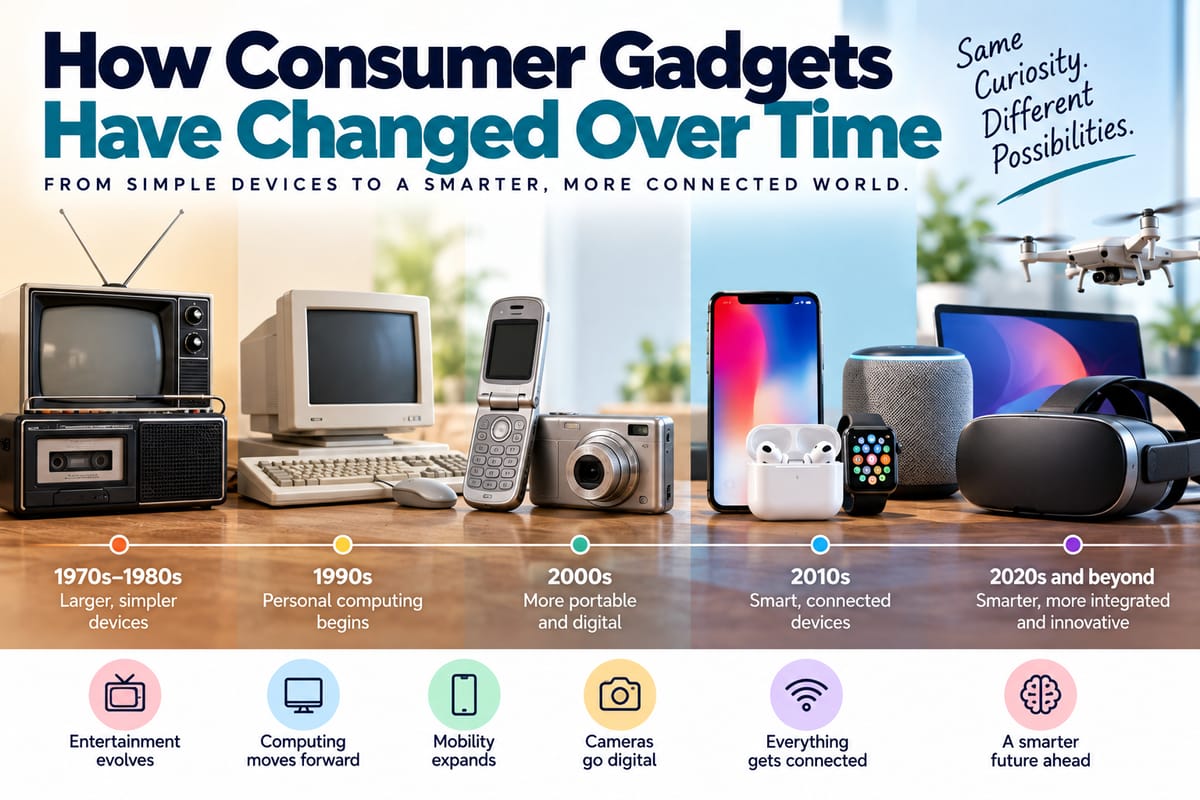
Consumer gadgets have changed dramatically over the past several decades. Devices that once performed a single function have evolved into connected, software-driven products capable of handling communication, entertainment, work, photography, navigation, health tracking, and countless other tasks.
The biggest changes have not simply involved making gadgets smaller or faster. Modern devices are increasingly connected to one another, powered by sophisticated software, equipped with sensors, and capable of adapting to how people use them.
Understanding this evolution helps explain why today's smartphones, wearables, smart-home devices, wireless accessories, and other electronics look so different from the gadgets that came before them.
What Counts as a Consumer Gadget?
Consumer gadgets are electronic devices designed primarily for everyday personal use.
They can include:
- Smartphones
- Tablets
- Smartwatches
- Headphones
- Cameras
- Gaming consoles
- Smart speakers
- E-readers
- Fitness trackers
- Streaming devices
- Portable computers
- Smart-home products
These devices vary considerably, but they share a common purpose: using technology to provide practical, entertainment, communication, or convenience-related functions.
A broader overview is available in What Are Consumer Gadgets and How Do Modern Gadgets Work?.
The Era of Single-Purpose Devices
Many early consumer electronics were designed around one primary function.
A calculator performed calculations. A portable music player played music. A camera captured photographs. A telephone provided voice communication.
This specialization was partly a result of technological limitations.
Processors, memory, batteries, displays, and storage were more expensive and less capable than they are today. Manufacturers therefore designed devices around specific tasks.
Consumers often needed several different gadgets to perform activities that a modern smartphone can handle with a single device.
Gadgets Became Smaller and More Portable
Miniaturization became one of the most important trends in consumer electronics.
As electronic components became smaller, manufacturers could fit increasingly powerful technology into portable products.
Computers that once occupied large spaces became desktop systems and eventually laptops. Music collections that required shelves of physical media could eventually fit onto portable digital players.
Smaller components also made it possible to develop new categories of products that could be carried or worn throughout the day.
Digital Technology Replaced Many Analog Functions
Another major transformation was the shift from analog to digital technology.
Digital systems made it easier to store, process, copy, transmit, and manipulate information.
Photography provides a clear example.
Traditional cameras captured images using photographic film. Digital cameras replaced film with electronic image sensors and digital storage.
Music underwent a similar transformation as physical formats increasingly gave way to digital files and eventually streaming services.
The shift to digital technology created the foundation for multifunctional gadgets.
The Rise of Personal Computers
Personal computers brought powerful computing capabilities into homes and workplaces.
Early consumer computers could perform tasks such as word processing, calculations, programming, and basic gaming.
As processors became faster and storage increased, computers became capable of handling increasingly sophisticated software.
The development of graphical interfaces also made computers more accessible to people who did not have programming knowledge.
Eventually, portable computers brought many of these capabilities outside traditional offices and homes.
The Internet Changed What Gadgets Could Do
The spread of the internet transformed consumer electronics.
Before widespread internet connectivity, many gadgets operated primarily as standalone devices.
Once devices could connect to online services, their capabilities expanded.
A computer could access websites, communicate instantly with people around the world, download software, store information remotely, and access constantly updated services.
Internet connectivity eventually became a defining feature of many consumer gadgets.
Mobile Phones Became Smartphones
One of the biggest changes in consumer electronics occurred when mobile phones evolved into smartphones.
Early mobile phones primarily focused on voice calls and text messaging.
Modern smartphones combine many functions, including:
- Telephone communication
- Internet access
- Photography
- Video recording
- Navigation
- Music
- Gaming
- Banking
- Social communication
- Video conferencing
- Mobile payments
- Health and fitness tracking
The smartphone effectively became a general-purpose computing platform that fits into a pocket.
Software Became as Important as Hardware
Traditional gadgets were often defined primarily by their physical components.
Modern gadgets are increasingly defined by the combination of hardware and software.
A smartphone's usefulness depends not only on its processor, camera, display, and battery but also on its operating system and applications.
Software updates can add features, improve security, change interfaces, and extend the useful life of a device.
This means the functionality of a gadget can continue evolving after it has been purchased.
Apps Transformed Consumer Gadgets
Applications expanded what consumer devices could accomplish.
Instead of manufacturers having to build a separate physical device for every function, software could add new capabilities to an existing product.
A smartphone can become a navigation system, fitness tracker, video editor, music player, banking tool, or productivity device simply by installing different applications.
This software-driven model has become one of the defining characteristics of modern consumer technology.
Touchscreens Changed Device Interaction
Touchscreens transformed how people interact with electronics.
Instead of relying primarily on physical buttons, keyboards, switches, or other controls, users could interact directly with information displayed on a screen.
Gestures such as tapping, swiping, pinching, and dragging became common.
Touch interfaces also allowed manufacturers to create cleaner hardware designs with fewer physical controls.
Cameras Became Computerized
Digital cameras changed photography, but smartphones took the transformation further.
Modern smartphone cameras combine image sensors, lenses, processors, software, and artificial intelligence techniques.
A photograph may be computationally processed immediately after it is captured. The device can adjust exposure, reduce noise, combine multiple frames, recognize scenes, and apply other corrections.
As a result, photography has become increasingly dependent on both hardware and software.
Wireless Connectivity Became Standard
Older consumer electronics often relied heavily on physical cables.
Modern gadgets increasingly communicate wirelessly through technologies such as:
- Wi-Fi
- Bluetooth
- Cellular networks
- NFC
- Wireless charging systems
Wireless connectivity has made it easier for devices to communicate with one another and access online services.
A smartphone can connect to headphones, watches, vehicles, speakers, computers, and smart-home equipment without requiring a separate cable for every connection.
Gadgets Became Part of Larger Ecosystems
Modern devices increasingly operate as part of connected ecosystems.
A smartphone may control smart lights, synchronize with a smartwatch, connect to a vehicle, share files with a computer, and manage entertainment equipment.
Manufacturers have also created ecosystems in which different products share accounts, software services, accessories, and data.
This creates a more integrated experience but can also make consumers more dependent on particular platforms.
Wearable Technology Became Mainstream
Technology also moved from pockets and desks onto people's bodies.
Smartwatches and fitness trackers can monitor movement, exercise, heart-related measurements, sleep patterns, notifications, and other information depending on the device.
Wireless earbuds have similarly transformed portable audio by combining small electronics, microphones, batteries, sensors, and wireless connectivity into compact accessories.
Wearable technology illustrates how consumer electronics have become increasingly integrated into everyday activities.
Smart-Home Gadgets Expanded Connectivity
Homes have also become more technologically connected.
Consumers can now purchase smart:
- Lights
- Thermostats
- Cameras
- Doorbells
- Locks
- Speakers
- Appliances
- Security systems
- Energy-management devices
These products can communicate with smartphones and other devices, allowing users to monitor or control parts of the home remotely.
The result is a shift from isolated appliances toward connected household systems.
Artificial Intelligence Is Changing Gadgets
Artificial intelligence is becoming an increasingly important component of consumer electronics.
AI can help devices recognize speech, process images, predict user preferences, improve search, translate languages, detect patterns, and automate tasks.
Smartphone cameras are one example. Voice assistants are another.
AI can make devices feel more responsive because they can interpret information rather than simply execute rigid commands.
This trend is likely to become even more significant as AI models become smaller, faster, and more capable of running directly on consumer devices.
Gadgets Are Becoming More Adaptive
Older devices generally performed predefined functions.
Modern gadgets increasingly adapt to their users.
A smartphone can learn usage patterns, a smartwatch can personalize health information, and a smart speaker can recognize different types of requests.
This does not mean every device truly understands its user in a human sense. Instead, software can analyze patterns and use them to adjust how certain functions operate.
Personalization has therefore become a major part of modern gadget design.
Batteries Have Improved, but Power Remains Important
Battery technology has played a major role in the development of portable electronics.
More efficient processors and improved battery designs have allowed manufacturers to make devices thinner and more capable.
However, battery capacity remains an important limitation.
High-resolution displays, powerful processors, wireless communication, cameras, sensors, and AI processing all require energy.
Manufacturers therefore continue to balance performance with power efficiency.
Charging Has Become More Convenient
Charging technology has also evolved.
Physical charging cables remain common, but wireless charging has become increasingly widespread.
Fast-charging technologies can also reduce the amount of time users need to keep devices connected to a power source.
The development of better charging systems is particularly important as consumers carry more battery-powered gadgets throughout the day.
Flexible Electronics Could Change Device Design
Traditional electronics are built around rigid components and fixed shapes.
Flexible electronics could allow certain components to bend, stretch, or conform to unusual surfaces.
This could create new possibilities for wearable technology, foldable devices, flexible displays, and other product categories.
The potential impact is explored in How Flexible Electronics Could Change Gadgets.
If flexible electronics become more practical and affordable, future gadgets may no longer be limited to conventional rectangular forms.
Foldable Devices Challenge Traditional Designs
Foldable smartphones and other flexible devices demonstrate how manufacturers are experimenting with new physical designs.
Instead of treating a display as a fixed flat surface, foldable technology allows larger screens to occupy smaller physical spaces when not in use.
This approach could eventually influence smartphones, tablets, laptops, and other categories.
However, durability, cost, thickness, battery capacity, and hinge design remain important considerations.
Gadgets Became More Connected to the Cloud
Many modern gadgets depend on cloud services.
Photos can be synchronized across devices, files can be stored remotely, applications can communicate with online servers, and smart-home systems can be managed through internet-connected platforms.
Cloud computing allows relatively small devices to access substantial computing and storage resources.
However, it can also create dependence on internet connections and service providers.
Privacy Became a Bigger Consideration
As gadgets became more connected and capable of collecting information, privacy became a more important consideration.
Modern devices may contain cameras, microphones, location systems, motion sensors, biometric sensors, and other technologies capable of collecting personal information.
Consumers therefore need to consider not only what a gadget can do but also what information it collects, where that information is stored, and how it is used.
Security Became Part of Product Design
Connected gadgets also create cybersecurity considerations.
A smart device connected to the internet can potentially become a target for unauthorized access if it is poorly secured.
Manufacturers increasingly incorporate security features such as encrypted communications, authentication systems, secure updates, and hardware-based protections.
Consumers also play an important role by using strong passwords, enabling available security features, and keeping devices updated.
Gadgets Became More Environmentally Significant
The rapid development of consumer electronics has also raised questions about environmental impact.
Manufacturing gadgets requires raw materials, energy, transportation, and complex supply chains.
Electronic waste becomes another issue when devices are discarded.
Longer-lasting products, repairability, recycling, software support, and responsible disposal can influence the overall environmental footprint of consumer electronics.
Consumers may therefore consider durability and lifecycle issues alongside features and price.
Choosing Gadgets Became More Complicated
Modern products offer more features than earlier generations, but that does not necessarily make purchasing decisions easier.
A smartphone, laptop, television, or wearable device can have dozens of specifications to compare.
Consumers may need to consider:
- Performance
- Battery life
- Display quality
- Storage
- Connectivity
- Compatibility
- Software support
- Durability
- Repairability
- Price
The Complete Guide to Choosing the Right Products provides broader guidance for evaluating products based on actual needs rather than simply choosing the device with the longest feature list.
Gadgets Are Becoming More Specialized and More General at the Same Time
Modern consumer electronics show an interesting combination of trends.
Some products are becoming highly specialized, such as professional cameras, gaming equipment, and health-monitoring devices.
At the same time, general-purpose products such as smartphones are absorbing functions that once required separate gadgets.
This has reduced the number of devices many people need while increasing the complexity of the devices they do use.
The Future Could Bring Even More Integration
Future consumer gadgets are likely to become more connected, intelligent, energy-efficient, and adaptable.
Artificial intelligence could allow devices to understand more natural instructions. Flexible electronics could enable new physical designs. Sensors could make gadgets more aware of their surroundings, while wireless technologies could allow increasingly seamless communication between products.
The broader possibilities are explored in How Future Technology Will Change Gadgets.
The direction of development will depend not only on technological capability but also on affordability, consumer demand, privacy expectations, regulation, environmental concerns, and practical usefulness.
From Simple Devices to Connected Systems
The history of consumer gadgets is essentially a story of convergence.
Devices that once performed one task have gradually absorbed additional functions. Hardware has become smaller and more powerful, software has become central to product functionality, and wireless connectivity has connected individual devices into larger ecosystems.
Today's gadgets are therefore more than standalone pieces of electronics. They are increasingly part of connected systems that combine hardware, software, data, cloud services, sensors, and artificial intelligence.
As technology continues to develop, the biggest changes may come not from adding another isolated feature but from making gadgets work together more naturally and adapt more effectively to the way people live.