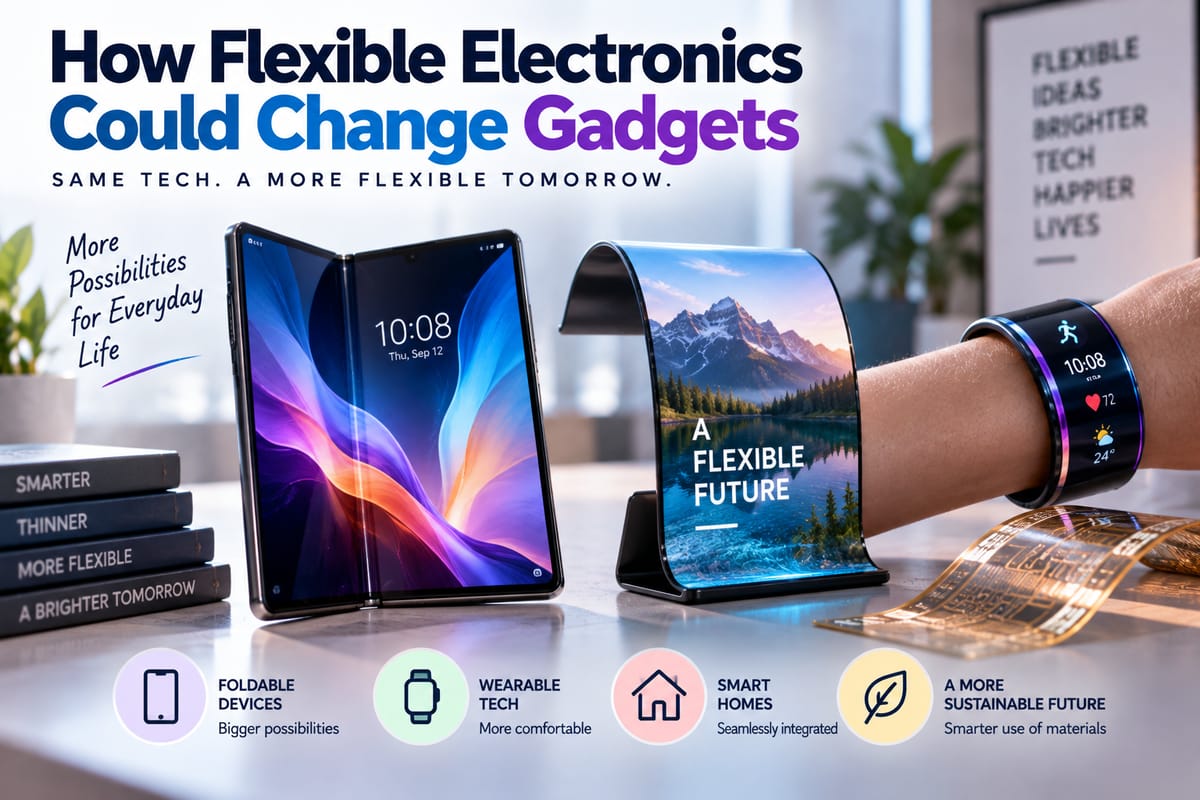
How Flexible Electronics Could Change Gadgets
For decades, most electronic devices have been built around rigid components, flat circuit boards, glass displays, and fixed shapes. Smartphones, televisions, laptops, watches, and other gadgets have generally followed the same basic design principles because conventional electronics work best when components remain stable and protected.
Flexible electronics could change that approach.
Instead of requiring every electronic component to remain rigid, flexible electronics use materials and manufacturing techniques that allow circuits, displays, sensors, and other components to bend, stretch, or conform to different surfaces. The technology could eventually influence how gadgets are designed, worn, carried, and integrated into everyday environments.
While flexible electronics are already appearing in products such as foldable smartphones and wearable devices, their potential extends well beyond simply making screens bend.
What Are Flexible Electronics?
Flexible electronics are electronic systems designed to operate on materials that can bend, curve, fold, or in some cases stretch.
Traditional electronics often rely on rigid substrates such as conventional glass or hard circuit boards. Flexible systems can instead use materials such as flexible plastics, thin films, specialized polymers, and other substrates capable of supporting electronic components while allowing movement.
The technology can involve flexible:
- Displays
- Sensors
- Circuits
- Batteries
- Solar cells
- Touch interfaces
- Lighting components
- Electronic components embedded into fabrics or surfaces
The important distinction is that flexibility can be incorporated into different parts of a device rather than being limited to the screen.
Why Flexible Electronics Matter for Future Gadgets
The physical structure of a gadget influences what designers can do with it.
Rigid components naturally limit the shapes and configurations that devices can take. A flexible component can potentially be curved around an object, folded into a smaller form, or integrated into a surface that is not flat.
This could lead to gadgets that are smaller when stored but larger when being used, devices that wrap around the body, and electronic systems that blend more naturally into furniture, clothing, vehicles, and other environments.
This possibility is part of the broader transformation described in discussions about how future technology will change gadgets, where new materials and engineering techniques could influence not only what gadgets do but also how they physically interact with people.
Foldable Displays Are an Early Example
Foldable smartphones are among the most visible examples of flexible electronics.
A foldable phone can provide a larger display while still allowing the device to become more compact when closed. Instead of treating screen size and portability as completely opposing requirements, manufacturers can use flexible display technology to combine both characteristics in a single product.
The development of foldable smartphones evolving with AI illustrates how flexible hardware can intersect with advances in software and artificial intelligence.
As foldable designs mature, future devices could become increasingly capable of adapting their interfaces to different physical configurations.
Flexible Electronics Could Go Beyond Smartphones
Although smartphones receive much of the attention, flexible electronics could eventually affect a much wider range of gadgets.
Wearable Technology
Flexible electronics are particularly suitable for wearable devices because the human body is constantly moving.
Electronic systems could be designed to follow the shape of a wrist, arm, clothing surface, or other part of the body. This could make some wearable products thinner, lighter, and more comfortable.
Flexible sensors could also be incorporated into clothing or other wearable materials, creating new ways to collect information and interact with digital systems.
Flexible Laptops and Tablets
Laptop and tablet designs could also change.
A device might use a flexible display that expands when a larger workspace is needed and folds into a smaller form for transportation. Instead of relying on separate screens and conventional hinges, manufacturers could explore entirely new physical configurations.
Such products could blur the traditional distinction between phones, tablets, and laptops.
Smart Clothing
Flexible electronics could eventually make electronic components part of clothing itself.
Fabric-integrated sensors, flexible displays, and lightweight electronic systems could create garments capable of interacting with other devices or providing information directly to the wearer.
For this to become practical on a large scale, manufacturers would need to address challenges involving washing, durability, power consumption, comfort, and manufacturing costs.
Flexible Home Technology
Flexible electronics could also find applications inside homes.
Displays might be integrated into curved surfaces, furniture, walls, mirrors, or other objects. Instead of placing a conventional rectangular screen somewhere in a room, future products could make digital interfaces less visually intrusive.
This could contribute to a broader shift toward technology that blends into its surroundings rather than demanding a dedicated physical space.
New Materials Could Expand Design Possibilities
Materials science is one of the most important areas supporting flexible electronics.
Researchers and manufacturers are exploring materials that can conduct electricity while remaining thin, lightweight, flexible, or even stretchable. Advances in these materials could allow designers to build electronic systems that would be difficult or impossible to create using conventional components.
Some flexible electronic systems may also require new approaches to protecting delicate components.
A gadget that bends repeatedly needs materials capable of handling mechanical stress without losing performance. This makes durability a critical consideration alongside flexibility.
Artificial Intelligence Could Make Flexible Gadgets More Useful
Flexible hardware alone does not determine how useful a device becomes.
Software and artificial intelligence could help flexible gadgets respond intelligently to how they are positioned or used. A device could potentially recognize whether it is folded, unfolded, wrapped around an object, or being worn and adjust its interface accordingly.
For example, a foldable device might present different applications depending on its physical configuration. A wearable system could adapt the information it displays based on movement or context.
These possibilities demonstrate why flexible electronics should be viewed as part of the wider complete guide to emerging technology and innovation rather than as an isolated hardware trend.
Flexible Sensors Could Change How Gadgets Understand Their Environment
Sensors are another area where flexibility could provide important advantages.
A rigid sensor is often designed for a specific location and orientation. A flexible sensor can potentially conform to curved surfaces and moving objects.
This could be useful for applications involving:
- Motion detection
- Pressure sensing
- Temperature monitoring
- Environmental measurements
- Touch interaction
- Wearable devices
- Smart surfaces
As sensors become smaller and more adaptable, everyday objects could gain electronic capabilities without needing to resemble traditional gadgets.
Energy Storage Remains a Major Challenge
One of the biggest obstacles for flexible gadgets is power.
A flexible display or sensor is only useful if it can receive reliable energy. Conventional batteries are often relatively rigid, which can limit the flexibility of an otherwise flexible device.
Developing batteries and other energy-storage technologies that can safely bend or conform to unusual shapes could therefore be important for the future of flexible electronics.
Researchers and manufacturers are exploring different approaches to flexible and thin energy storage, but achieving the necessary combination of capacity, durability, safety, and affordability remains challenging.
Durability Will Determine Consumer Adoption
Consumers generally expect gadgets to survive everyday use.
Flexible devices may face mechanical stresses that conventional gadgets do not experience. Repeated bending, folding, stretching, twisting, and exposure to environmental conditions can create additional opportunities for components to wear out.
A flexible gadget therefore needs more than an impressive demonstration. It needs to remain reliable after thousands or potentially millions of movements.
Manufacturers will need to improve protective materials, hinges where they are still required, flexible connections, displays, batteries, and other components before flexible designs can become commonplace across many product categories.
Manufacturing Could Become More Complex
Producing flexible electronics can require specialized manufacturing processes.
Traditional electronics manufacturing has been optimized over decades around established materials and production methods. Flexible electronics may require different substrates, assembly techniques, protective layers, and quality-control processes.
Manufacturing efficiency will therefore have a major influence on the eventual price of flexible gadgets.
If production becomes sufficiently scalable, flexible components could become increasingly affordable. If manufacturing remains expensive or difficult, the technology may remain concentrated in premium products and specialized applications.
Consumers May Need to Rethink Device Selection
As gadgets become available in more unusual shapes and configurations, choosing the right product could become more complicated.
Consumers may need to consider more than processor performance, screen size, storage, and battery capacity. Durability, flexibility, repairability, software support, compatibility, and the practical value of a particular form factor could become equally important.
Guidance on how to choose the right technology devices can become especially relevant as manufacturers introduce products that combine conventional electronics with new physical designs.
The most innovative form factor will not necessarily be the most useful option for every person.
Flexible Electronics Could Make Technology Less Noticeable
One of the most interesting possibilities is that future electronics may become less visually obvious.
Today's gadgets often announce their presence. Smartphones have rectangular screens, smart speakers have recognizable shapes, and televisions occupy prominent spaces in rooms.
Flexible electronics could allow technology to become part of existing objects and surfaces.
A display could potentially curve around furniture. Sensors could be incorporated into clothing. Interactive surfaces could become part of household objects. Electronics could become something people interact with without necessarily thinking of the object as a conventional gadget.
This could represent a significant change in the relationship between people and technology.
The Path Toward Everyday Flexible Gadgets
Flexible electronics are unlikely to transform every category of gadget at the same time. Some applications are more practical than others, and many technical challenges still need to be solved.
The most likely progression is a gradual expansion from specialized and premium products toward broader applications as materials, manufacturing, power systems, durability, and costs improve.
Foldable smartphones provide one visible example, but the longer-term opportunity may be much larger. Flexible electronics could influence wearable technology, computers, sensors, home systems, vehicles, smart surfaces, and entirely new categories of devices.
The biggest change may ultimately be conceptual: instead of designing electronics around rigid shapes, manufacturers could increasingly design gadgets around how people move, interact, work, and live. That shift could open the door to devices that are not simply smaller, faster, or more powerful, but physically adaptable to the environments in which they are used.