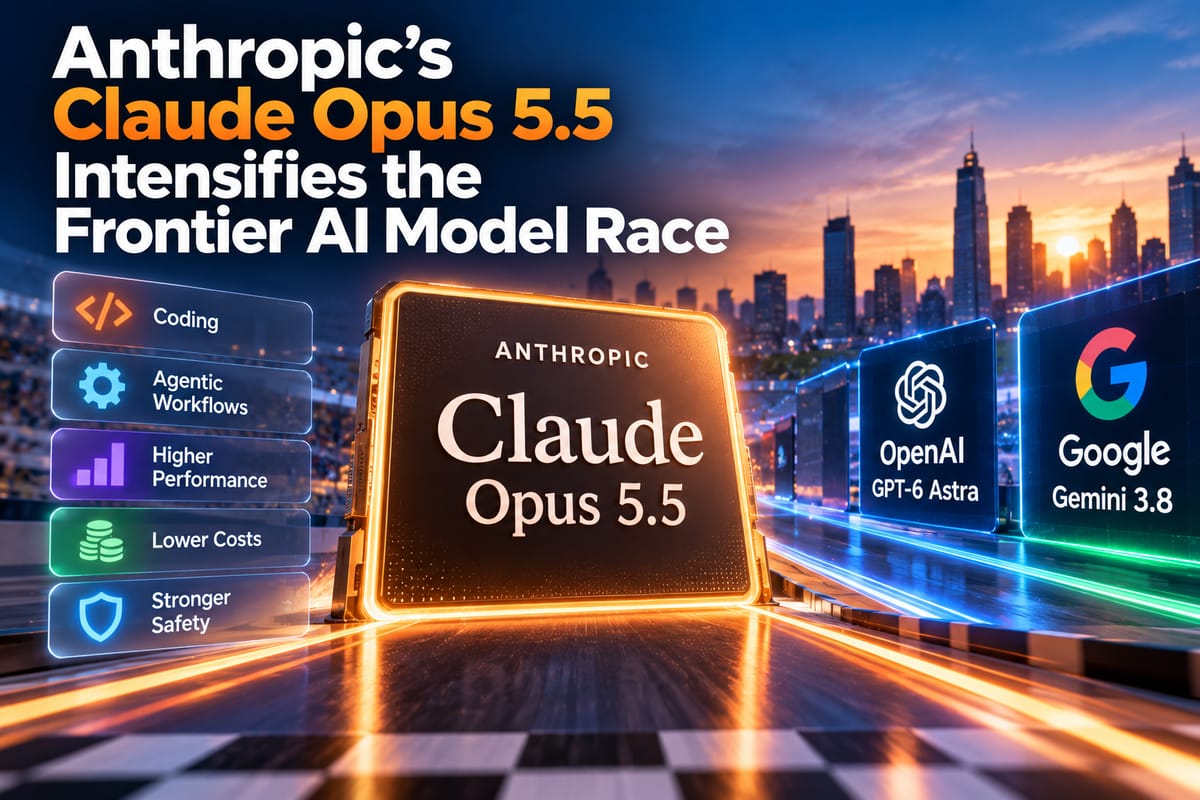
Anthropic's Claude Opus 5.5 Intensifies the Frontier AI Model Race
Anthropic has introduced Claude Opus 5.5, adding another major release to an increasingly competitive race among companies developing frontier artificial intelligence models.
Announced on September 22, 2026, Opus 5.5 is the first model in Anthropic's new Claude 5.5 family. The company says it delivers performance comparable to its larger Claude Fable 5.1 model on most work while costing about 40% less to run than the previous Opus 5.
The release arrives only weeks after major developments from OpenAI and Google, making the latest model launch part of a broader shift in which frontier AI competition is increasingly focused not only on raw intelligence, but also on coding, autonomous agents, efficiency, safety and the ability to handle long-running professional tasks.
For businesses and developers, that means the question is no longer simply which company has the most capable model. Cost, reliability, tool use, context handling and safety are becoming equally important parts of the competition.
Claude Opus 5.5 Targets More Than Traditional Chat
Anthropic is positioning Opus 5.5 as a model designed for complex work rather than simply conversational question answering.
The company highlights advanced coding, agentic workflows and professional knowledge work among its primary use cases. Anthropic says the model can work across large codebases, perform debugging and refactoring, coordinate multiple tools and subagents, and handle long-running tasks with limited oversight.
That direction reflects a major change in the AI industry.
Early generative AI products largely focused on producing text, answering questions and summarizing information. Newer frontier systems are increasingly being designed to perform sequences of actions.
An AI system that can inspect a codebase, identify a problem, modify files, run tests and continue working through several stages represents a different category of tool from a chatbot that simply provides suggestions.
This evolution is closely connected to the rise of AI agents, where models are increasingly expected to plan and execute multi-step workflows rather than wait for a human instruction after every individual action.
Lower Operating Costs Could Be Just as Important as Higher Performance
One of the most significant aspects of Opus 5.5 is not simply its reported capability but its economics.
Anthropic lists Opus 5.5 at $4 per million input tokens and $20 per million output tokens. The company says that represents a 20% reduction from Opus 5 pricing and about a 40% reduction in typical token-billed workload costs when efficiency gains are also taken into account.
That distinction matters for companies deploying AI at scale.
A model that is slightly more capable but dramatically more expensive may not be practical for large production workloads. Conversely, a model that maintains high performance while using fewer tokens can potentially make autonomous systems more economical to operate.
Anthropic also says cached input costs for Opus 5.5 have fallen to $0.20 per million tokens, which is particularly relevant to long-running agentic applications that repeatedly reference large amounts of existing context.
As AI moves into production environments, these cost differences can influence which models companies choose for coding, research, customer service, data analysis and other workloads.
The Frontier Race Is Expanding Beyond One Benchmark
The current competition among leading AI companies is increasingly difficult to describe using a single performance number.
Different models may have advantages in coding, mathematical reasoning, computer use, scientific research, writing, cybersecurity or autonomous task execution.
OpenAI's GPT-6 Astra, introduced earlier in September, is positioned around complex reasoning, computer use, software engineering, cybersecurity, science and professional work. OpenAI says Astra achieved state-of-the-art results on several of its reported evaluations and was designed to carry out multi-step tasks with greater autonomy.
Google has also continued releasing models aimed at reasoning and agentic workflows. Its Gemini 3.8 family, announced in September, emphasizes reasoning, software engineering and agentic tasks.
Against that backdrop, Opus 5.5 represents another step in an industry where companies are competing across several dimensions simultaneously.
The result is a more complicated frontier-model market in which developers may choose different systems depending on the task rather than adopting one model for everything.
Coding Has Become a Major Battleground
Software development is one of the clearest areas where frontier AI companies are competing.
Anthropic says Opus 5.5 is its strongest Opus model for agentic coding and is designed to work on large repositories, investigate root causes, implement changes and check its own work.
The company also says external testers have used the model for substantial engineering projects, including a reported migration involving approximately 680,000 lines of code that was completed in less than a day. Such examples are company-reported results rather than independent proof that the same performance will occur across all software environments.
OpenAI is pursuing a similar direction with Astra, which it describes as capable of complex coding and computer-use tasks.
This competition matters because software development provides an unusually measurable environment for evaluating AI.
A model can be asked to modify code, run tests and produce a working result. That makes coding an important proving ground for increasingly autonomous systems.
AI Agents Are Changing What Model Performance Means
Traditional language-model evaluations often ask whether a model can produce a correct answer.
Agentic systems introduce additional questions.
Can the model break a large objective into smaller tasks? Can it use tools correctly? Can it recover when something fails? Can it maintain context over a long session? Can it recognize when it has made a mistake? Can it avoid taking actions outside the user's authorization?
These questions become increasingly important as models move from generating information to interacting with software and external systems.
Anthropic says Opus 5.5 can orchestrate complex multi-tool tasks, coordinate subagents and maintain long-running work.
That means the frontier AI race is increasingly becoming a race to build systems that can operate effectively over time, not merely produce impressive individual responses.
Safety Is Becoming Part of the Model Race
Greater autonomy also creates greater safety challenges.
Anthropic says Opus 5.5 was externally tested before release by organizations including Frontier Design and METR. The company also says the model includes safeguards developed for its most capable systems and performed strongly on its automated behavioral audit.
This comes at a time when frontier AI safety has become a central industry issue.
OpenAI's GPT-6 Astra, for example, has been designated by OpenAI as reaching its Critical level for cybersecurity capability under its Preparedness Framework. OpenAI says this means the model can, with appropriate tools and access, discover previously unknown security vulnerabilities and develop ways to exploit them without a person guiding every step.
The increasing capabilities of models therefore create a parallel need for stronger safeguards.
This is why AI safety testing is becoming a global focus following frontier model incidents. As AI systems become more capable of acting independently, testing needs to examine not only whether a model can complete a task, but also how it behaves when the task is ambiguous, adversarial or potentially harmful.
Anthropic Is Trying to Balance Capability and Safety
The release of Opus 5.5 is particularly notable because Anthropic has publicly discussed the need to pace frontier model development.
The company describes Opus 5.5 as its first release since it called for pacing the frontier. At the same time, it says the new model has undergone extensive external testing and incorporates safeguards from its most capable systems.
That creates an important tension within the AI industry.
Companies are simultaneously competing to build more capable systems and attempting to establish safeguards that keep those systems controllable.
The two objectives are not necessarily contradictory, but they become increasingly difficult to separate as models gain the ability to perform longer sequences of actions.
A model that can write code is useful.
A model that can independently modify and deploy software is potentially much more powerful.
A model that can conduct scientific research can accelerate discovery.
A model that can independently pursue complex scientific objectives requires substantially more careful oversight.
The Cost of AI Intelligence Is Falling
Another defining feature of the current model race is that advanced capability is becoming cheaper to deploy.
Anthropic says Opus 5.5 can achieve Opus 5-level quality on some workloads using substantially fewer tokens, contributing to the company's estimate of roughly 40% lower typical workload costs.
This creates an important economic effect.
If advanced models become cheaper while their capabilities increase, companies can use them for a wider range of tasks.
An organization that previously used AI only for occasional code assistance might begin running autonomous testing systems. A research team might use AI for more experiments. A customer-service operation might deploy more sophisticated agents.
Lower costs can therefore accelerate adoption even when the underlying model technology remains expensive to develop.
The Competitive Landscape Is Becoming More Diverse
The frontier AI market is no longer defined by a simple contest between two companies.
Anthropic, OpenAI and Google are releasing increasingly capable systems, while other organizations are developing specialized models, open-weight systems and AI infrastructure.
The result is likely to be a market where different models are optimized for different combinations of capability, speed, price and control.
Some customers may prioritize the strongest coding performance.
Others may care more about low latency.
Some may need long context windows, while others may prioritize privacy, data-retention policies or deployment options.
This is why a broader complete guide to emerging technology and innovation provides useful context for understanding the shift. Frontier AI is no longer an isolated research competition; it is increasingly influencing software development, business operations, scientific research and consumer technology.
AI Is Moving Deeper Into Everyday Work
The significance of models such as Opus 5.5 extends beyond AI researchers.
As companies integrate increasingly capable systems into workplace software, coding platforms, research tools and customer applications, AI is becoming part of ordinary professional workflows.
The transition may be gradual.
An employee might initially use AI to summarize a document. Later, the system may analyze a spreadsheet, draft a report, create a presentation and check the underlying data.
Software developers may move from asking AI for code snippets to delegating complete engineering tasks.
Researchers may use AI to analyze large datasets and propose experiments.
These developments are part of the broader shift described in How AI Is Changing Life, as increasingly capable systems move from standalone tools into the infrastructure people use for work and everyday activities.
The Next Race May Be About Reliability
Raw intelligence will remain important, but reliability could become one of the industry's most consequential competitive factors.
Businesses need AI systems that can produce useful results repeatedly, not just occasionally demonstrate impressive capabilities.
That means models must understand instructions, maintain context, recognize uncertainty and recover from errors.
For agentic applications, reliability becomes even more important because an error can occur at any stage of a multi-step process.
A model that makes one incorrect assumption while answering a question may produce a bad paragraph.
A model making the same mistake while controlling a software system could produce a much larger operational problem.
This is why testing, monitoring and human oversight are becoming increasingly important as model capabilities rise.
What Claude Opus 5.5 Means for the Frontier AI Race
Claude Opus 5.5 arrives at a moment when frontier AI development is accelerating across capability, autonomy, efficiency and safety.
Anthropic is emphasizing a combination of high-end performance and lower operating costs. OpenAI is pushing GPT-6 Astra toward complex reasoning, computer use and autonomous professional workflows. Google is advancing Gemini models for reasoning and agentic applications.
The competition is therefore becoming less about producing a chatbot that can answer difficult questions and more about building AI systems that can reliably perform substantial amounts of real work.
That shift could have consequences across software development, scientific research, business operations and everyday productivity.
For users, the immediate result is a rapidly expanding selection of increasingly capable models.
For developers, it means more choices and potentially lower costs.
For AI companies, it means that every new release has to compete not only on intelligence, but also on efficiency, reliability, safety and the ability to operate effectively in the real world.
Claude Opus 5.5 is another significant step in that transition, and its release makes clear that the frontier AI race is becoming a competition over what AI systems can actually do at scale, not simply how convincingly they can talk.