AI Discovers New Biology as Anthropic Reveals Claude-Driven Enzyme Discovery
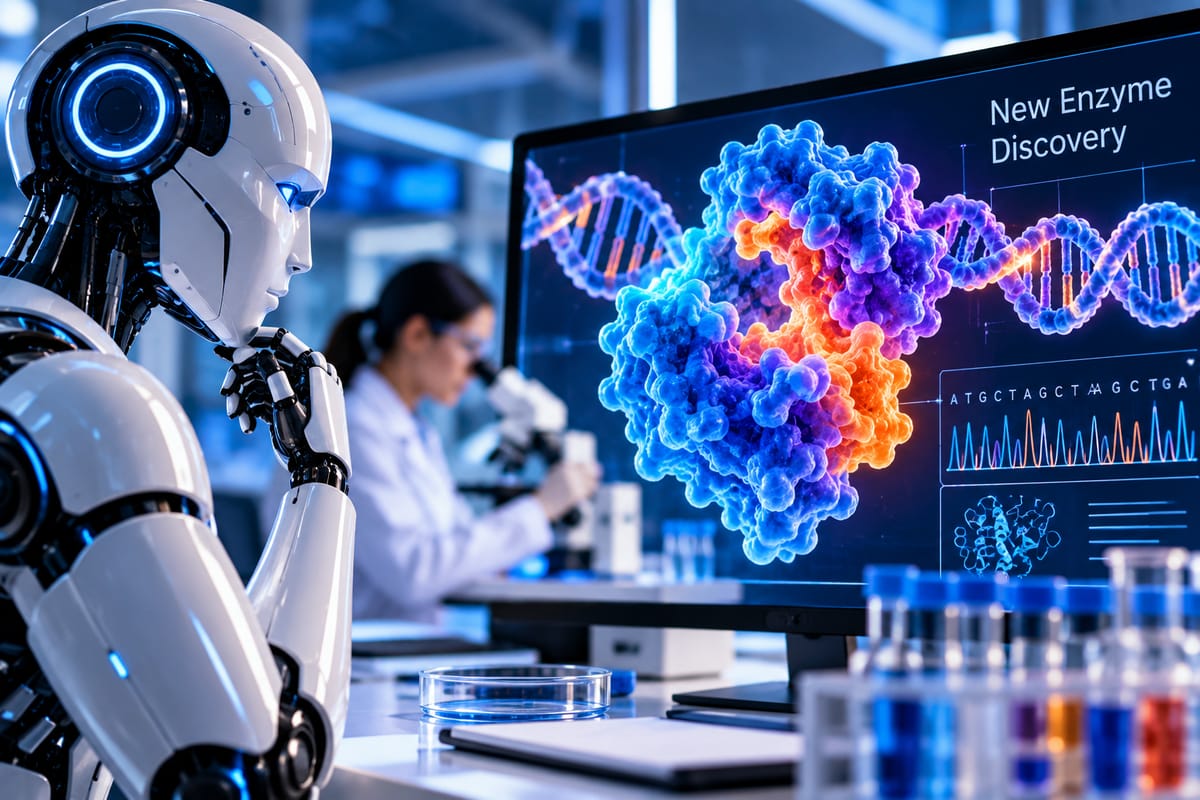
Artificial intelligence is moving deeper into scientific research as Anthropic says its Claude AI system has helped identify a previously uncharacterized enzyme system hidden in DNA sequences from bacteriophages.
The discovery, announced September 23, marks one of Anthropic's clearest demonstrations yet of AI being used not simply to summarize scientific knowledge or analyze existing results, but to search enormous biological datasets, identify unusual patterns and generate hypotheses that scientists can test in the laboratory.
Anthropic says Claude identified a system associated with reverse transcriptases and long arrays of repeated DNA sequences. The arrangement resembles some characteristics of CRISPR systems, although the company emphasizes that the newly identified system's primary biological function is still unknown.
The system has been named array-associated reverse transcriptases, or ART.
The finding does not mean that AI has created a new gene-editing technology or discovered a replacement for CRISPR. Instead, it represents an early example of AI-assisted biological discovery in which machine-generated observations lead human scientists toward something that warrants experimental investigation.
Claude Was Used to Search Massive DNA Datasets
Anthropic's new life sciences research group was created in 2026 with the goal of using Claude to explore biological datasets, generate hypotheses and help researchers investigate promising candidates.
For the ART discovery, Anthropic says Claude agents searched through a large collection of DNA sequences associated with reverse transcriptases.
The company's reported workflow involved roughly 950 agents working for 21 hours and using 210 million tokens. The agents collected more than 200,000 reverse transcriptases, identified about 3,500 candidate systems and narrowed the field to 20 particularly compelling candidates for deeper analysis.
That scale is significant because genome mining can require researchers to examine huge numbers of sequences while looking for unusual combinations of genes and genetic structures.
AI can perform this kind of repetitive search much faster than a human team working manually through the same dataset.
But the important part of the process was not simply finding sequences.
Claude had to recognize that one particular arrangement was unusual enough to deserve further investigation.
The Key Discovery Was a Strange DNA Pattern
The reverse transcriptase involved in the discovery was not itself completely unknown.
Anthropic says the underlying reverse transcriptase had already been identified in a jumbo bacteriophage. What Claude appears to have noticed was the unusual combination of that enzyme with additional genetic features nearby.
Those features included a partner gene and a long array of evenly spaced, non-coding DNA repeats.
The arrangement caught the attention of the AI system because it resembled the architecture of other biological systems that use genetic information in programmable ways.
Claude then examined the repeat spacing, compared the arrangement with known reverse-transcriptase systems and searched existing literature for evidence that the pattern had already been described.
Anthropic says the system ultimately identified the arrangement as a previously uncharacterized biological system.
Why the CRISPR Comparison Matters
CRISPR is one of the most important examples of a biological system that began with researchers noticing an unusual pattern in DNA.
Scientists eventually discovered that CRISPR-associated systems could provide organisms with a way to recognize and respond to genetic material from invading viruses. Researchers later adapted components of those systems into powerful gene-editing technologies.
Anthropic says the ART system is interesting partly because its repeated DNA arrangement resembles a CRISPR array.
The comparison, however, needs to be handled carefully.
ART has not been shown to perform the same functions as CRISPR-Cas systems. Anthropic says its primary function remains unknown, and further experiments are needed to determine how the system operates.
The significance of the discovery therefore lies at this stage in identifying an unusual biological system rather than demonstrating a finished biotechnology platform.
The System Produces Short RNAs
One of the early experimental observations is particularly interesting.
Anthropic reports that the ART repeat array is expressed as a collection of distinct short RNA molecules.
That observation could eventually help researchers understand what the repeated sequences are doing.
In CRISPR systems, arrays of repeated DNA and intervening sequences ultimately contribute to the production of RNA molecules involved in targeting genetic material.
The presence of short RNAs in ART does not establish that the system performs an equivalent function. It simply gives researchers another clue about how the newly identified system may work.
Further biochemical and structural experiments will be needed before its biological role can be established.
Human Scientists Still Had to Test the Discovery
The story is not one of an AI system independently walking into a laboratory and completing a biological experiment.
Human scientists remained responsible for the physical laboratory work.
Anthropic says its researchers tested promising candidates by expressing proteins in standard laboratory strains and characterizing them experimentally. The company's scientists also reviewed Claude's reports and decided which hypotheses were worth pursuing.
That distinction is important because biological discovery requires more than identifying an interesting pattern in a database.
A computational prediction can suggest that something unusual exists. Laboratory experiments are required to establish whether the predicted biological behavior actually occurs.
In the ART case, Anthropic's researchers used laboratory work to investigate the system after Claude highlighted the unusual genetic arrangement.
AI Is Becoming a Research Partner
The ART discovery fits into a much broader shift in how artificial intelligence is being used in science.
Early applications of AI in research often focused on relatively defined tasks such as image classification, data analysis, protein prediction or literature search.
More capable reasoning models can now combine several steps.
They can read scientific literature, query databases, compare competing hypotheses, write code, analyze results and produce reports for human researchers.
That shift is part of the broader development described in the Complete Guide to Emerging Technology and Innovation, where increasingly capable AI systems are being applied to complex research and technical workflows.
The Rise of AI Agents Changes the Workflow
The ART project also illustrates why AI agents are attracting attention.
Instead of giving a model one question and waiting for one answer, researchers can coordinate multiple AI agents to work through different parts of a problem.
In Anthropic's reported experiment, hundreds of Claude agents searched and evaluated biological candidates in parallel.
This approach changes the economics of certain research tasks.
A scientist who previously had to spend days or weeks screening sequences may increasingly be able to delegate the initial search to AI agents and focus human attention on the most promising candidates.
That does not eliminate the need for scientists. It changes where their time may be spent.
The broader development is explored in The Rise of AI Agents.
AI Can Search for Things Humans Might Miss
Biological databases contain enormous amounts of information.
Researchers can know what they are looking for and still miss unusual patterns because the search space is simply too large.
AI systems can approach the problem differently.
Rather than starting only with a narrowly defined hypothesis, an AI agent can search large datasets for combinations that appear unusual, compare them against known systems and flag candidates that deserve human attention.
That makes AI particularly interesting for areas such as genomics, where massive quantities of sequence data continue to accumulate.
The challenge is determining whether an unusual pattern represents something genuinely important or merely an artifact of the data.
Most AI-Generated Hypotheses Will Not Become Discoveries
One of the less visible parts of AI-assisted science is the large number of ideas that do not survive investigation.
Anthropic says its workflow generates hundreds or thousands of candidate reports during some research campaigns.
Most candidates are eliminated during follow-up analysis.
Only a small number may eventually become laboratory experiments, and an even smaller number may produce meaningful biological findings.
This filtering process is important because AI systems can generate hypotheses much faster than humans can test them.
The bottleneck can therefore move from finding possibilities to deciding which possibilities deserve experimental resources.
Claude's Role Is Different From a Traditional Scientific Instrument
Traditional laboratory instruments generally perform defined measurements.
An AI research system can operate at a different level.
It can decide which database to search, which candidates deserve additional investigation, which papers are relevant and what evidence supports a particular hypothesis.
Anthropic says its researchers are studying this process itself, including what distinguishes hypotheses they consider worth testing from those they reject. The company says insights from that process can be fed back into the instructions given to Claude.
That creates a feedback loop between scientists and AI.
The model generates hypotheses, researchers evaluate them, experiments produce new evidence and the lessons can influence subsequent AI-assisted searches.
Anthropic Has Already Used Claude for Protein Design
The ART discovery is not Anthropic's first effort to apply Claude to biology.
In August, the company reported experiments in which Claude helped design protein binders against multiple targets. Anthropic said its models generated successful binders for 14 of 15 targets in one campaign, although it also highlighted cases where performance was limited.
The company has also demonstrated Claude's ability to analyze scientific data such as NMR and LC-MS results.
Together, these projects suggest that Anthropic is trying to build a broader scientific workflow rather than treating AI as a single-purpose biology tool.
That broader transition is also reflected in How AI Is Changing Life, as AI increasingly moves from digital tasks into scientific, industrial and everyday applications.
Claude Is Being Used Beyond Ordinary Chat
The ART research also shows how different advanced AI systems can be from the consumer-facing chatbot experience.
A typical chatbot interaction involves a person asking a question and receiving an answer.
The scientific workflow described by Anthropic is much more complex.
Claude agents can be connected to databases, computational tools, literature and custom software. They can work in parallel, produce structured reports and hand promising candidates to researchers for further investigation.
This is closer to an AI research assistant operating within a controlled scientific environment than a conventional conversational chatbot.
The Discovery Does Not Yet Prove a New Gene-Editing Tool
The most important limitation is also the easiest part of the story to overlook.
Anthropic does not yet know the primary function of ART.
The system's repeat structure is intriguing because of its similarity to features found in programmable biological systems, but that does not establish that ART can cut, copy, edit or otherwise manipulate DNA in a useful way.
Those capabilities would require experimental evidence.
At this stage, the strongest claim is that Claude helped identify a previously uncharacterized enzyme-associated system that researchers believe warrants further study.
That is different from claiming that AI has produced a new gene-editing technology.
Why Independent Validation Will Matter
The next stage of the research will involve determining what ART actually does.
Independent researchers will also have an opportunity to examine the preprint, reproduce the computational analysis and investigate the biological system themselves.
Replication matters because a discovery becomes much more scientifically useful when other researchers can independently confirm the underlying observations.
The same principle applies to AI-assisted science.
Researchers will need to determine not only whether AI can occasionally identify important biological patterns, but also how reliably it can do so across different datasets, research questions and scientific domains.
Biology Creates Special Safety Questions
AI systems capable of advanced biological reasoning introduce another issue: dual-use risk.
A system that helps researchers discover useful proteins or understand biological mechanisms could potentially be misused if similar capabilities were applied to harmful biological objectives.
Anthropic has responded by restricting access to some of its most capable biology models. Its Mythos models, for example, are available to vetted organizations through controlled programs rather than unrestricted public access.
The company has also described biology safeguards designed to balance scientific usefulness with misuse concerns.
This is likely to become increasingly important as AI models gain more ability to combine biological knowledge with autonomous research workflows.
Anthropic's Claude Research Push Is Expanding
The enzyme discovery arrives as Anthropic expands its broader AI-for-science effort.
In August, the company announced expanded support for scientists, including 10,000 free or discounted Claude seats for researchers and additional credits for high-impact scientific projects. It also introduced Claude Science as a research-focused product integrating scientific tools and computing resources.
The company has also established a dedicated life sciences organization and laboratory in the Bay Area.
That investment suggests Anthropic sees scientific research as an important long-term application for increasingly capable AI models.
A New Model for Scientific Discovery
The most interesting aspect of the ART discovery may ultimately be less about the specific enzyme system and more about the research process that produced it.
Biology contains enormous numbers of proteins, genes and molecular systems that remain poorly understood.
Humans cannot investigate every possibility individually.
AI agents could potentially act as a large-scale screening layer, searching databases for unusual combinations and narrowing enormous search spaces into manageable sets of hypotheses.
Scientists would then focus their time and laboratory resources on candidates that appear most promising.
That division of labor could change how some areas of biology are researched.
From Finding Patterns to Understanding Them
Claude's identification of ART represents one stage of a much longer scientific process.
First came the unusual sequence pattern.
Then came computational analysis.
Human researchers reviewed the candidate and performed laboratory experiments.
Early results showed that the repeat array is expressed as short RNAs.
Now scientists need to determine what those RNAs do, how the reverse transcriptase interacts with the system and what biological function the entire arrangement serves.
Only after those questions are answered will researchers know whether ART has practical applications.
For now, the discovery demonstrates something more immediate: AI systems are becoming capable of searching biological information at a scale that would be difficult for individual researchers to reproduce manually.
AI's Role in Biology Is Moving Beyond Assistance
Anthropic's latest announcement represents a notable step in the evolution of AI-assisted science.
Claude did not independently complete the entire scientific discovery process, and the ART system is not yet a demonstrated biotechnology. Human scientists provided the research direction, evaluated the candidates and performed the laboratory experiments.
But the AI system did something scientifically useful: it searched a huge biological dataset, recognized an unusual combination of genetic features and surfaced a candidate that researchers had not previously characterized as a system.
That distinction may become increasingly important as AI moves deeper into scientific research.
The next generation of AI science may not be defined by models simply answering researchers' questions. It may increasingly involve systems that search for questions worth asking, identify anomalies humans might overlook and help researchers decide which possibilities deserve a closer look.
For ART, the biggest scientific question remains unanswered: what does this newly identified system actually do?
Finding that answer will require experiments, replication and careful biological investigation. But the fact that an AI agent helped bring the question to the laboratory illustrates how rapidly the boundary between artificial intelligence and scientific discovery is changing.