How Replacement Coverage Works for Products
Buying a product often comes with an expectation that it will continue working as intended for a reasonable period of time. When something goes wrong, however, the question quickly becomes more complicated: Will the manufacturer repair it, replace it, refund the purchase, or leave the customer responsible for the cost?
Replacement coverage is one way companies address that question. It can provide a replacement product when an eligible item is defective, damaged under specific circumstances, or otherwise meets the terms of a particular coverage program.
The exact rules vary considerably between products and providers. Understanding how replacement coverage works can help shoppers compare products more carefully and know what to expect when something goes wrong.
What Is Replacement Coverage?
Replacement coverage is a protection or service arrangement under which an eligible product may be replaced when certain conditions are met.
Depending on the product and provider, replacement may occur because of:
- A manufacturing defect
- A covered mechanical or electrical failure
- Certain accidental damage
- A product that cannot reasonably be repaired
- A qualifying failure during a specified coverage period
- A special replacement program offered by the manufacturer or retailer
Replacement coverage is not automatically included with every purchase. It may be part of a manufacturer's warranty, an extended protection plan, an insurance-like service contract, or a separate program.
That is why consumers should examine the actual terms rather than assuming that every product comes with the same level of protection.
Replacement Coverage vs. a Warranty
Replacement coverage and warranties are closely related, but they are not necessarily identical.
A warranty generally describes a manufacturer's or seller's commitment concerning the condition, performance, or repair of a product for a specified period.
Some warranties provide repair as the primary remedy. Others may allow the manufacturer to replace the product if a covered problem cannot be resolved.
A replacement plan, meanwhile, may be specifically structured around replacing the product when certain conditions are met.
Understanding the distinction is particularly important with electronics. How Electronics Warranties Actually Work explains how warranty coverage can vary depending on the product, provider, and type of problem.
How Replacement Coverage Usually Works
Although programs differ, the process commonly follows several steps.
1. The Product Develops a Problem
The process generally begins when the customer notices a failure or condition covered by the relevant agreement.
The issue could be something as simple as a device that stops powering on or a component that fails during normal use.
The customer usually needs to determine whether the problem falls within the coverage terms.
2. The Customer Submits a Claim
The next step is usually contacting the manufacturer, retailer, protection-plan provider, or another responsible company.
The provider may request:
- Proof of purchase
- Product model and serial number
- Description of the problem
- Photographs or videos
- Troubleshooting information
- Date of purchase
- Details about how the product was used
Some programs allow claims to be submitted online, while others use telephone or in-person support.
3. The Provider Reviews the Claim
The provider may determine whether the reported problem qualifies for coverage.
This can involve troubleshooting, inspection, diagnostic testing, or review of the product's condition.
If the issue is outside the terms of the agreement, the replacement request may be denied.
4. A Replacement Is Authorized
If the claim qualifies, the provider may authorize a replacement.
The replacement may be identical to the original product, a comparable model, or another product specified by the coverage terms.
5. The Original Product May Need to Be Returned
Many programs require customers to send the defective product back before receiving a replacement or within a specified period afterward.
The provider may supply return packaging or shipping instructions.
Consumers should follow those instructions carefully because failing to return the original item could result in additional charges under some programs.
What Products Can Have Replacement Coverage?
Replacement programs exist across many categories.
They can apply to products such as:
- Smartphones
- Computers
- Tablets
- Appliances
- Cameras
- Home electronics
- Tools
- Furniture
- Certain household equipment
- Specialized consumer products
The availability and terms depend on the manufacturer, retailer, product category, and coverage program.
Some products may have straightforward warranty replacement procedures, while others may require extensive inspection before a replacement is approved.
What Does Replacement Coverage Usually Include?
The answer depends entirely on the agreement.
Coverage may include certain defects or failures that occur during normal use. Some protection plans go further and cover specific accidental events.
For example, an electronics protection plan might cover accidental damage, while a standard manufacturer's warranty may exclude it.
Consumers should therefore look for specific language explaining:
- Covered problems
- Covered causes of damage
- Coverage duration
- Replacement eligibility
- Deductibles or service fees
- Shipping costs
- Exclusions
- Claim limits
- Replacement-product requirements
The word "replacement" alone does not explain the full level of protection.
What Replacement Coverage Usually Does Not Include
Many coverage programs exclude certain situations.
Common exclusions can include:
- Intentional damage
- Normal wear and tear
- Cosmetic damage that does not affect functionality
- Unauthorized modifications
- Improper installation
- Misuse
- Damage caused by certain environmental conditions
- Lost or stolen products
- Problems caused by accessories or third-party components
These exclusions vary considerably.
For example, a product may be covered against manufacturing defects but not accidental damage. Another plan may specifically include accidental damage while excluding loss or theft.
Reading the exclusions can therefore be just as important as reading the benefits.
Replacement Coverage and Accidental Damage
Accidental damage is one of the areas where replacement coverage can differ significantly from a standard warranty.
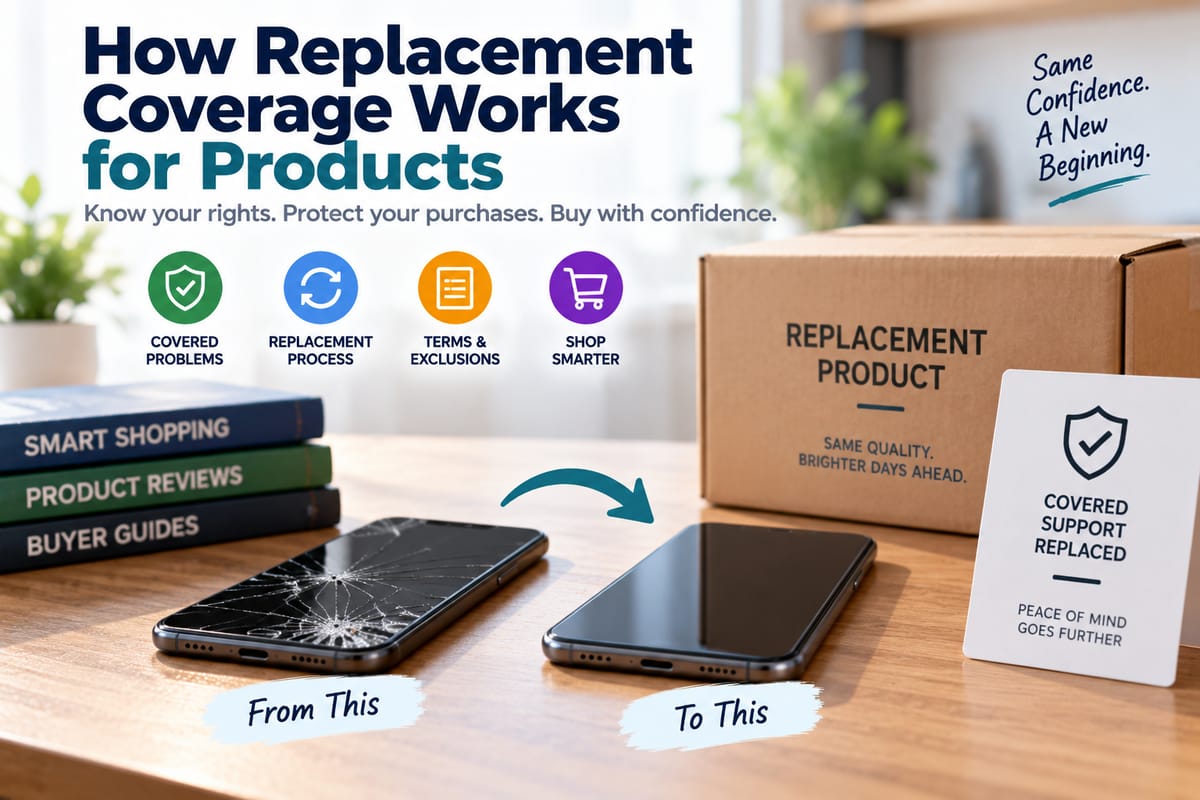
Imagine a smartphone stops working because of a manufacturing defect. A manufacturer's warranty might cover the problem.
If the same phone is dropped and the screen breaks, the standard warranty may not cover it.
A separate protection plan might cover accidental damage, depending on its terms.
Consumers should not assume that a warranty automatically protects against accidents.
Replacement Coverage and Product Returns Are Different
Replacement coverage should also be distinguished from a return policy.
A return policy generally gives customers a defined period during which they can return a product under specific conditions. The reason might be that the customer changed their mind, ordered the wrong item, or received a product that did not meet expectations.
Replacement coverage usually addresses a product problem after purchase, subject to the terms of the relevant warranty or protection agreement.
How Product Return Policies Work provides a broader explanation of how return rules operate and why they can differ from warranty or replacement arrangements.
A product could therefore be outside its return period while still being covered by a warranty.
Replacement vs. Repair
Replacement is not always the first remedy.
Some warranties and protection plans give the provider the option to repair the product before replacing it.
For example, a laptop with a defective component might be repaired rather than replaced entirely.
The terms may also allow the provider to choose between repair, replacement, or another remedy.
Consumers should check whether the agreement guarantees replacement or simply permits replacement under certain circumstances.
Are Replacement Products New?
Not necessarily.
Depending on the program, a replacement product could be:
- New
- Refurbished
- Reconditioned
- Equivalent to the original
- A comparable current model
Some programs specifically state what type of replacement customers can expect.
This can matter when a discontinued product is being replaced. A manufacturer may no longer have the original model available and could provide a newer or comparable model instead.
What Happens When the Original Product Is Discontinued?
Products do not remain available forever.
If a covered product is discontinued, the provider may replace it with a comparable product according to the terms of the agreement.
The replacement may have different specifications, features, dimensions, or accessories.
Consumers should therefore look for language describing what happens when the original model is unavailable.
How Long Does Replacement Coverage Last?
Coverage periods vary widely.
Some products may have relatively short warranty periods, while certain protection plans can extend coverage for several years.
The important date is usually the beginning of the coverage period, which may be tied to the purchase date or another qualifying event.
Some plans also impose limits on the number of claims or replacements that can be made.
A consumer should know both how long coverage lasts and what can be claimed during that period.
Does Replacement Coverage Cost Extra?
Sometimes.
Basic warranty protection may be included with the product at no separate charge.
Extended warranties and protection plans may require an additional purchase. Some plans may also require a deductible, service fee, shipping charge, or other payment when a claim is made.
The total cost should be considered when evaluating whether additional coverage provides meaningful value.
How Replacement Coverage Can Affect Product Value
Replacement coverage can be one factor in evaluating the overall value of a product.
Two products with similar purchase prices may provide very different levels of protection.
One might have a longer warranty, easier replacement process, or broader coverage. Another might have a lower initial price but require customers to pay more for additional protection.
When The Complete Guide to Choosing the Right Products is used as a framework for evaluating purchases, warranty and replacement terms can be considered alongside price, features, durability, and customer support.
Why Product Reliability Still Matters
Replacement coverage should not be viewed as a substitute for buying a reliable product.
A replacement plan can reduce the financial impact of certain failures, but frequent problems can still create inconvenience. Customers may have to file claims, ship products, wait for replacements, reinstall software, or transfer data.
Reliability therefore remains an important consideration before purchase.
The Complete Guide to Evaluating Product Reliability Before Buying provides a broader framework for considering durability, failure risks, product history, and other reliability factors.
What to Check Before Buying Replacement Coverage
Before paying for additional protection, review the terms carefully.
Important questions include:
- How long does the coverage last?
- What types of failures are covered?
- Is accidental damage included?
- Are there deductibles or service fees?
- Is there a limit on the number of claims?
- Will the provider repair or replace the product?
- Are replacement products new or refurbished?
- Who pays return shipping?
- What exclusions apply?
- What happens if the original model is discontinued?
These questions can reveal significant differences between plans that initially appear similar.
What to Do When a Replacement Is Needed
When a product fails, start by reviewing the purchase documentation and applicable coverage terms.
Gather the receipt, order confirmation, serial number, model information, and any other documents that may be required.
Avoid attempting unauthorized repairs before contacting the provider. Opening a product or modifying it could affect eligibility under certain warranty terms.
Follow the provider's troubleshooting and claim instructions carefully.
If a replacement is approved, keep records of the claim, shipping information, and communications until the matter is fully resolved.
Replacement Coverage Is Part of the Buying Decision
Replacement coverage is more than a benefit that matters after a product fails. It can also be part of the purchasing decision itself.
Consumers who understand the difference between warranties, return policies, protection plans, and replacement programs are better positioned to compare the actual protection attached to different products.
The key is to look beyond the word "replacement" and examine the details: what is covered, how long coverage lasts, what exclusions apply, whether repair comes first, what fees may apply, and what type of replacement the provider promises.
Those details can determine how much practical protection a product purchase actually provides when something goes wrong.