What Is a Data Warehouse for Business?
Modern businesses generate enormous amounts of data every day. Sales transactions, customer interactions, website activity, inventory records, financial information, employee data, and operational systems all create valuable information. The challenge is not simply collecting that data. It is making it available in a form that businesses can actually use.
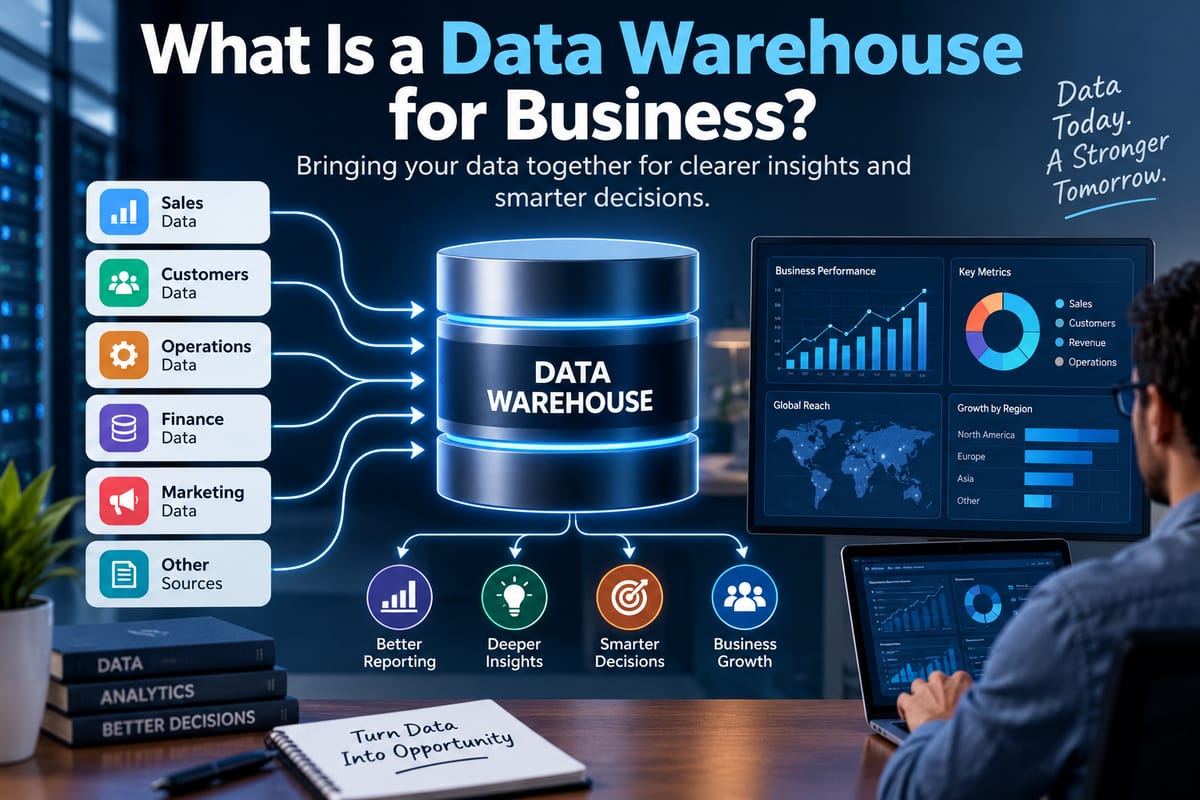
A data warehouse is a technology system designed to bring data from multiple sources into a centralized environment where it can be stored, organized, analyzed, and used for reporting and decision-making.
Instead of forcing employees to search through separate operational systems, a data warehouse can provide a consolidated view of important business information. This makes it easier to identify trends, compare performance, understand customers, monitor operations, and support strategic planning.
Data warehouses have become an important part of modern business technology because organizations increasingly depend on data to understand what is happening across their operations.
What Is a Data Warehouse?
A data warehouse is a centralized data storage and analysis environment that collects information from multiple sources and organizes it for business reporting and analysis.
The sources feeding a data warehouse might include:
- Sales systems
- Customer relationship management platforms
- Enterprise resource planning systems
- E-commerce platforms
- Accounting software
- Marketing platforms
- Websites and mobile applications
- Inventory systems
- Human resources systems
- Operational databases
- External data sources
The data is typically extracted from these systems, transformed into a consistent format, and loaded into the warehouse.
This process allows information that was originally stored in separate systems to be analyzed together.
For example, a retailer could combine sales data, customer information, website activity, and inventory records. Analysts could then examine whether particular marketing campaigns increased sales and whether the business had enough inventory to meet the resulting demand.
Why Do Businesses Need Data Warehouses?
Operational systems are generally designed to support everyday business activities.
A sales database, for example, needs to process orders quickly. An accounting system needs to record financial transactions accurately. A customer service platform needs to help employees manage customer interactions.
These systems are not always designed for large-scale historical analysis.
A data warehouse provides a separate environment optimized for analytical workloads.
This separation can offer several benefits:
- Centralized information
- Consistent reporting
- Historical analysis
- Faster analytical queries
- Integration of multiple data sources
- Improved business visibility
- More reliable performance reporting
Rather than asking each operational system to answer complex analytical questions, businesses can move analytical workloads into a dedicated data environment.
How Does a Business Data Warehouse Work?
A typical data warehouse follows a series of steps.
1. Data Is Collected
Information is gathered from different business systems and other sources.
For example, a company might collect information from its CRM, accounting platform, online store, advertising systems, and inventory database.
2. Data Is Extracted
Data is extracted from the source systems using data integration processes.
The extraction process may happen on a scheduled basis or continuously, depending on the architecture and business requirements.
3. Data Is Transformed
Information from different systems may use different names, formats, units, or structures.
Transformation processes can standardize the information before it enters the warehouse.
For example, one system might identify a customer using Customer_ID, while another uses Client_Number. Data transformation can help create a consistent structure.
4. Data Is Loaded
The prepared information is loaded into the data warehouse.
Once it is available there, it can be queried and analyzed alongside information from other sources.
5. Data Is Analyzed
Business users, analysts, reporting systems, and business intelligence tools can access the warehouse to create reports, dashboards, and analytical models.
This process turns raw business information into a resource for understanding performance and making decisions.
Data Warehouses and Databases
A data warehouse is closely related to a database, but the two are not necessarily designed for the same purpose.
A traditional operational database is often optimized for transaction processing. It needs to efficiently handle activities such as creating orders, updating customer records, processing payments, and changing inventory levels.
A data warehouse is generally optimized for analytical processing.
Analytical queries may involve millions or billions of records and ask questions such as:
- How have sales changed over five years?
- Which customer segments generate the most revenue?
- Which products have declining demand?
- What regions are growing fastest?
- How does performance compare between quarters?
Businesses can learn more about the broader role of databases through The Complete Guide to Databases.
Data Warehouse vs. Operational Database
The difference becomes clearer when considering how each system is used.
| Data Warehouse | Operational Database |
|---|---|
| Designed primarily for analysis | Designed primarily for transactions |
| Often stores historical data | Often focuses on current operational data |
| Combines information from multiple sources | Usually supports a particular application or process |
| Supports complex analytical queries | Supports frequent transactional operations |
| Used by analysts and reporting systems | Used by applications and operational employees |
| Optimized for analytical workloads | Optimized for transactional workloads |
Many businesses need both.
An operational database can support everyday business activities while a data warehouse provides a broader analytical view of the organization's information.
What Kind of Data Goes Into a Data Warehouse?
The information stored in a business data warehouse depends on the organization's goals.
Common categories include:
Sales Data
Sales information can include orders, products, prices, discounts, customers, locations, sales representatives, and transaction dates.
Customer Data
A warehouse may contain information about customer accounts, purchases, interactions, demographics, and customer segments.
Financial Data
Organizations can integrate revenue, expenses, invoices, payments, budgets, and other financial information.
Marketing Data
Marketing data can include campaigns, advertising activity, website visits, leads, conversions, and customer acquisition information.
Operations Data
Operational information might include inventory, production, logistics, suppliers, and fulfillment activity.
Employee Data
Depending on access controls and organizational requirements, companies may also analyze workforce information such as departments, staffing levels, compensation categories, or workforce trends.
Bringing these different datasets together can reveal relationships that are difficult to identify when each system is examined separately.
What Is ETL?
One traditional approach to loading data into a warehouse is called ETL, which stands for:
Extract → Transform → Load
The process begins by extracting information from source systems.
The information is then transformed. This can involve cleaning records, changing formats, standardizing values, removing duplicates, and applying business rules.
Finally, the transformed information is loaded into the data warehouse.
ETL has been widely used in data integration architectures for many years.
What Is ELT?
Modern cloud data platforms have also made ELT increasingly common.
ELT stands for:
Extract → Load → Transform
Instead of performing all transformations before loading the information, data is first loaded into the target environment and transformed there.
This approach can take advantage of the processing capabilities of modern cloud data platforms.
The choice between ETL and ELT depends on factors such as the organization's architecture, data volumes, security requirements, tools, processing needs, and operational processes.
Data Warehouses and Business Intelligence
Data warehouses often serve as a foundation for business intelligence, or BI.
Business intelligence systems use data to create reports, dashboards, visualizations, and analytical views that help people understand organizational performance.
For example, a sales dashboard could use warehouse data to show:
- Revenue by region
- Sales by product
- Monthly growth
- Customer acquisition
- Conversion rates
- Sales performance against targets
The warehouse provides the underlying information, while BI tools can provide an accessible interface for exploring it.
For a broader look at this relationship, How Business Intelligence Helps Businesses Make Better Data-Driven Decisions explains how organizations use business intelligence to turn information into actionable insights.
Data Warehouses and Data Analytics
Data analytics goes beyond basic reporting.
A business might use warehouse data to investigate why sales declined, identify high-value customer groups, evaluate marketing performance, or detect operational patterns.
Different forms of analytics can be applied to warehouse information.
Descriptive Analytics
Descriptive analytics focuses on what has already happened.
Examples include:
- Monthly sales reports
- Revenue dashboards
- Customer counts
- Inventory reports
- Historical performance measurements
Diagnostic Analytics
Diagnostic analytics explores why something happened.
For example, an organization could investigate why sales declined in a particular region.
Predictive Analytics
Predictive analytics uses historical information and statistical or machine learning techniques to estimate potential future outcomes.
A retailer might use historical purchasing patterns to estimate future demand.
Prescriptive Analytics
Prescriptive analytics explores potential actions based on available information and possible outcomes.
The more effectively a business organizes its information, the easier it can be to perform these types of analysis.
Businesses can explore this broader subject in The Complete Guide to Data Analytics for Business.
What Is a Data Warehouse Schema?
A schema defines how information is organized inside a data warehouse.
One common approach uses fact tables and dimension tables.
Fact tables generally contain measurable business events or transactions. Examples include sales amounts, quantities, costs, or order counts.
Dimension tables provide descriptive information about those events. They might contain information about customers, products, locations, employees, or dates.
For example, a sales fact table could contain:
- Product ID
- Customer ID
- Store ID
- Date ID
- Quantity
- Revenue
Dimension tables could then provide the descriptive details associated with each identifier.
This structure makes it possible to analyze business activity from different perspectives.
What Is a Data Mart?
A data mart is a smaller analytical data environment focused on a particular business function, department, or subject.
For example, an organization could create:
- A sales data mart
- A marketing data mart
- A finance data mart
- An inventory data mart
A data mart may be created from information in a larger enterprise data warehouse or through another data architecture.
The goal is generally to provide users with focused access to information relevant to their responsibilities.
Cloud Data Warehouses
Traditional data warehouses were often hosted on an organization's own hardware.
Cloud computing has changed how many businesses build and operate analytical data platforms.
Cloud data warehouses can provide scalable computing and storage resources without requiring an organization to purchase and maintain all of the underlying physical infrastructure itself.
Businesses can often scale resources according to their analytical workloads, although costs still need to be carefully managed.
Cloud-based platforms can also make it easier to integrate data from applications, SaaS platforms, APIs, and other online services.
Benefits of a Business Data Warehouse
A well-designed data warehouse can provide several practical advantages.
A Centralized View of Business Information
Instead of examining isolated systems, employees can access information that has been brought together into a common analytical environment.
Better Historical Analysis
Warehouses can preserve historical information, allowing businesses to compare performance across months, quarters, and years.
More Consistent Reporting
Centralized data definitions can reduce situations where different departments produce conflicting versions of the same business metric.
Improved Analytical Performance
Data warehouses are designed for analytical workloads, allowing complex queries to run without placing the same burden on transactional systems.
Easier Cross-Department Analysis
A company can combine information from sales, marketing, finance, operations, and customer systems to develop a broader understanding of its business.
Better Support for Decision-Making
When reliable information is accessible, managers and analysts have more evidence available when evaluating business performance and planning future activities.
Challenges of Building a Data Warehouse
A data warehouse can be valuable, but creating one is not simply a matter of buying technology and connecting databases.
Businesses may face challenges involving:
- Data quality
- Integration complexity
- Legacy systems
- Data duplication
- Inconsistent definitions
- Security
- Privacy
- Governance
- Storage costs
- Computing costs
- Maintenance
- User access
- Data modeling
A warehouse containing inaccurate or inconsistent information can produce reports that look precise while still being misleading.
This is why data management is an important part of the process.
The Importance of Data Quality
A data warehouse is only as useful as the information it contains.
Poor-quality data can include:
- Duplicate records
- Missing values
- Incorrect dates
- Invalid identifiers
- Inconsistent customer names
- Incorrect product categories
- Outdated information
Businesses therefore need processes for monitoring and improving data quality.
Data validation, cleansing, standardization, monitoring, and governance can all contribute to more reliable analytical information.
Data Governance and Security
Business data can contain sensitive or commercially important information, making governance and security essential.
Organizations may need controls governing:
- Who can access particular datasets
- Which employees can modify information
- How sensitive data is protected
- How long information is retained
- How data is classified
- How data usage is monitored
- How regulatory requirements are addressed
Access should generally be based on business responsibilities and organizational policies.
A data warehouse should not become a single location where everyone automatically has access to every piece of company information.
Data Warehouses and a Single Source of Truth
Businesses sometimes describe a well-managed data warehouse as a single source of truth.
The phrase does not mean that every piece of company information must exist in one system.
Instead, it generally refers to creating a trusted and consistently defined analytical source for important business metrics.
For example, a company might establish a standardized definition of “monthly revenue” so that finance, sales, and management dashboards use the same underlying logic.
This can reduce disagreements caused by different departments calculating the same metric in different ways.
How Businesses Use Data Warehouses
The applications of data warehouses vary widely between organizations.
A retailer might use one to understand purchasing behavior and inventory demand.
A financial organization might analyze transactions, customer activity, and financial performance.
A manufacturer could combine production, supply chain, inventory, and sales information.
An online company might analyze website activity, subscriptions, customer engagement, and revenue.
A logistics company could examine deliveries, routes, fuel consumption, and operational performance.
In each case, the underlying principle is similar: bring relevant information together so it can be analyzed more effectively.
What Makes a Data Warehouse Effective?
Technology alone does not determine whether a data warehouse succeeds.
An effective warehouse usually depends on several factors working together:
- Clear business objectives — The organization should understand what questions the warehouse needs to answer.
- Reliable data sources — Source systems need to provide usable information.
- Strong data integration — Data should move between systems consistently.
- Well-designed data models — Information should be structured in a way that supports analytical needs.
- Data governance — Definitions, ownership, quality, and access need to be managed.
- Security controls — Sensitive information needs appropriate protection.
- Good documentation — Users should understand what datasets and metrics mean.
- Ongoing monitoring — Pipelines and data quality should be regularly checked.
- User adoption — Employees need practical ways to use the information.
- Cost management — Storage and computing resources should be monitored as usage grows.
Data Warehouse vs. Data Lake
Data warehouses and data lakes are sometimes confused because both can store large amounts of information.
A data warehouse generally focuses on structured, prepared, and organized data intended for analysis and reporting.
A data lake can store a broader variety of information, including structured, semi-structured, and unstructured data.
For example, a data lake could contain raw logs, documents, images, application data, and other forms of information.
Modern organizations may use warehouses, data lakes, lakehouses, and other architectures together rather than treating them as mutually exclusive choices.
The Role of Data Warehouses in Modern Business Technology
As organizations adopt more software and digital services, the number of systems generating information continues to grow.
A business might use dozens or even hundreds of applications across its operations. Each application can create its own datasets, identifiers, reports, and workflows.
Without an effective integration strategy, this can create information silos.
A data warehouse can help connect these systems at the analytical level.
It gives organizations a structured environment where information from different parts of the business can be combined, compared, and analyzed.
This makes the data warehouse an important component of broader business data management rather than simply another storage system.
Building a Data Warehouse Around Business Questions
The most useful data warehouse projects generally begin with business needs rather than technology alone.
A company should first identify the questions it wants its data to answer.
For example:
- Which products generate the highest margins?
- Which customers return most frequently?
- Where are sales growing?
- Which marketing channels produce valuable customers?
- Where are operational delays occurring?
- How does performance compare with previous years?
Once these questions are understood, the organization can identify the data required to answer them.
This approach helps prevent a common problem: collecting huge amounts of information without a clear purpose.
Businesses can explore the broader discipline of organizing, governing, and using organizational information in The Complete Guide to Business Data Management.
Why Data Warehouses Matter for Businesses
A data warehouse provides businesses with a structured way to bring information from different systems together for analysis.
Its value comes from more than simply storing data. A well-designed warehouse can help organizations establish consistent metrics, preserve historical information, support analytical workloads, and provide a common foundation for reporting and business intelligence.
As businesses become increasingly digital, the ability to connect information across departments becomes more important.
A data warehouse can provide that analytical foundation, helping turn scattered operational information into a resource that people across an organization can use to understand performance, investigate problems, identify opportunities, and plan with greater visibility.