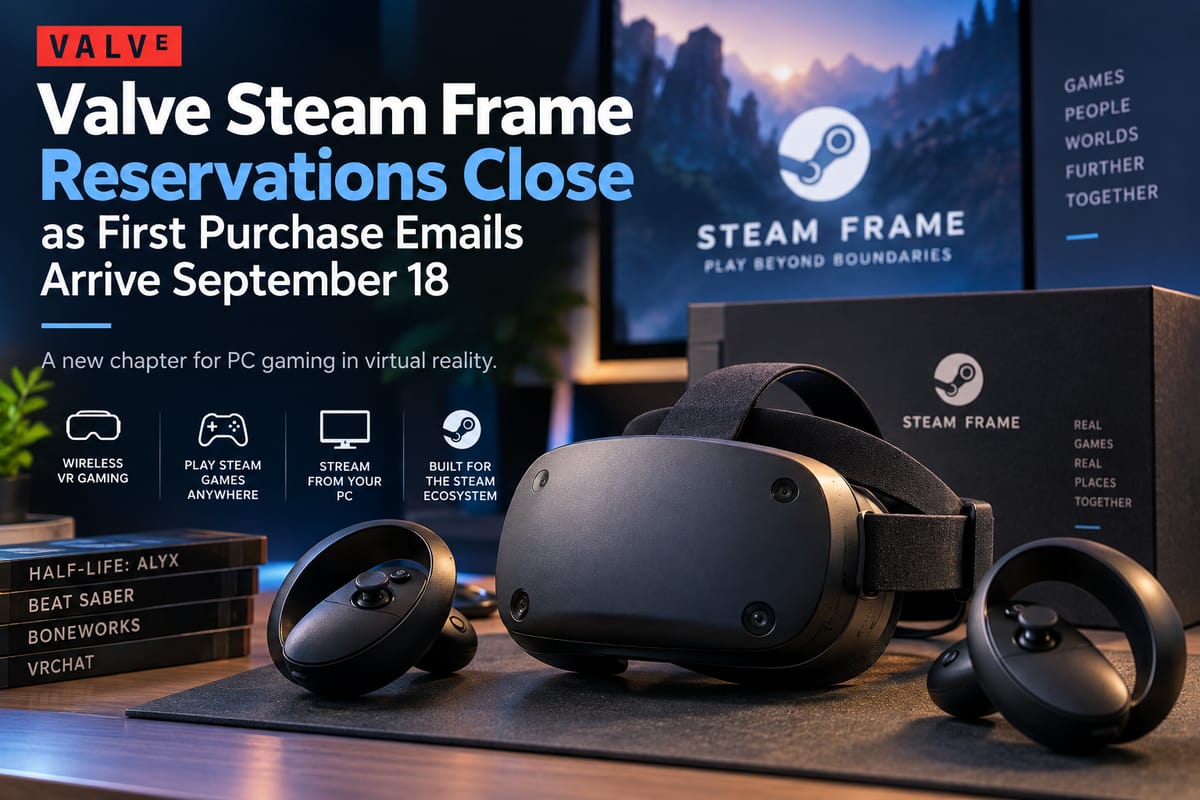
Valve Steam Frame Reservations Close as First Purchase Emails Arrive September 18
Valve's Steam Frame reservation window is closing, with the first purchase invitations scheduled to arrive on September 18 as the company prepares to bring its new wireless virtual-reality headset to customers.
The reservation process opened on September 14 and uses a randomized allocation system rather than a conventional first-come, first-served preorder. Interested customers had until September 17 at 10 a.m. Pacific Time to enter the initial reservation pool. Those selected can then receive an email invitation allowing them to purchase the headset.
The approach reflects the expected constraints around the Steam Frame's launch supply while giving Valve a way to manage demand without requiring customers to repeatedly refresh a product page.
Steam Frame Reservations Enter the Final Stage
The Steam Frame is Valve's newest virtual-reality device and its first major VR headset since the Valve Index.
Rather than immediately opening unrestricted sales, Valve has chosen a reservation lottery. Customers who entered before the deadline are assigned a position through a randomized process, with purchase invitations beginning September 18.
The system is designed to determine who gets an opportunity to buy early units while creating a queue for customers who are not included in the initial purchasing group. PC Gamer reported that Valve's reservation approach is intended to help manage limited availability and reduce the impact of resellers.
For consumers, that means having a reservation does not necessarily mean having a Steam Frame immediately. The reservation is effectively an opportunity to enter the purchasing process, with availability depending on the allocation and subsequent production schedule.
Steam Frame Starts at $1,059
Price is one of the biggest points of attention surrounding the new headset.
Valve has listed the Steam Frame at $1,059 for the 256GB model, while the 1TB version starts at $1,299. The Steam store also lists separate accessories, including an ergonomic accessories kit, a replacement accessories kit and a hardware power supply.
That places the Steam Frame firmly in the premium consumer technology market.
The pricing also matters because Valve's earlier reputation with PC gaming hardware has often been associated with products that attempt to balance performance and accessibility. The Steam Frame's cost reflects the more expensive components required for a modern wireless VR device, including its display, processor, memory and storage.
For shoppers evaluating a device at this price, understanding the broader principles covered in The Complete Guide to Choosing the Right Products can be useful, particularly when comparing specifications against actual everyday needs.
What Makes the Steam Frame Different?
The Steam Frame is designed to function as more than a conventional PC-connected VR headset.
Valve's device can run compatible games locally while also supporting wireless streaming from a PC. That combination gives users two different ways to access their Steam libraries.
The headset uses a Qualcomm Snapdragon 8 Gen 3 processor and includes 16GB of RAM. It is designed to run less demanding games natively, while more demanding PC titles can be streamed from a computer.
That hybrid approach is central to the product.
A conventional PC VR headset can depend heavily on a wired or wireless connection to a powerful computer. The Steam Frame instead attempts to make the headset itself capable of running selected games while retaining access to the larger performance capabilities of a gaming PC.
Wireless PC Streaming Is a Key Feature
Wireless connectivity is one of the Steam Frame's major selling points.
Valve says the headset can stream games from a PC over Wi-Fi, while the package also includes a dedicated 6GHz USB dongle for wireless PC connectivity.
That design could make PC VR more convenient because users do not necessarily need to remain physically connected to a computer during play.
At the same time, wireless VR introduces its own requirements. Network performance, latency and the capabilities of the host PC can influence the experience when games are streamed rather than running locally.
The distinction between local processing and cloud or PC streaming is becoming increasingly important across consumer technology, particularly as devices become more capable while still maintaining relatively compact designs.
Half-Life: Alyx Comes With the Headset
Valve is also including a copy of Half-Life: Alyx with the Steam Frame.
The game has been optimized for the headset and can take advantage of both native and streaming capabilities.
That is notable because Half-Life: Alyx has long been one of the most prominent examples of a major PC game designed specifically around virtual reality.
Including it gives new owners an immediate high-profile VR experience while also demonstrating what the platform is intended to deliver.
For Valve, the strategy makes sense beyond simply adding a free game. A strong first-party title can help consumers understand why the hardware exists and encourage them to explore the wider Steam VR ecosystem.
The Steam Frame Is Part of a Larger Valve Hardware Push
The headset is arriving as part of a broader expansion of Valve's hardware ambitions.
The company has also introduced the Steam Controller and Steam Machine, giving it a larger hardware portfolio spanning handheld gaming, traditional PC gaming and living-room entertainment.
The Steam Frame extends that strategy into wireless VR.
Valve's approach differs from companies that treat VR primarily as a standalone social or mixed-reality platform. Steam Frame is closely connected to the company's existing PC gaming ecosystem, meaning its value is tied heavily to access to Steam games and PC hardware.
That makes it important for prospective buyers to consider the headset as part of a broader gaming setup rather than simply as another standalone gadget.
Supply Constraints Have Become Part of the Story
Availability has been a recurring issue around the Steam Frame.
The reservation lottery itself indicates that Valve expects demand and initial supply to require careful management. Reports have also linked the headset's higher-than-expected price to rising costs for memory and other components.
The Verge reported that Valve's developers acknowledged the effect of component costs and said the headset's pricing closely reflects the cost of producing the hardware.
The situation illustrates a broader issue affecting consumer electronics.
Products that rely on advanced processors, memory and storage can become significantly more expensive when component supply is constrained. Companies must then decide whether to absorb higher costs, delay launches or increase retail prices.
Choosing Between the 256GB and 1TB Models
The two Steam Frame storage configurations give consumers an important choice.
The 256GB model starts at $1,059, while the 1TB version starts at $1,299.
Storage capacity can become particularly important for gaming devices because modern titles can occupy substantial amounts of space.
A buyer who mainly streams games from a PC may have different storage requirements from someone who expects to install a large collection of compatible titles directly on the headset.
That makes storage one of several specifications consumers should consider rather than automatically assuming that the larger model is necessary.
A closer look at how to understand product features and specifications can help put those numbers into context.
Accessories Add to the Overall Cost
The headline price is not the only expense potential buyers need to consider.
Valve's Steam store lists an ergonomic accessories kit at $59, a replacement accessories kit at $49 and a hardware power supply at $29.
Not every buyer will need every accessory, but the additional costs demonstrate why comparing the complete package matters when evaluating expensive technology.
Consumers should consider what is included with the base headset, which accessories are optional and which upgrades may become useful over time.
This is particularly relevant for VR because comfort can influence how frequently a headset is actually used.
Who Is the Steam Frame Designed For?
The Steam Frame is primarily aimed at people who want access to PC gaming through a more flexible VR platform.
Its ability to run selected games locally makes it more independent than a headset that relies entirely on a computer. Its PC-streaming capabilities, meanwhile, allow users to access more demanding games without putting all of the processing workload on the headset.
That combination could appeal to existing Steam users who are interested in VR but do not want to be restricted to a single type of gaming experience.
However, the price means consumers need to consider how frequently they expect to use VR and whether the headset's capabilities justify the additional hardware investment.
For a broader approach to evaluating technology purchases, How to Choose the Right Technology Devices offers useful principles around performance, compatibility, features and long-term value.
The Reservation System Could Shape the Launch
The September 18 purchase emails represent an important milestone for the Steam Frame.
Instead of creating a conventional launch-day rush, Valve has divided the process into several stages: reservation, randomized allocation, purchase invitation and eventual fulfillment.
That approach can make the launch more predictable for the company while giving Valve greater control over the number of orders entering its system at once.
It also creates uncertainty for customers because entering the reservation process does not guarantee an immediate purchase opportunity.
The first wave of emails should therefore provide a clearer indication of how Valve is distributing early inventory and how quickly customers can expect orders to move through the system.
Steam Frame Could Push PC VR Further Into the Mainstream
Virtual reality has gone through several waves of excitement, experimentation and changing consumer expectations.
The Steam Frame arrives at a point when wireless hardware, faster processors and increasingly sophisticated software are making VR more flexible.
Valve's approach is particularly interesting because it connects standalone-style hardware with the established PC gaming ecosystem. Rather than asking consumers to choose exclusively between a standalone headset and a traditional PC VR setup, the Steam Frame attempts to combine aspects of both.
Whether that approach can attract a large audience will depend on factors including price, comfort, software support, availability and how well wireless streaming performs in everyday use.
For now, the immediate focus is on the reservation process.
With the initial reservation window closing and purchase invitations beginning September 18, Valve's Steam Frame is moving from an announced hardware project into the hands of its first customers. The response to those early units could provide an important signal about how consumers view premium wireless PC VR and where Valve's expanding hardware strategy goes next.