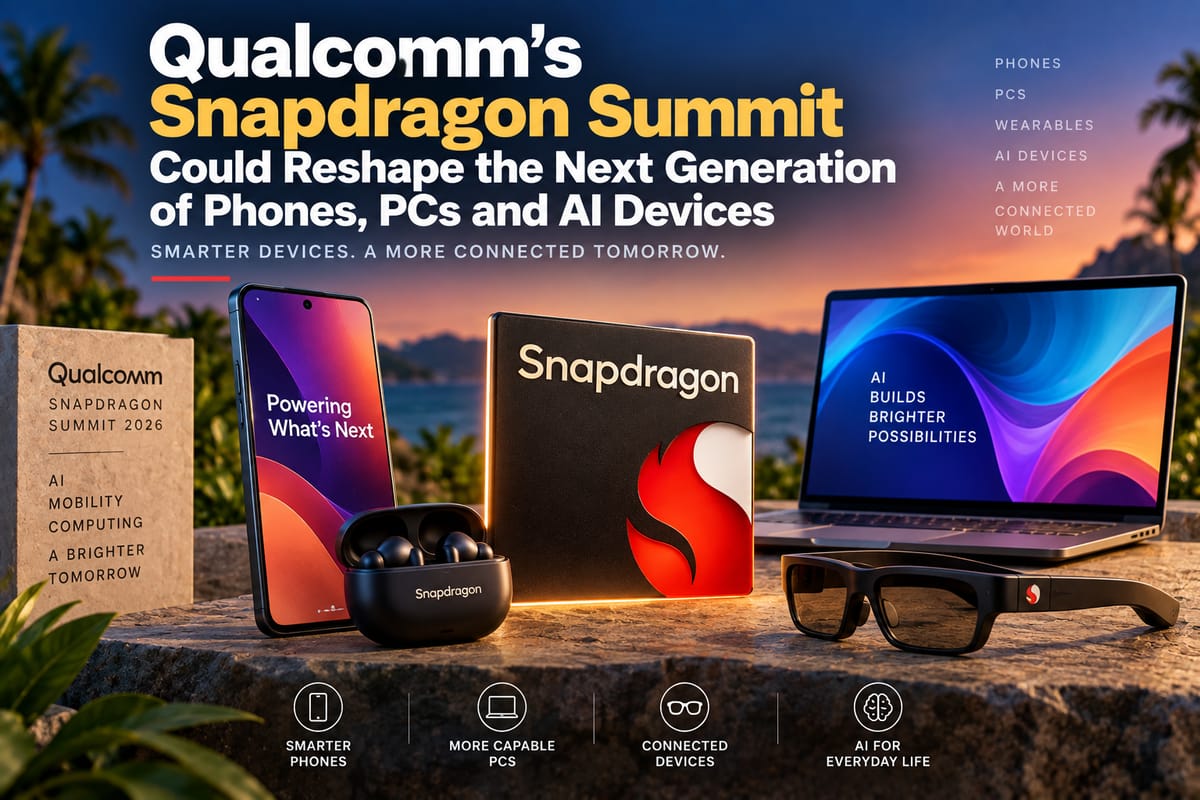
Qualcomm's Snapdragon Summit Could Reshape the Next Generation of Phones, PCs and AI Devices
Qualcomm's annual Snapdragon Summit is entering a new phase this week as the chipmaker places artificial intelligence at the center of its strategy for smartphones, personal computers and a growing range of connected devices.
The 2026 Snapdragon Summit runs from September 22 to 24 in Maui, Hawaii, with Qualcomm framing this year's event around the "agentic age." The opening day focuses on the company's broader AI vision and mobile technology, while the second day is dedicated to personal AI, sound and computing, including what Qualcomm calls the "Agentic PC."
That agenda reflects a broader change taking place across consumer technology.
The next generation of devices is increasingly being designed not simply to run applications faster, but to understand context, process AI locally and work together across different parts of a user's digital life.
For Qualcomm, that creates an opportunity to make Snapdragon more than a processor brand. It could become the underlying platform connecting phones, laptops, wearables, smart glasses and other AI-enabled devices.
From Faster Chips to More Intelligent Devices
For years, smartphone processor launches were largely defined by familiar specifications.
Consumers looked at CPU performance, graphics capabilities, battery efficiency, camera processing and connectivity. Those measurements still matter, but AI is changing what manufacturers want their chips to accomplish.
Qualcomm has increasingly focused on dedicated AI processing through its Hexagon neural processing technology. Ahead of this year's Summit, the company described its next-generation mobile architecture as being designed specifically for agentic AI, where systems can understand context, handle multiple steps and potentially take actions on a user's behalf.
That represents an important change in emphasis.
Instead of asking only whether a phone can run an AI chatbot, manufacturers are beginning to explore whether the device can use AI continuously and intelligently across applications.
For consumers trying to understand the role processors play in everyday devices, How Smartphone Processors Affect Performance provides useful context on why the chip inside a phone can influence everything from responsiveness to battery life.
Agentic AI Could Become the Next Big Device Shift
Generative AI has already changed how people interact with software.
The next step is increasingly being described as agentic AI.
Rather than waiting for a user to issue a single prompt, an AI agent can potentially break a request into several steps, use different tools and coordinate actions across applications.
Qualcomm has been positioning its Snapdragon platforms around this idea for much of 2026. The company's recent descriptions of personal AI envision phones, PCs, wearables, earbuds and smart glasses working as a coordinated system, with each device contributing different information and capabilities.
That could eventually change how consumers think about individual gadgets.
A smartphone might become the central device for certain tasks, while a laptop handles heavier workloads, earbuds provide audio interaction and smart glasses supply contextual information.
The important development would not necessarily be any one device becoming dramatically more powerful.
Instead, the devices could become better at working together.
Why On-Device AI Matters
One of Qualcomm's strongest arguments for AI processing at the device level is responsiveness.
Sending every AI request to a remote data center can introduce latency and requires an internet connection. Running at least part of the workload locally can allow devices to respond more quickly and potentially keep more sensitive information on the device.
Qualcomm's next-generation Hexagon NPU is designed around this approach. The company says its architecture includes a transformer-focused Element Accelerator and larger shared memory intended to improve the performance of AI models running directly on smartphones.
That does not mean cloud computing is disappearing.
Instead, future devices are likely to divide AI workloads between local hardware and remote data centers depending on the complexity of the task.
Simple or privacy-sensitive tasks could run locally, while larger workloads could be sent to the cloud.
Smartphones Remain Qualcomm's Biggest Showcase
Despite Qualcomm's expanding ambitions, smartphones remain central to Snapdragon's identity.
A successful flagship mobile processor has to balance several competing requirements.
It needs enough computing power for demanding applications and games while using as little energy as possible. It also has to support increasingly sophisticated cameras, high-speed connectivity, displays and AI workloads without creating excessive heat or draining the battery.
That makes smartphone chip design increasingly complex.
AI adds another layer because manufacturers want devices that can perform AI processing without sacrificing battery life.
Qualcomm's current mobile strategy therefore places significant emphasis on performance per watt rather than raw performance alone.
That distinction could become increasingly important as AI applications become more common.
Camera Technology Is Becoming an AI Problem
Smartphone cameras provide one of the clearest examples of how AI and traditional hardware are merging.
Modern phones already use computational photography to combine multiple frames, improve low-light images, recognize scenes and enhance details.
Future systems can take this further by using AI models to understand objects, people and environments in real time.
The processor therefore becomes part of the camera system.
A stronger AI engine can potentially allow manufacturers to introduce more sophisticated image processing without relying entirely on remote computing.
This is one reason processor design increasingly affects the overall character of a smartphone rather than simply its benchmark scores.
Qualcomm Is Also Targeting the PC Market
The company's ambitions extend well beyond phones.
Snapdragon has become increasingly important to Qualcomm's attempt to establish a larger position in Windows PCs.
The Snapdragon X family is designed around a combination of CPU performance, power efficiency and dedicated AI processing. Qualcomm says there are now more than 20 Copilot+ PCs powered by Snapdragon X2-series processors, including models from companies such as ASUS, Lenovo and HP.
The company is also involved in a new laptop category from Google.
Qualcomm announced on September 21 that Snapdragon X Elite would power the first Googlebook laptops, which are designed around Google's Gemini Intelligence experience. Dell and HP models were listed for preorder, with Qualcomm highlighting features such as Android integration, on-device AI capabilities and support for native Android applications and games.
That development is significant because it shows Qualcomm's chips moving into new categories of consumer computing.
For shoppers evaluating this changing PC market, Everything You Need to Know Before Buying a Laptop covers the hardware and specifications that matter when comparing modern laptops.
The AI PC Market Could Become More Diverse
The PC market is gradually becoming less dependent on a single hardware architecture.
Traditional x86 processors from Intel and AMD remain dominant, while Apple has demonstrated how ARM-based processors can power full desktop operating systems with strong performance and efficiency.
Qualcomm's Snapdragon approach adds another alternative.
The company is betting that efficient ARM-based processors combined with dedicated AI hardware can provide a compelling experience for laptops that prioritize battery life and always-available intelligence.
The success of that strategy will depend on more than processor performance.
Software compatibility remains crucial. Users expect their applications, peripherals, games and accessories to work properly without requiring extensive compromises.
Qualcomm therefore needs the broader Windows ecosystem to continue supporting its architecture.
Googlebook Shows How AI Could Change Laptop Design
The Googlebook partnership provides another clue about where consumer computing could be heading.
Google is positioning the new category around Gemini Intelligence rather than simply presenting it as another conventional laptop. Qualcomm's Snapdragon X Elite supplies the underlying computing platform, while Google provides the software and AI experience.
That combination highlights an increasingly important trend.
The processor, operating system and AI assistant are becoming more tightly connected.
In the past, consumers could often think about hardware and software separately. A processor determined performance while the operating system provided the interface.
AI is blurring that distinction.
The hardware needs specialized capabilities for AI, while the operating system needs to understand how to use those capabilities effectively.
Wearables and Smart Glasses Could Be the Next Frontier
Qualcomm is also expanding Snapdragon into smaller personal devices.
The company has been developing platforms for smart glasses, wearables and other connected products as part of its broader personal AI strategy.
In June, Qualcomm introduced Snapdragon START, a program designed to help companies develop personal AI devices, beginning with smart glasses and with support for additional form factors planned.
This could become important because smart glasses require a very different computing model from smartphones and laptops.
They need to be lightweight, power efficient and capable of processing information without constantly relying on a phone or cloud connection.
AI therefore becomes a natural part of the hardware architecture.
A pair of glasses that can understand surroundings, provide information and interact with other devices requires continuous processing within a very small power budget.
One AI System Across Multiple Devices
Perhaps Qualcomm's most ambitious idea is not about individual gadgets at all.
It is about creating an ecosystem in which different devices share intelligence.
Imagine starting a task on a smartphone, continuing it on a laptop and receiving contextual information through earbuds or smart glasses.
The user would not necessarily need to think about which device is performing each part of the task.
Qualcomm calls this broader vision an "Ecosystem of You," in which personal devices work together around an individual's context.
That could change the traditional relationship between consumers and their devices.
Instead of owning several independent products, people could increasingly interact with a distributed computing system.
Competition Will Help Shape the Outcome
Qualcomm is not pursuing this strategy in isolation.
Apple has its own custom silicon and tightly integrated ecosystem. Google is developing Gemini across Android and Chrome-based products. Samsung is combining its Galaxy hardware with increasingly sophisticated AI features. Microsoft is pushing Copilot+ PCs, while MediaTek and other semiconductor companies continue developing competing platforms.
The competition means consumers could have more choices over how AI becomes integrated into their devices.
It also means manufacturers will need to demonstrate that AI features provide meaningful benefits rather than simply adding another marketing label to existing products.
The broader shift is already visible across mobile platforms, as explored in Apple and Android Makers Push New AI Features.
AI Performance Will Not Be Measured by One Number
Another important change is that conventional benchmarks may become less useful for comparing AI devices.
A processor can have impressive CPU performance but deliver a less compelling AI experience if its neural processing hardware, memory architecture or software optimization is weaker.
AI workloads also vary considerably.
Running a small language model locally is different from generating images, enhancing video, translating speech or operating an autonomous agent.
This means consumers may eventually need to consider several different measurements when buying a device.
Those could include:
- CPU performance
- GPU performance
- NPU or AI acceleration
- Memory capacity
- Memory bandwidth
- Power efficiency
- Battery life
- Software compatibility
- Local AI capabilities
- Cloud connectivity
The result could be a more complicated but also more meaningful definition of device performance.
The Importance of Memory Is Growing
AI also places new demands on memory.
Large models require data to be moved between storage and processing components efficiently. If memory capacity or bandwidth becomes a bottleneck, a powerful processor cannot operate at its full potential.
That makes memory architecture an increasingly important part of AI hardware design.
Qualcomm's emphasis on larger shared memory for its next-generation Hexagon NPU illustrates the direction of travel. Keeping frequently accessed AI model data closer to the processing engine can reduce delays and improve efficiency.
For consumers, this may eventually make memory specifications just as important as CPU and GPU specifications when evaluating AI-focused devices.
What Snapdragon Summit Could Mean for Consumers
The significance of Snapdragon Summit is ultimately measured by what reaches retail products.
A new processor can look impressive on paper, but consumers experience the results through actual smartphones, laptops, glasses, headphones and other devices.
The important questions will therefore be practical.
Will phones become more responsive while lasting longer between charges?
Will laptops provide useful AI assistance without requiring a constant internet connection?
Will smart glasses become practical enough for everyday use?
Will different devices communicate with each other more naturally?
And will developers build applications that take advantage of the new hardware?
Those answers will determine whether the current AI hardware push becomes a genuine shift in consumer computing or simply another generation of processor upgrades.
Snapdragon's Strategy Is Becoming Broader Than the Smartphone
Qualcomm's position in consumer technology is changing.
The company remains deeply connected to smartphones, but its ambitions now span PCs, wearables, smart glasses, gaming, connected devices and AI infrastructure.
Its September 22–24 Summit agenda makes that expansion particularly clear. Qualcomm is separating discussions around mobile, personal AI, sound and PCs while presenting them as parts of the same broader transition toward agentic computing.
That could make this generation of Snapdragon technology particularly important.
The next major device upgrade may not be defined by a faster processor alone. It may be defined by how effectively hardware, software and AI work together.
If Qualcomm can make that combination efficient enough for everyday products, Snapdragon could become an important part of the next stage of consumer computing — one in which phones, PCs and emerging AI devices behave less like separate machines and more like parts of one intelligent personal ecosystem.