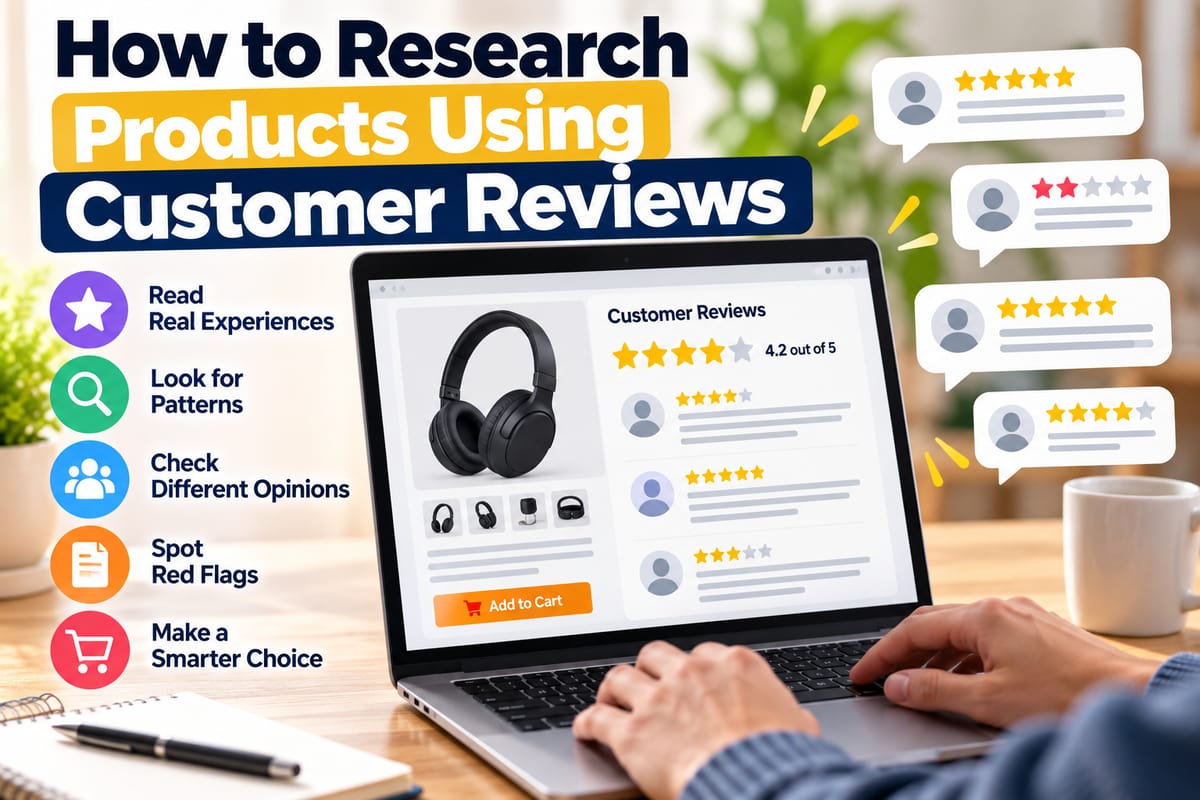
How to Research Products Using Customer Reviews
Customer reviews can be one of the most useful sources of information when researching a product before buying it. They can reveal how a product performs in everyday situations, identify recurring problems, explain how easy something is to use, and highlight differences that may not be obvious from a manufacturer's description.
However, not every review provides equally useful information. Some reviews are detailed and based on genuine experience, while others may be extremely brief, emotionally driven, outdated, or influenced by incentives.
Learning how to research products using customer reviews means looking for patterns rather than relying on a single opinion. It also means considering the reviewer's circumstances, the product's intended use, and the credibility of the information being presented.
Why Customer Reviews Matter When Researching Products
Product descriptions typically explain what a product is supposed to do. Customer reviews can provide insight into what happens after people actually use it.
Reviews may reveal information about:
- Ease of use
- Build quality
- Reliability
- Performance
- Setup difficulty
- Comfort
- Battery life
- Noise levels
- Customer support
- Long-term durability
- Common problems
- Compatibility
- Value for money
This makes reviews particularly useful when researching products that are difficult to evaluate from specifications alone.
A buyer considering a product can use customer feedback to identify questions that deserve further investigation before making a purchase.
Start With Your Own Buying Requirements
Before reading hundreds of reviews, identify what you actually need from the product.
Consider:
- What will the product be used for?
- How frequently will it be used?
- Which features are essential?
- Which features are optional?
- What limitations would make the product unsuitable?
- How much are you prepared to spend?
- How long do you expect the product to last?
This prevents reviews from becoming a source of unnecessary information.
For example, a reviewer may complain that a laptop is too heavy for frequent travel, while another buyer who primarily uses it at a desk may consider its weight irrelevant.
The usefulness of a review depends partly on whether the reviewer's circumstances resemble your own.
For a broader framework for evaluating products before purchase, see The Complete Guide to Choosing the Right Products.
Read Reviews From Different Types of Customers
A single type of reviewer cannot represent every buyer.
Try to find feedback from people with different experiences, including:
- First-time users
- Long-term owners
- Frequent users
- Occasional users
- Professional users
- Buyers with similar requirements
- Customers who purchased different versions of the product
This can reveal whether a particular experience is widespread or specific to a certain type of user.
A professional photographer, for example, may evaluate a camera very differently from someone who wants it for occasional family photographs.
Look for Patterns Instead of Individual Opinions
One of the most important rules when researching products through reviews is to look for recurring themes.
A single complaint about a product may not tell you much. Ten independent reviewers describing the same problem can provide a stronger reason to investigate further.
Look for repeated comments about:
- Defective components
- Difficult setup
- Poor battery performance
- Software problems
- Weak materials
- Customer service
- Product reliability
- Missing features
- Unexpected limitations
The goal is not to count every positive and negative comment mechanically. Instead, look for consistent evidence across multiple reviews.
Pay Attention to Detailed Reviews
A detailed review generally provides more useful information than a one-line statement such as "Great product" or "Terrible."
Useful reviews often explain:
- How long the reviewer has owned the product
- How frequently it is used
- What the reviewer expected
- What worked well
- What did not work well
- Specific examples of performance
- Problems encountered
- Whether the reviewer would make the same purchase again
Specific experiences are easier to evaluate because they provide context.
For guidance on evaluating review quality and extracting useful information from customer feedback, How to Read Product Reviews Like an Expert can be used as part of the research process.
Check How Long the Reviewer Used the Product
The length of ownership can significantly affect the usefulness of a review.
Someone who has used a product for two days can describe:
- Initial setup
- First impressions
- Packaging
- Appearance
- Basic operation
A long-term owner may be able to comment on:
- Durability
- Battery degradation
- Wear and tear
- Software updates
- Recurring problems
- Maintenance
- Customer support
- Long-term performance
Neither perspective is automatically more valuable in every situation. They simply answer different questions.
For products expected to last several years, long-term reviews can be particularly useful.
Separate First Impressions From Long-Term Experience
A product can make an excellent first impression and still develop problems later.
Conversely, a product may require a difficult setup but perform reliably for years afterward.
When reading reviews, distinguish between:
Initial experience
- Packaging
- Appearance
- Setup
- First-use experience
- Basic functionality
Long-term experience
- Durability
- Reliability
- Maintenance
- Performance over time
- Support
- Recurring issues
This distinction helps prevent short-term impressions from being mistaken for evidence about long-term ownership.
Examine Both Positive and Negative Reviews
Reading only positive reviews can produce an incomplete picture.
Negative reviews can identify weaknesses that buyers need to understand before purchasing. Positive reviews can explain which strengths users consistently appreciate.
A balanced research process examines both.
When reading negative feedback, ask:
- What specifically went wrong?
- Was the problem caused by the product or user error?
- How common does the issue appear to be?
- Did the manufacturer provide a solution?
- Is the problem relevant to my intended use?
When reading positive feedback, ask similar questions:
- What specifically worked well?
- How long did the reviewer use the product?
- Does the reviewer explain why they liked it?
- Is the praise relevant to my needs?
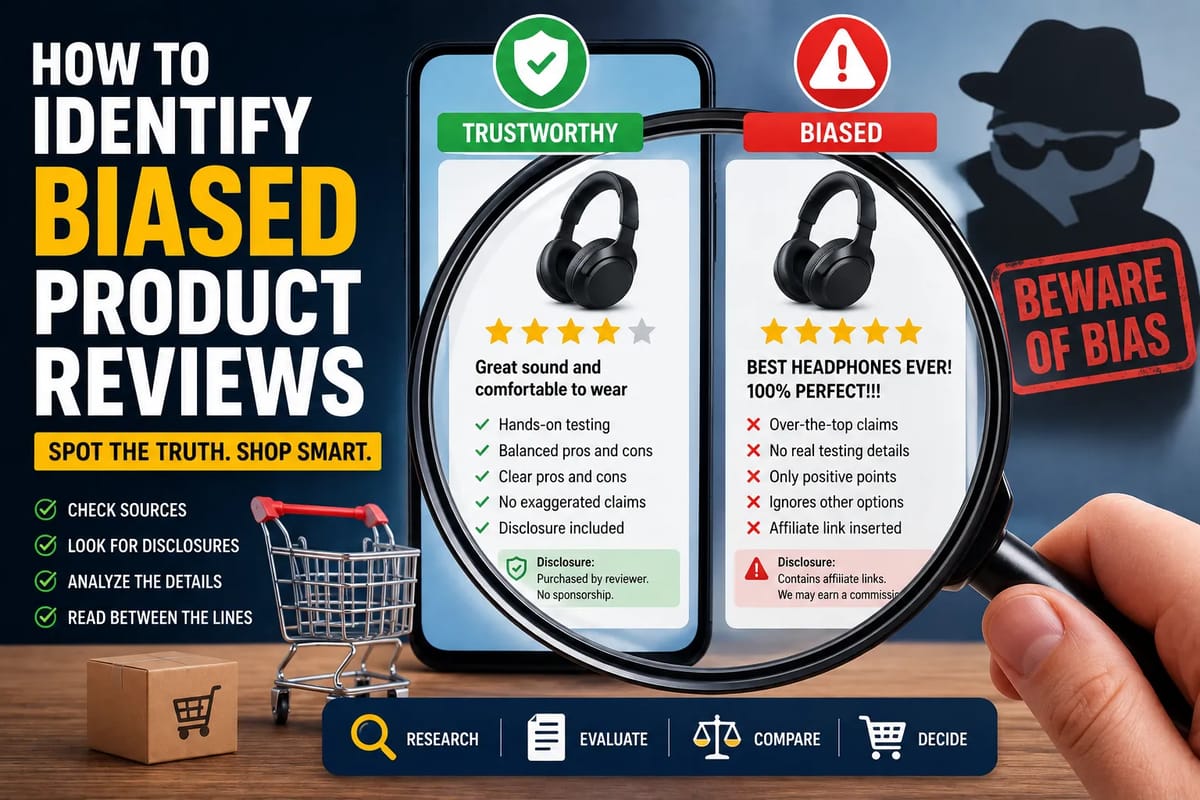
Learn to Recognize Potentially Biased Reviews
Not all customer feedback is equally independent.
Reviews can be influenced by:
- Incentives
- Free products
- Affiliate relationships
- Sponsorships
- Brand relationships
- Personal preferences
- Expectations
- Emotional reactions
The presence of a positive opinion does not automatically make a review unreliable. The important question is whether the reviewer provides enough information to understand the circumstances behind the recommendation.
The guide How to Identify Biased Product Reviews provides additional context for recognizing signs that may affect the independence or usefulness of review content.
Understand Sponsored Reviews
Sponsored content requires particular attention because the relationship between the reviewer and brand can affect how information is presented.
Sponsored reviews are not necessarily useless. A sponsored review may still contain accurate and valuable information.
However, readers should understand:
- Whether compensation was provided
- Whether the product was supplied for free
- Whether the reviewer has a commercial relationship with the brand
- Whether negative characteristics are discussed
- Whether claims can be independently verified
How Sponsored Product Reviews Can Affect Review Credibility explores the relationship between sponsorship and the credibility of product reviews.
Be Careful With Extremely Short Reviews
Short reviews can sometimes provide useful information, but they often lack context.
Compare:
"Excellent product. Five stars."
with a review explaining how the product was used for six months, what worked well, which features were disappointing, and whether any problems occurred.
The second review gives the buyer more information to evaluate.
Short reviews can still contribute to a broader pattern, but they should generally be interpreted alongside more detailed feedback.
Look at the Distribution of Ratings
The average rating can provide a quick overview, but it should not be treated as the entire story.
A product with mostly high ratings may have a different risk profile from one with a highly polarized distribution.
For example, imagine two products:
Product A
- Many ratings clustered around four and five stars
- Few very negative reviews
Product B
- Large numbers of five-star and one-star reviews
- Fewer middle ratings
The averages alone may not explain why customers have such different experiences.
Reading reviews across the rating spectrum can reveal what causes the disagreement.
Investigate One-Star Reviews Carefully
Very negative reviews can contain valuable information, but they should be examined critically.
Ask:
- Was the product actually defective?
- Was the reviewer expecting something the product was never designed to do?
- Was the problem caused by shipping?
- Was the product installed incorrectly?
- Was customer support contacted?
- Have other customers reported the same issue?
A one-star review describing a specific, repeatable technical failure can be highly informative.
A review consisting entirely of emotional language without details may provide much less useful evidence.
Read Three-Star Reviews
Middle-rated reviews are sometimes particularly useful because they can provide a more balanced assessment.
A three-star reviewer may explain:
- What they liked
- What disappointed them
- Which features worked
- Which features could be improved
- Who might benefit from the product
- Who might want a different option
These reviews can reveal trade-offs that are less visible in strongly positive or negative feedback.
Watch for Repeated Language
When many reviews use nearly identical wording, investigate further.
Repeated phrases may sometimes result from:
- Templates
- Review campaigns
- Incentives
- Copied content
- Coordinated feedback
This does not automatically prove that the reviews are fake, but unusual similarities can be a reason to give the comments less weight until additional evidence is available.
Check the Date of the Review
Product reviews become less useful when they describe an older version of a product.
Manufacturers may change:
- Components
- Software
- Firmware
- Packaging
- Accessories
- Pricing
- Warranty terms
- Manufacturing processes
A review from several years ago may therefore describe a version that is no longer identical to the current product.
When possible, prioritize recent reviews while retaining older feedback that provides useful long-term durability information.
Compare Reviews Across Multiple Platforms
No single review platform necessarily provides a complete picture.
Different platforms may attract different types of customers and organize reviews differently.
Comparing feedback across several independent sources can help identify whether an issue appears consistently.
For example, if customers on multiple platforms independently report the same battery problem, the pattern may deserve more attention than a complaint appearing only once.
Separate Product Problems From Seller Problems
Not every negative experience is evidence that the product itself is poor.
A customer might report:
- Damaged packaging
- Late delivery
- Missing accessories
- Poor seller communication
- Incorrect item shipped
These problems can be important, but they may relate to the seller or fulfillment process rather than the product's underlying quality.
When researching a product, separate comments about the product, seller, shipping, and customer service whenever possible.
Look for Evidence of Long-Term Reliability
For durable products, search reviews specifically for phrases related to extended ownership.
Useful search terms can include:
- "after one year"
- "after six months"
- "long-term review"
- "still working"
- "battery after a year"
- "two years later"
- "durability"
- "wear and tear"
- "repair"
- "replacement"
This can uncover information that is difficult to find in recent first-impression reviews.
Compare Reviews With Product Specifications
Customer reviews should complement, not replace, objective product information.
Specifications can help verify:
- Dimensions
- Weight
- Capacity
- Compatibility
- Battery size
- Connectivity
- Materials
- Included features
- Warranty terms
Reviews can then help explain how those specifications translate into everyday use.
For example, a manufacturer may state that a device has a particular battery capacity, while customer feedback may reveal how that capacity performs under different usage conditions.
Check Whether Complaints Are Relevant to You
Not every weakness matters equally to every buyer.
Suppose customers frequently complain that a product lacks an advanced feature. If you do not need that feature, the complaint may have little effect on your decision.
Likewise, a minor design issue may be insignificant for occasional users but frustrating for someone who uses the product every day.
Always translate review information into your own requirements.
Look for Recurring Strengths Too
Review research should not focus exclusively on problems.
Repeated positive observations can reveal genuine strengths.
Look for recurring comments about:
- Durability
- Ease of use
- Performance
- Comfort
- Reliability
- Design
- Battery life
- Customer support
- Useful features
If many independent users describe the same benefit with specific examples, that can provide useful evidence about the product's strengths.
Be Wary of Review Extremes
Extremely positive and extremely negative reviews can sometimes be less representative than moderate ones.
An enthusiastic customer may overlook weaknesses because they are excited about the purchase. A frustrated customer may emphasize problems while ignoring the product's strengths.
This does not mean extreme reviews should be ignored.
Instead, compare them with the broader body of evidence and look for specific details that can be independently evaluated.
Use Reviews to Build a Research Checklist
As you read customer feedback, keep a list of recurring questions.
For example:
| Research question | What to look for |
|---|---|
| Is it reliable? | Repeated reports of failures or long-term reliability |
| Is it easy to use? | Setup and everyday-use experiences |
| Is it durable? | Long-term ownership reports |
| Does it perform well? | Specific real-world performance examples |
| Are there common problems? | Repeated complaints across independent reviews |
| Is support helpful? | Experiences with repairs, returns, or assistance |
| Is it suitable for me? | Reviews from customers with similar needs |
This turns a large collection of opinions into structured research.
Don't Let the Star Rating Make the Decision
A star rating is a useful starting point, not a complete product evaluation.
Two products with identical average ratings can have very different characteristics.
One might receive high ratings because it is inexpensive and easy to use. Another might receive similar ratings because it offers advanced performance despite being more expensive or complicated.
The reasons behind the ratings are more informative than the number alone.
Combine Reviews With Total Ownership Considerations
Customer feedback is most useful when combined with other purchasing factors.
Consider:
- Purchase price
- Expected lifespan
- Maintenance costs
- Repairability
- Warranty
- Replacement costs
- Features
- Performance
- Customer support
- Resale potential
A product with excellent reviews may still be unsuitable if it does not meet your requirements or falls outside your budget.
Likewise, a product with some negative reviews may still be appropriate if the reported weaknesses are irrelevant to your intended use.
A Practical Process for Researching Products
A structured review-research process can look like this:
Step 1: Define Your Requirements
Write down the features and characteristics that matter most.
Step 2: Identify Several Products
Avoid researching only one product from the beginning.
Step 3: Read Broad Customer Feedback
Look at positive, negative, and middle-rated reviews.
Step 4: Identify Recurring Themes
Record common strengths and weaknesses.
Step 5: Check Review Dates
Determine whether the feedback applies to the current version.
Step 6: Investigate Long-Term Experiences
Look for reports from people who have owned the product for extended periods.
Step 7: Examine Potential Bias
Consider whether incentives, sponsorships, or commercial relationships could affect the information.
Step 8: Compare With Objective Information
Check specifications, warranty terms, compatibility, and other documented product details.
Step 9: Match Findings to Your Needs
Decide which strengths and weaknesses actually matter for your intended use.
Step 10: Calculate the Broader Cost
Consider not just the purchase price but also ownership and replacement costs.
Customer Reviews Are Evidence, Not Guarantees
Customer reviews provide useful real-world information, but they cannot guarantee that you will have the same experience.
Individual outcomes can vary because of:
- Usage patterns
- Environment
- Maintenance
- Expectations
- Product variations
- Manufacturing differences
- Compatibility
- User skill
The most useful approach is therefore to treat reviews as one part of a broader research process.
Turning Customer Feedback Into Better Product Research
Researching products through customer reviews works best when buyers move beyond simple star ratings and individual opinions. The goal is to identify recurring evidence, understand the circumstances behind each experience, and determine whether those experiences are relevant to the way the product will actually be used.
Detailed reviews, long-term ownership reports, balanced ratings, current feedback, product specifications, warranty information, and ownership costs can all contribute to a clearer picture.
When these sources are considered together, customer reviews become more than a collection of opinions. They become a practical research tool for identifying potential strengths, weaknesses, trade-offs, and questions to investigate before making a purchase.