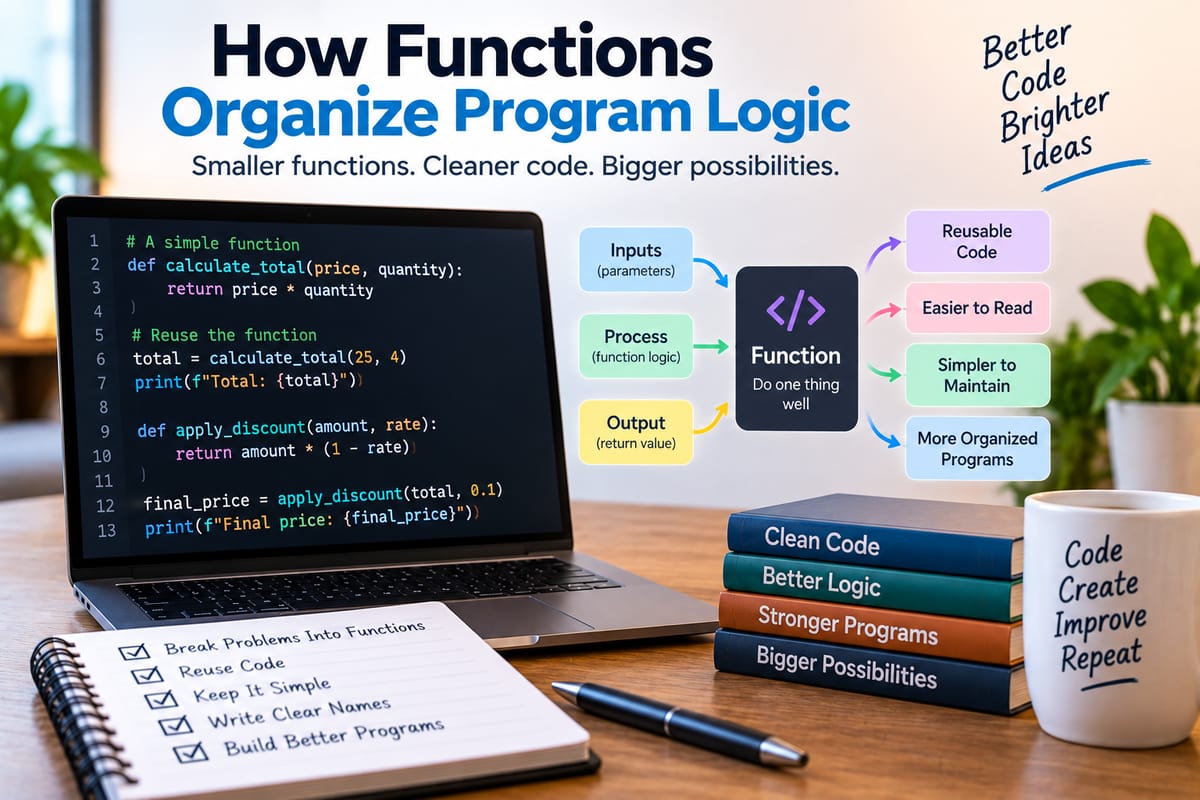
How Functions Organize Program Logic
Functions are one of the fundamental building blocks of programming. They allow developers to take a sequence of instructions, give that sequence a name, and reuse it whenever the same task needs to be performed.
Without functions, even relatively simple programs can become long, repetitive, and difficult to maintain. With well-designed functions, developers can divide complex problems into smaller pieces that are easier to understand, test, debug, and modify.
A function might calculate a total, validate user input, retrieve information from a database, format a date, process a payment, or perform almost any other operation a program needs.
Understanding how functions organize program logic provides a foundation for understanding how larger software systems are designed.
What Is a Function in Programming?
A function is a named block of code designed to perform a particular task.
A simple function might receive information, process it, and return a result.
For example:
def calculate_total(price, quantity):
return price * quantity
The function above is called calculate_total.
It accepts two pieces of information:
pricequantity
It then multiplies them and returns the result.
The function can be called whenever the program needs to calculate a total.
total = calculate_total(25, 4)
The result would be 100.
The syntax differs between programming languages, but the underlying concept is widely used.
For a broader introduction to programming concepts, What Is Programming and How Does It Work? provides additional context on how instructions are created and executed by computers.
Why Functions Matter
Functions help developers manage complexity.
Imagine a program that contains thousands of lines of code. If every operation is written directly into one enormous sequence, understanding how the program works becomes increasingly difficult.
Functions allow developers to divide the program into logical units.
Instead of thinking about hundreds of individual instructions, a developer can think in terms of actions such as:
create_account()
validate_payment()
calculate_total()
send_email()
generate_report()
Each function represents a particular responsibility.
This makes the overall program easier to reason about.
Functions Reduce Repetition
One of the most obvious benefits of functions is code reuse.
Suppose a program needs to calculate sales tax in dozens of places.
Without a function, the calculation might be repeated throughout the code.
With a function:
def calculate_tax(amount, rate):
return amount * rate
The same logic can be reused:
tax1 = calculate_tax(100, 0.08)
tax2 = calculate_tax(250, 0.08)
tax3 = calculate_tax(75, 0.08)
If the calculation needs to change later, developers can update the function rather than searching through many separate sections of code.
This can reduce duplication and make maintenance easier.
Functions Give Names to Actions
Programming involves many abstract operations.
A function gives an operation a meaningful name.
Compare:
total = price * quantity
with:
total = calculate_total(price, quantity)
The second version communicates more about the intention of the code.
A developer reading it can understand what the program is trying to accomplish without immediately examining every underlying instruction.
Good function names therefore make code easier to read.
Functions Can Accept Inputs
Many functions work with information supplied by the rest of the program.
These inputs are called parameters or arguments, depending on the programming context.
For example:
def greet_user(name):
return "Hello, " + name
The function can then be used with different values:
greet_user("Maria")
greet_user("David")
greet_user("James")
The same logic works for each name.
This makes functions flexible instead of requiring developers to create separate versions of the same operation.
Parameters Define What a Function Needs
Parameters provide a way for a function to receive the information required to perform its task.
Consider:
def calculate_discount(price, discount_rate):
return price * discount_rate
The function needs two pieces of information:
- The price.
- The discount rate.
By making those requirements explicit, the function becomes easier to understand and reuse.
A well-designed function generally makes it reasonably clear what information it expects.
Functions Can Return Results
A function may perform an action without returning a value, or it may calculate something and return the result.
For example:
def add_numbers(a, b):
return a + b
Another part of the program can use that result:
result = add_numbers(10, 5)
The returned value becomes available to the calling code.
This allows functions to become building blocks that feed information into other parts of a program.
Functions Can Perform Actions Without Returning Values
Not every function needs to calculate something.
For example:
def display_message(message):
print(message)
The function performs an action but does not necessarily return a meaningful result.
Other examples might include functions that:
- Save a file.
- Send an email.
- Update a database.
- Display a notification.
- Record an event.
- Log information.
The distinction between performing an action and returning a value depends on what the function is designed to accomplish.
Functions Help Break Large Problems Into Smaller Problems
Software development often begins with a large problem.
For example:
Build an online shopping system.
That is too broad to implement as one undivided block of logic.
Developers can break it into smaller responsibilities:
create_account()
authenticate_user()
search_products()
add_to_cart()
calculate_total()
process_payment()
create_order()
send_confirmation()
Each function represents a smaller part of the overall problem.
This approach is closely related to decomposition, a fundamental programming technique for turning complex problems into manageable pieces.
Functions and Program Flow
Functions also help determine the order in which operations occur.
Consider a simplified checkout process:
validate_cart()
calculate_total()
process_payment()
create_order()
send_confirmation()
The sequence communicates the basic flow of the operation.
Each function hides the detailed implementation while exposing the overall structure.
This allows developers to understand both levels:
High-level logic:
Validate → Calculate → Pay → Create Order → Notify
Detailed implementation:
Each function contains the instructions required to perform its individual responsibility.
This separation is one of the reasons functions are so useful for organizing programs.
Functions Create Abstraction
Abstraction means hiding unnecessary implementation details while exposing the important parts of an operation.
Suppose a program contains:
send_email(customer_email, message)
A developer using that function does not necessarily need to know:
- Which email server is used.
- How the connection is established.
- How the message is formatted.
- How authentication works.
- How errors are handled internally.
Those details can remain inside the function.
The caller only needs to know what the function does and what information it requires.
This allows developers to work with complex systems at a higher level.
Functions Can Call Other Functions
Functions do not have to operate independently.
One function can call another.
For example:
def checkout(cart):
validate_cart(cart)
total = calculate_total(cart)
payment = process_payment(total)
return create_order(cart, payment)
The checkout() function coordinates several smaller functions.
This creates layers of logic.
A high-level function describes the overall process, while lower-level functions handle specific operations.
Nested Function Calls
When one function calls another, the program can move through multiple levels of logic.
For example:
checkout()
↓
calculate_total()
↓
calculate_item_price()
The program temporarily enters the called function, performs its work, and then returns to the calling function.
This allows complex behavior to be assembled from smaller operations.
Developers must still be careful not to create unnecessarily complicated chains of function calls because excessive indirection can make code harder to follow.
Local Variables and Function Scope
Functions often have their own variables.
For example:
def calculate_total(price, quantity):
total = price * quantity
return total
The variable total exists within the function's local scope.
Scope determines where a variable can be accessed.
Keeping variables local when possible can reduce unintended interactions between different parts of a program.
Instead of allowing every function to modify the same collection of global variables, developers can pass information through parameters and return values.
This generally makes program behavior easier to understand.
Global State Can Complicate Functions
A function that depends heavily on global variables can be harder to understand and test.
For example:
tax_rate = 0.08
def calculate_tax(price):
return price * tax_rate
The function appears simple, but its result depends on a value outside the function.
A more explicit approach could be:
def calculate_tax(price, tax_rate):
return price * tax_rate
Now the function clearly states what information it requires.
Reducing unnecessary dependencies can make functions more predictable.
Pure Functions
A pure function produces the same output whenever it receives the same inputs and does not create unintended side effects.
For example:
def square(number):
return number * number
If the function receives 5, it always returns 25.
Pure functions can be particularly easy to test because their behavior is predictable.
They are an important concept in functional programming, where developers often emphasize predictable transformations of data.
For a deeper exploration, Functional Programming Principles Explained for Developers examines the ideas behind this programming style.
Functions and Side Effects
A side effect occurs when a function changes something outside its immediate calculation.
Examples include:
- Modifying a global variable.
- Writing to a file.
- Updating a database.
- Sending a network request.
- Displaying something on screen.
- Changing external state.
Side effects are not inherently bad.
Software needs to perform real-world actions.
The important issue is making them clear and controlling them appropriately.
A function that appears to calculate a value but secretly changes unrelated data can be difficult to understand.
Functions Help With Testing
Testing individual functions is often easier than testing an entire application as one large unit.
Suppose a program contains:
def calculate_discount(price, rate):
return price * rate
A developer can test different cases:
100, 0.10 → 10
200, 0.20 → 40
50, 0.00 → 0
The function's behavior can be evaluated independently.
This makes it easier to locate errors.
If a larger application produces an incorrect total, developers can test the relevant functions individually to determine where the problem occurs.
Functions Make Debugging More Manageable
When a program contains well-separated functions, debugging can become more focused.
Suppose a website calculates an incorrect shopping cart total.
Instead of examining the entire application, a developer can investigate functions such as:
calculate_item_total()
calculate_discount()
calculate_tax()
calculate_shipping()
calculate_cart_total()
Each function can be tested separately.
This does not eliminate bugs, but it can reduce the area that developers need to inspect.
Functions and Algorithms
Functions often provide a practical way to implement algorithms.
An algorithm is a defined sequence of steps used to solve a problem or perform a computation.
For example, a function might implement an algorithm for:
- Sorting data.
- Searching a collection.
- Finding the shortest path.
- Calculating an average.
- Compressing information.
- Validating input.
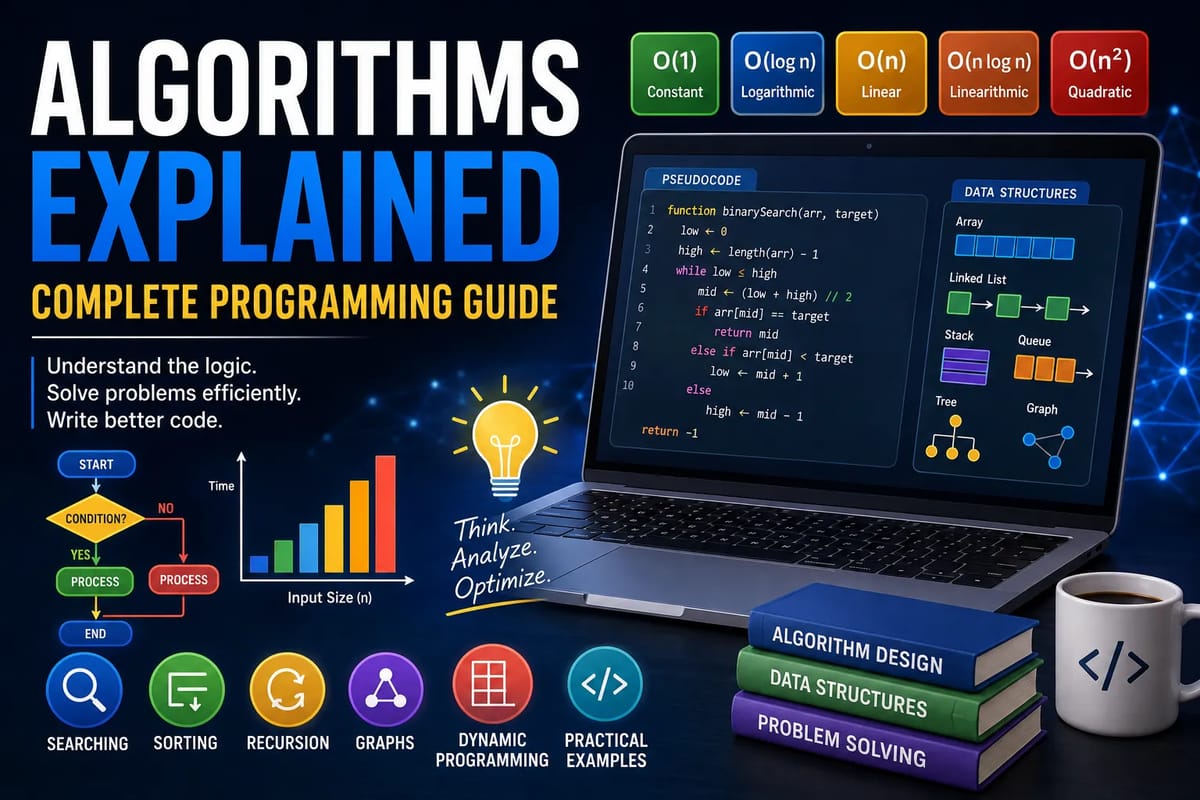
A broader understanding of algorithms explained in this complete programming guide can help explain how these problem-solving procedures translate into working code.
Functions and Different Programming Languages
Functions appear in many programming languages, although their syntax and behavior can vary.
Examples include:
- Python functions.
- JavaScript functions.
- Java methods.
- C functions.
- C++ functions.
- Go functions.
- Rust functions.
- PHP functions.
Some languages emphasize functions as central programming constructs, while object-oriented languages may place functions inside classes and refer to them as methods.
Understanding how functions work at a conceptual level makes it easier to move between programming languages.
The syntax may change, but ideas such as parameters, return values, scope, abstraction, and reuse remain important.
For a broader comparison of programming languages, What Are Programming Languages and How Do Different Languages Work? explores how languages provide different ways to express instructions for computers.
Functions and Object-Oriented Programming
In object-oriented programming, functions are commonly associated with objects and classes.
These functions are generally called methods.
For example:
class BankAccount:
def deposit(self, amount):
self.balance += amount
The deposit() method represents an operation that can be performed on a BankAccount.
Methods can operate on the data associated with an object while keeping related behavior organized with that data.
This provides another way functions contribute to software organization.
Functions and Modularity
Modularity means dividing software into separate components that can be developed and maintained independently.
Functions are one of the smallest and most fundamental tools for creating modular code.
A larger application might be organized into modules containing related functions:
authentication.py
payments.py
products.py
customers.py
reports.py
Each module can contain functions associated with a particular area of responsibility.
This organization can make large codebases easier to navigate.
Good Functions Usually Have Clear Responsibilities
A function should generally have a clear purpose.
For example:
calculate_shipping_cost()
has an obvious responsibility.
A function such as:
process_everything()
does not communicate much about what it actually does.
Clear responsibilities make code easier to understand and maintain.
If a function performs too many unrelated tasks, developers may eventually split it into smaller functions.
The Single-Responsibility Idea
A commonly used design principle is that a component should have a focused responsibility.
Consider this function:
def register_user(user):
validate_user(user)
save_user(user)
send_welcome_email(user)
create_profile(user)
This function coordinates several operations.
That can be reasonable if its responsibility is to orchestrate user registration.
However, each individual operation can remain separated into its own function.
This creates a useful distinction between coordination and implementation.
Function Names Should Communicate Intent
Naming is an important part of function design.
Compare:
process_data()
with:
calculate_monthly_revenue()
The second name provides much more information.
Useful function names generally communicate an action or purpose.
Examples include:
calculate_total()
validate_email()
load_customer()
save_order()
send_notification()
generate_invoice()
Good names reduce the amount of explanation developers need to provide elsewhere.
Functions Should Avoid Unnecessary Complexity
A function can technically perform many tasks, but that does not mean it should.
Long functions can become difficult to understand because developers have to track many variables, conditions, and operations at once.
Breaking a large function into smaller pieces can make each part easier to reason about.
For example:
process_order()
validate_order()
calculate_price()
apply_discount()
process_payment()
create_receipt()
Each function becomes easier to examine independently.
Functions and Error Handling
Functions can also define how errors are handled.
For example, a function that retrieves a customer might encounter a situation where the customer does not exist.
The function may:
- Return a special value.
- Raise an exception.
- Return an error object.
- Trigger another error-handling mechanism.
The appropriate approach depends on the programming language and application design.
The important point is that functions provide clear boundaries where developers can decide how failures should be represented and handled.
Functions and Reusable Libraries
Functions are not limited to code written inside a single application.
Developers can use functions provided by libraries and frameworks.
For example, a library might provide functions for:
- Parsing JSON.
- Resizing images.
- Encrypting information.
- Connecting to databases.
- Sending network requests.
- Processing dates.
Instead of implementing everything from scratch, developers can call well-tested functions provided by existing software.
This is one of the reasons programming ecosystems can become so powerful.
Functions Can Hide Implementation Changes
One of the advantages of abstraction is that the internal implementation of a function can change without requiring every caller to change.
Suppose an application uses:
get_customer(id)
The function might initially retrieve information from one database.
Later, the development team could change the underlying storage system.
If the function maintains the same interface, the rest of the application may not need to know how the data is retrieved.
This separation can make software easier to evolve.
Avoid Functions That Do Too Much
There is a balance between having functions that are too large and functions that are unnecessarily tiny.
A function that performs dozens of unrelated tasks may be difficult to maintain.
But dividing every single instruction into its own function can also make a program harder to follow.
The goal is meaningful organization.
Developers should create function boundaries where they improve:
- Readability.
- Reuse.
- Testing.
- Abstraction.
- Maintenance.
- Separation of responsibilities.
Functions Make Collaboration Easier
Functions also help teams work on large projects.
When responsibilities are divided into understandable components, developers can work on different areas without constantly modifying the same block of code.
For example, one developer might work on payment functions while another works on customer-account functions.
Clear interfaces between components can reduce conflicts and make collaboration more manageable.
A Simple Example of Functions Organizing a Program
Consider a small program that calculates the final cost of an online order.
Instead of writing everything in one block, the developer might create:
def calculate_subtotal(items):
pass
def calculate_discount(subtotal):
pass
def calculate_tax(amount):
pass
def calculate_shipping(items):
pass
def calculate_total(items):
subtotal = calculate_subtotal(items)
discount = calculate_discount(subtotal)
taxable_amount = subtotal – discount
tax = calculate_tax(taxable_amount)
shipping = calculate_shipping(items)
return taxable\_amount \+ tax \+ shipping
The details have been simplified, but the structure communicates the program's logic.
The main function coordinates the process while smaller functions handle individual calculations.
A developer can therefore understand the overall workflow without reading every implementation detail immediately.
Common Mistakes When Designing Functions
Making Functions Too Long
Large functions can become difficult to understand and test.
Giving Functions Unclear Names
A vague name makes it difficult to understand the function's purpose.
Passing Too Many Parameters
A function that requires a very large number of arguments may indicate that its responsibilities need to be reconsidered.
Relying Too Heavily on Global State
Hidden dependencies can make functions harder to test and reuse.
Mixing Unrelated Responsibilities
A function that handles database access, formatting, authentication, and email delivery may be doing too much.
Ignoring Error Handling
Functions should behave predictably when something goes wrong.
Creating Abstraction Without Purpose
Not every few lines of code need their own function. Abstraction should make the program clearer, not more complicated.
How Beginners Can Practice Using Functions
A useful way to learn functions is to take a simple program and gradually break it into logical operations.
For example, start with a program that calculates the cost of several products.
Then create functions for:
calculate_subtotal()
calculate_discount()
calculate_tax()
calculate_total()
Next, add input validation.
Then add functions for displaying the result.
This process teaches several important concepts at once:
- Parameters.
- Return values.
- Scope.
- Reuse.
- Decomposition.
- Abstraction.
- Testing.
The goal is not simply to create more functions. It is to learn how to identify meaningful boundaries in program logic.
Functions Turn Complex Logic Into Manageable Pieces
Functions provide programmers with a way to organize instructions around clear responsibilities.
They reduce repetition, support reuse, create abstraction, improve testing, simplify debugging, and make complex programs easier to understand.
At a high level, a well-structured application can often be read as a sequence of meaningful operations:
receive_input()
validate_input()
process_data()
calculate_result()
save_result()
display_output()
The individual functions can contain considerable complexity, but the overall program remains understandable because that complexity is divided into manageable pieces.
As programs grow, this ability to separate responsibilities becomes increasingly important. Functions are therefore more than convenient blocks of reusable code—they are one of the fundamental tools developers use to turn complex programming problems into organized, maintainable software.


One thought on “How Functions Organize Program Logic”