How to Identify Product Red Flags
Buying a product can look simple until shoppers start comparing specifications, prices, reviews, brands, warranties, and marketing claims. A product may appear attractive at first glance but still have characteristics that suggest it deserves closer examination.
These warning signs, often called product red flags, do not automatically mean that a product is poor quality. Instead, they indicate that shoppers may need more information before spending their money.
Learning how to recognize these signals can help buyers slow down, ask better questions, and distinguish genuine value from aggressive marketing.
What Is a Product Red Flag?
A product red flag is a warning sign that suggests a product, seller, listing, or purchasing decision deserves additional scrutiny.
Red flags can involve:
- Unclear product information
- Suspiciously low prices
- Exaggerated claims
- Poor-quality specifications
- Inconsistent reviews
- Weak customer support
- Unclear warranty terms
- Missing safety information
- Questionable seller practices
- Repeated complaints from customers
One warning sign does not necessarily prove that something is wrong. The goal is to identify patterns that justify further investigation.
Why Product Red Flags Matter
Shoppers often make decisions using limited information.
A product page may emphasize attractive features while leaving out important details about durability, compatibility, safety, maintenance, or long-term costs.
Recognizing red flags helps buyers look beyond the headline claims.
For example, a product described as "professional grade" may sound impressive, but that phrase has little value if the listing does not explain what makes the product suitable for professional use.
Good buying decisions depend on evidence rather than impressive wording.
Extremely Low Prices Can Be a Warning Sign
Price is one of the easiest things to compare between products, but an unusually low price deserves attention.
A major price difference may have a legitimate explanation. The product could be older, refurbished, discounted, discontinued, or sold by a different type of retailer.
However, an unusually low price can also indicate:
- Missing accessories
- Lower-quality materials
- Counterfeit products
- Used or refurbished items
- Shorter warranties
- Hidden shipping charges
- Unclear seller information
- Misleading product listings
Instead of assuming that the lowest price is the best deal, shoppers should determine why the price is so different.
Vague Product Descriptions
A trustworthy product listing should provide enough information for a buyer to understand what they are purchasing.
Vague descriptions can be a warning sign when important details are missing.
For example, a listing might repeatedly describe a product as "premium," "advanced," or "high performance" without explaining:
- What materials are used
- What the product actually does
- Which specifications it has
- What it is compatible with
- How large or powerful it is
- What is included in the package
Marketing language is not necessarily evidence of product quality.
Concrete specifications are generally more useful than broad promotional terms.
Exaggerated Performance Claims
Claims that sound too absolute deserve careful examination.
Examples include phrases such as:
- "Works for everyone"
- "Guaranteed results"
- "Lasts forever"
- "The best product available"
- "Completely risk-free"
- "Never breaks"
- "Instant results"
Some products can legitimately perform extremely well, but absolute claims should encourage shoppers to look for supporting evidence.
The more significant the claim, the more useful independent evidence becomes.
Missing Safety Information
Safety information can be particularly important for products involving electricity, heat, chemicals, children, vehicles, tools, or physical activity.
A product listing that provides extensive marketing information but little information about safe use may deserve closer attention.
Buyers can look for details about:
- Intended use
- Warnings
- Operating instructions
- Safety certifications where relevant
- Age restrictions
- Required protective equipment
- Installation requirements
- Maintenance procedures
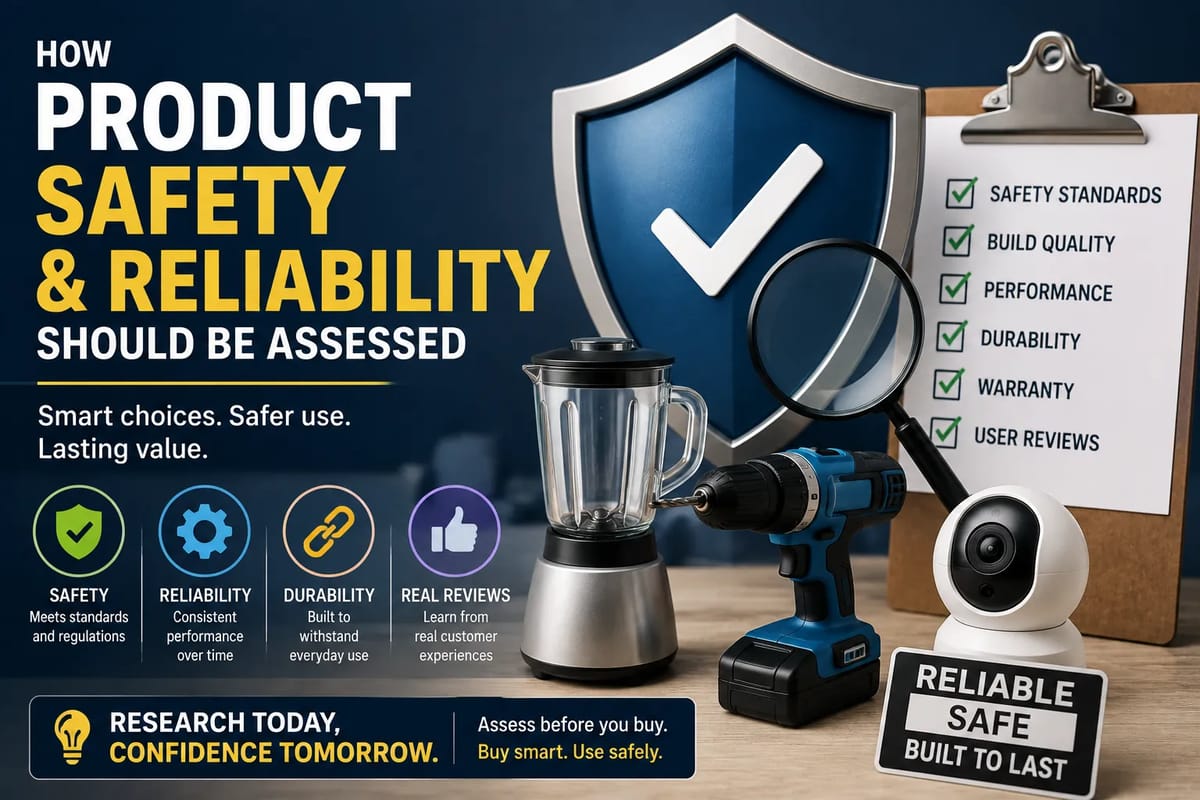
Understanding how product safety and reliability should be assessed can help shoppers evaluate these issues more systematically.
Unclear Manufacturer Information
A product should generally have identifiable information about the company responsible for making or selling it.
Potential warning signs include:
- No manufacturer information
- No meaningful business address
- Unclear ownership of the brand
- Missing customer service details
- Inconsistent company names
- A website with very little company information
This does not automatically prove that a product is unreliable, particularly with small or newly established businesses.
However, shoppers should have enough information to understand who stands behind the product.
A Brand With an Unclear Track Record
Brand reputation can provide useful context when comparing products.
This does not mean established brands are always better or smaller brands are always worse. Instead, buyers can investigate whether a company has a history of delivering products, supporting customers, and addressing problems.
Shoppers can look at:
- How long the brand has operated
- Product warranty policies
- Customer support availability
- Recall information where relevant
- Customer complaints
- Independent product testing
- Business transparency
A broader approach to this process is covered in how to evaluate product brands before buying.
Reviews That Sound Too Perfect
Product reviews can provide valuable information, but unusually positive reviews can sometimes be less useful than balanced ones.
A review that says a product is "perfect" without explaining how it performed may provide little practical information.
More useful reviews often describe:
- How the product was used
- What worked well
- What did not work well
- How long it was used
- Whether the product matched its description
- Any problems encountered
- Whether customer support helped
A mixture of positive and negative experiences can sometimes provide a more realistic picture.
Reviews That All Sound the Same
Repeated wording across many reviews can be another warning sign.
If numerous reviews use nearly identical phrases, mention the same unusual details, or appear to follow a similar structure, shoppers may want to investigate further.
This does not automatically mean the reviews are fake. Customers sometimes use similar language because they are responding to the same product features or review prompts.
Nevertheless, unusual repetition is worth considering alongside other evidence.
Reviews Without Specific Details
A review saying "Great product!" provides limited information.
A detailed review might explain how the product performed after several weeks, whether the materials held up, whether installation was easy, or whether the product worked as expected.
When evaluating reviews, look for concrete experiences rather than simply counting stars.
Learning how to identify biased product reviews can help shoppers separate useful customer experiences from reviews that may provide a distorted picture.
A Large Number of Reviews Does Not Guarantee Quality
A product with thousands of reviews may appear trustworthy, but review volume alone does not establish quality.
Shoppers should consider:
- The distribution of ratings
- The substance of written reviews
- How recent the reviews are
- Whether reviews discuss the same product version
- Whether negative feedback describes recurring problems
A large number of reviews can be useful, but the quality and relevance of those reviews matter too.
Inconsistent Product Specifications
Inconsistent information across a product listing can be a significant warning sign.
For example, a product description might state one capacity while a technical specification table lists another.
Other inconsistencies could involve:
- Dimensions
- Weight
- Battery capacity
- Materials
- Compatibility
- Warranty length
- Included accessories
When important information conflicts, buyers should seek clarification before purchasing.
Missing Warranty Information
A warranty can provide important information about how a manufacturer or seller stands behind a product.
A product does not necessarily have to offer a long warranty to be worthwhile. However, unclear warranty terms can make it difficult to understand what happens if the product fails.
Shoppers should look for information about:
- Warranty duration
- Covered defects
- Exclusions
- Repair options
- Replacement policies
- Who provides warranty service
- How claims are submitted
A warranty that sounds impressive but contains extensive exclusions may offer less protection than the headline suggests.
Poor Customer Support Can Be a Warning Sign
Customer support becomes particularly important when a product is complicated, expensive, or difficult to repair.
Before buying, shoppers can check whether the seller provides clear contact methods and useful information.
Potential concerns include:
- No customer service contact
- Only automated responses
- Unanswered customer questions
- Long delays in resolving complaints
- Unclear return procedures
- No information about repairs or replacements
Poor support does not necessarily mean the product itself is defective, but it can increase the difficulty of resolving problems.
Hidden Costs
The initial purchase price does not always represent the total cost of owning a product.
Additional costs might include:
- Shipping
- Installation
- Replacement parts
- Accessories
- Subscriptions
- Maintenance
- Batteries
- Software fees
- Repairs
- Specialized equipment
A product that appears inexpensive may become significantly more expensive after these costs are considered.
Before buying, shoppers should consider the product's total ownership cost rather than focusing exclusively on its advertised price.
Subscription Requirements
Some products depend on recurring subscriptions.
This can apply to software, smart devices, security systems, digital services, and other connected products.
A shopper may purchase the hardware at a reasonable price only to discover that important features require a monthly or annual fee.
The subscription terms should therefore be reviewed before purchasing.
Important questions include:
- Which features work without a subscription?
- How much does the subscription cost?
- Is the subscription optional?
- Can the product remain functional if the subscription ends?
- Are prices subject to change?
Difficult Return Policies
A product with a complicated or restrictive return policy may present additional purchasing risk.
Shoppers should examine:
- The return period
- Return shipping costs
- Restocking fees
- Product-condition requirements
- Refund methods
- Excluded products
- Exchange policies
A favorable product description is less reassuring if returning an unsuitable product would be extremely difficult or expensive.
Products That Do Not Match Their Intended Use
A product can be well made and still be the wrong choice for a particular buyer.
For example, a device designed for casual use may not be suitable for professional workloads.
Before purchasing, shoppers should consider:
- How the product will be used
- How frequently it will be used
- Required performance
- Compatibility
- Environmental conditions
- Expected lifespan
- Necessary features
Matching the product to the intended use can be more important than choosing the product with the most impressive specifications.
Compatibility Problems
Compatibility is an easy issue to overlook.
A product may work perfectly on its own but fail to work with equipment or software the buyer already owns.
Potential compatibility concerns include:
- Operating systems
- Connectors
- Network standards
- Accessories
- Software versions
- Device generations
- Physical dimensions
- Power requirements
Checking compatibility before purchase can prevent an otherwise avoidable return.
Products With Limited Replacement Parts
Long-term ownership can become difficult if replacement parts are unavailable.
For products expected to last several years, shoppers may want to know whether important components can be replaced or repaired.
This can be especially relevant for:
- Appliances
- Tools
- Electronics
- Furniture
- Vehicles
- Equipment
A product with a reasonable purchase price may become less attractive if a minor component failure requires replacing the entire product.
Poor-Quality Product Images
Product images can provide useful information, but low-quality or misleading images may be a warning sign.
Shoppers should be cautious when:
- Images are extremely limited
- Important product areas are never shown
- Photos appear heavily edited
- Images do not match the written description
- The same generic image appears across unrelated listings
Clear photographs from multiple angles can make it easier to understand what is actually being purchased.
Pressure to Buy Immediately
Urgency is a common marketing technique.
Messages such as "buy now," "last chance," or "only a few remaining" can encourage shoppers to make decisions before researching the product properly.
Limited-time offers can be legitimate, but pressure should not replace careful evaluation.
If a product requires significant spending, taking time to check specifications, reviews, return terms, and seller information can be worthwhile.
Too Many Unverified Claims
A product listing becomes difficult to evaluate when nearly every benefit is presented as a claim without supporting information.
For example, saying that a product is:
- Revolutionary
- Scientifically proven
- Industry-leading
- Ultra-durable
- Premium
- Professional
- Eco-friendly
does not explain what evidence supports those descriptions.
Shoppers should look for measurable specifications, credible certifications where relevant, independent testing, and detailed documentation.
How Multiple Red Flags Change the Picture
One unusual feature should not automatically eliminate a product from consideration.
The bigger concern is when several warning signs appear together.
For example, a product may have:
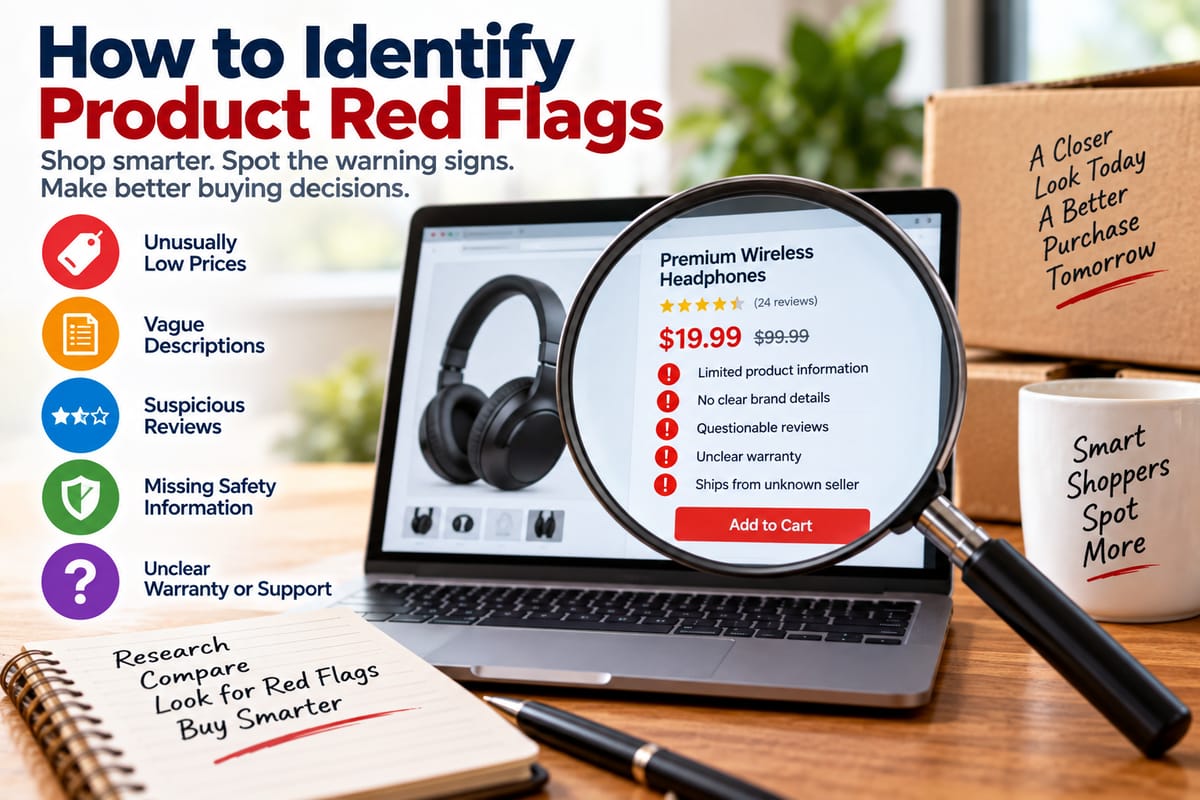
- An unusually low price
- Very vague specifications
- No clear manufacturer information
- Suspiciously repetitive reviews
- An unclear warranty
- Poor customer support
Each issue deserves investigation. Taken together, they provide a much stronger reason to slow down before purchasing.
A Simple Product Red Flag Checklist
Before buying an unfamiliar product, shoppers can ask:
- Is the product description specific and consistent?
- Are important specifications clearly provided?
- Is the manufacturer or seller identifiable?
- Does the price make sense compared with similar products?
- Are customer reviews detailed and varied?
- Are there recurring complaints?
- Is the warranty clearly explained?
- Is the return policy reasonable?
- Are safety details available where relevant?
- Will the product work with existing equipment?
- Are there hidden ongoing costs?
- Are replacement parts or repairs available?
- Does the product actually fit the intended use?
The more unanswered questions there are, the more research may be worthwhile.
How to Respond When You Spot a Red Flag
Finding a red flag does not always mean abandoning a purchase immediately.
Instead, shoppers can investigate the specific concern.
For example, if the warranty is unclear, look for the full warranty terms. If reviews are inconsistent, examine detailed reviews from multiple sources. If the specifications conflict, contact the seller or manufacturer.
If the concern cannot be resolved, the buyer can compare alternative products.
This approach turns a warning sign into a useful part of the decision-making process.
Product Red Flags and Better Buying Decisions
Good purchasing decisions rarely come from one piece of information.
Price, specifications, quality, reliability, safety, customer support, warranty coverage, return policies, and long-term costs all contribute to the overall picture.
Learning how to make better buying decisions can help shoppers organize these factors instead of relying on a single review, discount, or marketing claim.
The goal is not to find a product with absolutely no potential drawbacks. Almost every product has trade-offs. The goal is to understand those trade-offs before spending money.
Look Beyond the Sales Pitch
Product red flags are useful because they encourage shoppers to pause before accepting marketing claims at face value.
An unusually low price, vague specifications, inconsistent reviews, unclear warranty, missing safety information, or questionable seller practices does not automatically prove that a product is bad. But each can be a reason to investigate further.
By checking evidence, comparing alternatives, understanding the total cost, and paying attention to recurring warning signs, shoppers can approach purchases with clearer expectations.
The best buying decisions are often made not by finding the product with the most impressive advertising, but by recognizing what deserves a closer look before committing to the purchase.