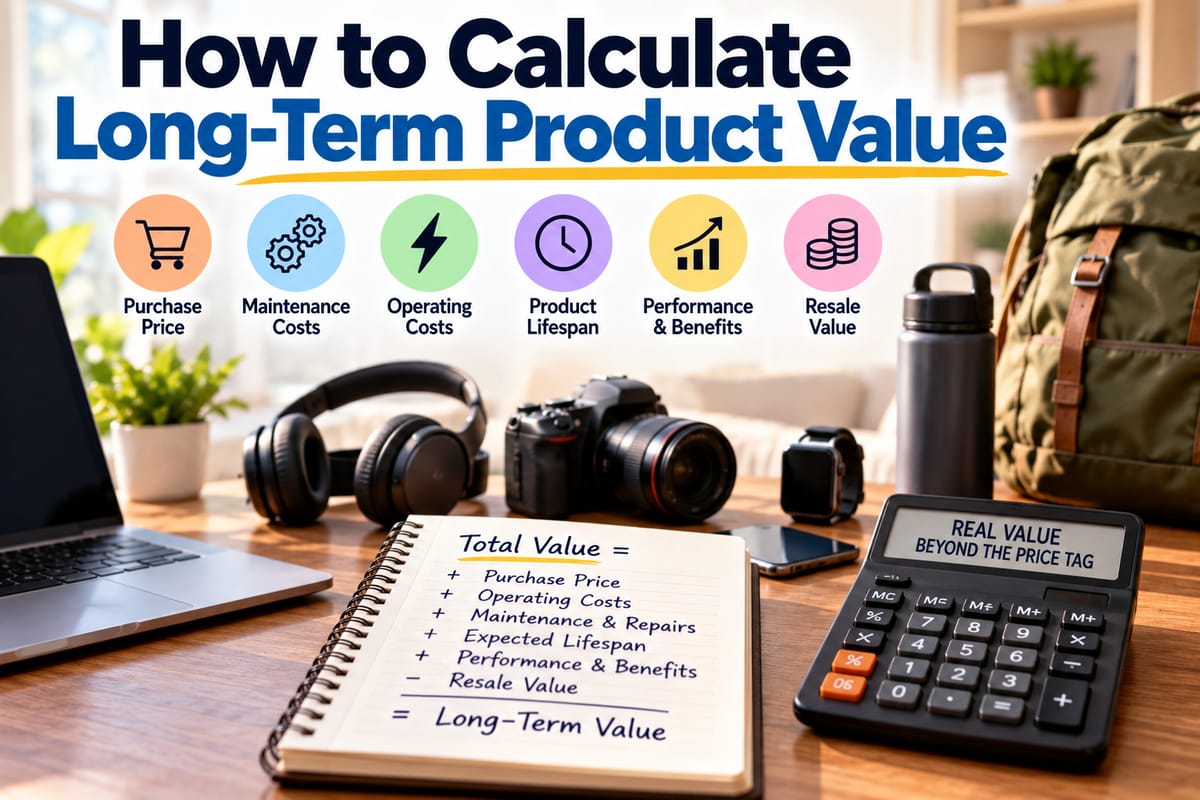
How to Calculate Long-Term Product Value
The price of a product at checkout tells only part of the story. A product that costs less initially may become expensive to maintain, replace, or operate, while a more expensive product can sometimes deliver greater value over several years.
Calculating long-term product value means looking beyond the purchase price and considering how much a product costs to own, how long it remains useful, what it costs to maintain, and how effectively it performs its intended job. This approach can make buying decisions more practical and less focused on the initial price tag.
What Is Long-Term Product Value?
Long-term product value is the overall benefit a product provides compared with the total cost of owning and using it over its useful life.
A simple way to think about it is:
Long-term product value = Total benefits received − Total costs of ownership
The benefits can include useful performance, convenience, durability, reliability, productivity, comfort, and continued functionality. Costs may include the purchase price, maintenance, repairs, accessories, energy consumption, subscriptions, and eventual replacement.
This differs from simply asking whether a product is cheap or expensive.
For a broader explanation of the factors that influence value, the Product Value Guide provides a useful framework for understanding how price, performance, durability, and ownership considerations fit together.
Start With the Purchase Price
The first number to record is the amount paid to acquire the product.
This should include more than the advertised base price when applicable. Consider:
- Purchase price
- Sales taxes
- Delivery charges
- Installation costs
- Required accessories
- Setup fees
- Initial software or service costs
For example, a device advertised at $500 may require a $50 accessory and a $75 installation service. Its effective starting cost would therefore be $625 rather than $500.
Starting with the complete acquisition cost provides a more realistic foundation for the calculation.
Estimate How Long the Product Will Be Used
The expected useful life is one of the most important variables in long-term value calculations.
A product used for eight years has a very different cost profile from one that needs to be replaced after three years, even if both have similar purchase prices.
Useful-life estimates can be based on:
- Manufacturer specifications
- Warranty periods
- Expected durability
- Historical reliability
- Availability of replacement parts
- Software support
- Repairability
- How heavily the product will be used
It is important to distinguish between physical lifespan and useful lifespan.
A product may continue functioning mechanically while becoming less useful because its software is no longer supported, replacement parts are unavailable, or newer standards make it difficult to use.
For a deeper look at this relationship, How Product Lifespan Affects Value explains why durability and usable life can have such a significant effect on the value a product provides.
Calculate Ongoing Ownership Costs
The purchase price is only the beginning for many products.
Ownership costs can accumulate throughout the product's useful life. These may include:
- Routine maintenance
- Repairs
- Replacement parts
- Batteries
- Consumables
- Energy or fuel
- Software subscriptions
- Service plans
- Accessories
- Cleaning or servicing
- Storage
- Insurance where applicable
Suppose a product costs $600 and requires approximately $100 per year to operate and maintain. If it is used for five years, the basic ownership cost could reach:
$600 + ($100 × 5) = $1,100
That is substantially different from judging the product solely by its $600 purchase price.
The Product Ownership Costs: Complete Guide to True Cost offers a broader framework for examining these expenses and understanding why the purchase price does not always represent the true cost of a product.
Consider the Cost of Replacement
Replacement frequency can dramatically change long-term value.
Imagine two products:
- Product A costs $400 and lasts four years.
- Product B costs $650 and lasts eight years.
If both perform a similar job, Product A may need to be purchased twice during an eight-year period.
Ignoring other costs, that produces:
Product A: $400 × 2 = $800
Product B: $650 × 1 = $650
The initially cheaper product therefore becomes more expensive over the longer period.
This is one reason it is useful to calculate value over a consistent time horizon rather than comparing products only at the moment of purchase.
Calculate Cost Per Year of Use
One of the simplest ways to compare long-term value is to calculate the annualized cost.
The basic formula is:
Annualized cost = Total ownership cost ÷ Years of useful use
For example, if a product costs $900 to purchase and another $300 to maintain over six years:
Total ownership cost = $900 + $300 = $1,200
Annualized cost = $1,200 ÷ 6 = $200 per year
This does not automatically mean the product is a good purchase. It simply provides a useful way to compare its cost with other products that perform a similar function.
Look at Cost Per Use
For frequently used products, cost per use can be even more informative than cost per year.
The formula is:
Cost per use = Total ownership cost ÷ Number of uses
Consider a $1,000 product that is used 2,000 times over its life.
$1,000 ÷ 2,000 = $0.50 per use
Another product might cost $600 but be used only 600 times:
$600 ÷ 600 = $1 per use
The more expensive product has the lower cost per use in this example.
This approach is particularly useful for products where usage can be estimated reasonably well, such as tools, appliances, equipment, and certain consumer electronics.
Account for Maintenance and Repair Risk
Two products with similar prices can have very different long-term costs if one requires significantly more maintenance.
When evaluating a product, consider:
- How often routine maintenance is required
- Typical repair requirements
- Cost of replacement components
- Availability of authorized service
- Ease of finding spare parts
- Whether repairs can be performed locally
- Whether specialized tools are required
A product that is easy and inexpensive to repair may retain more practical value than one that becomes difficult or uneconomical to repair after a relatively minor failure.
Repairability can therefore be an important part of long-term value, particularly for products expected to remain in use for many years.
Include Energy and Operating Costs
Some products require substantial resources to operate.
Depending on the product, these expenses may include:
- Electricity
- Fuel
- Water
- Replacement batteries
- Internet connectivity
- Cloud storage
- Software subscriptions
- Consumable materials
For example, two appliances might have similar purchase prices but significantly different energy consumption. Over several years, the difference in operating costs could become large enough to influence their overall value.
A realistic calculation should estimate these expenses over the same period used to compare the products.
Consider Performance and Productivity
Value is not determined solely by minimizing costs.
A product can provide additional value by helping users accomplish tasks more effectively.
For example, a computer that costs more may save time through faster performance. A professional tool may cost more but enable work that would be difficult or impossible with a cheaper alternative.
Potential performance benefits include:
- Faster task completion
- Higher productivity
- Better accuracy
- Greater capacity
- Improved reliability
- Reduced downtime
- Greater convenience
- Better compatibility with existing equipment
These benefits can be difficult to express in exact monetary terms, but they should still be considered when evaluating long-term value.
Examine the Product's Resale Value
Some products retain a portion of their original value and can be resold after several years.
If resale is realistic, the expected resale amount can be deducted from the total ownership cost.
A simplified formula is:
Net ownership cost = Purchase and ownership costs − Resale value
For example:
- Purchase price: $1,000
- Maintenance and operating costs: $300
- Resale value: $200
The net ownership cost would be:
$1,000 + $300 − $200 = $1,100
Resale value should not be assumed, however. It can depend on condition, demand, age, brand reputation, functionality, and whether newer models have made the older product less desirable.
Factor in Downtime
A product that frequently stops working can create costs beyond the repair bill.
Downtime may result in:
- Lost productivity
- Missed deadlines
- Temporary replacement costs
- Additional service charges
- Inconvenience
- Disruption to other equipment or processes
For personal products, the financial impact of downtime may be relatively small. For business equipment, it can be considerably more significant.
Reliability should therefore be considered alongside purchase price and maintenance expenses.
Compare Products Over the Same Time Period
A common mistake is comparing products using different time horizons.
Suppose one product lasts three years and another lasts seven years. Comparing only their initial prices does not provide a meaningful long-term assessment.
Instead, select a consistent period.
For example, a five-year comparison could include:
- Initial purchase cost
- Expected maintenance
- Operating expenses
- Repairs
- Replacement costs
- Expected resale value
- Other recurring expenses
Using the same period makes it easier to identify the actual differences between competing products.
Understand the Difference Between Price and Value
Price and value are related but not identical.
Price answers the question:
How much does the product cost to buy?
Value asks:
What do I receive in return for the money spent over the product's useful life?
A product can have a low purchase price but poor long-term value if it breaks frequently, becomes obsolete quickly, or requires expensive accessories and repairs.
Conversely, a higher-priced product may provide strong long-term value if it lasts longer, performs consistently, costs little to maintain, and remains useful for many years.
Understanding How Product Pricing Works and What Determines Whether a Product Is Worth Its Price can help separate the amount a seller charges from the broader question of what the product actually delivers.
Use a Simple Long-Term Value Formula
A practical calculation can combine the major cost factors:
Net long-term cost = Purchase price + Operating costs + Maintenance costs + Repair costs + Replacement costs − Resale value
Once the net cost is calculated, it can be compared with the product's useful life or expected usage.
For example:
| Cost factor | Amount |
|---|---|
| Purchase price | $800 |
| Operating costs | $200 |
| Maintenance | $150 |
| Repairs | $100 |
| Resale value | −$150 |
| Net long-term cost | $1,100 |
If the product is expected to last five years:
$1,100 ÷ 5 = $220 per year
This provides a clearer picture of its financial impact than the $800 purchase price alone.
Build a Comparison Between Competing Products
When comparing several products, use the same calculation for each one.
| Factor | Product A | Product B |
|---|---|---|
| Purchase price | $700 | $900 |
| Operating costs | $250 | $150 |
| Maintenance | $150 | $100 |
| Repairs | $200 | $100 |
| Resale value | $100 | $200 |
| Net ownership cost | $1,200 | $1,050 |
| Expected life | 5 years | 7 years |
| Approx. annual cost | $240 | $150 |
This type of table does not determine which product is right for every buyer. It simply makes the financial differences easier to see.
A buyer may also value other factors, such as performance, convenience, features, compatibility, or reliability.
Watch for Hidden Costs
Long-term product calculations can become inaccurate when less obvious expenses are ignored.
Potential hidden costs include:
- Proprietary accessories
- Required subscriptions
- Replacement chargers or cables
- Specialized maintenance
- Installation
- Software upgrades
- Consumables
- Storage requirements
- Financing charges
- Disposal or recycling costs
Before making a comparison, identify everything that is reasonably likely to generate a cost during the product's expected life.
Consider the Cost of Upgrading
Technology products can introduce another complication: users may replace a functioning product because a newer model offers important improvements.
This means physical durability does not always equal economic longevity.
A device could remain operational for many years but lose practical value if:
- Software support ends
- Important applications stop working
- Security updates are discontinued
- New standards become incompatible
- Performance becomes inadequate
- Replacement components become difficult to obtain
When evaluating long-term value, consider both how long a product can physically survive and how long it is likely to remain useful for its intended purpose.
Account for Different Usage Patterns
The same product can provide very different value to different users.
Someone who uses a product every day may benefit significantly from durability and productivity. Someone who uses it occasionally may place greater importance on a low purchase price.
Consider:
- Frequency of use
- Intensity of use
- Environment of use
- Required performance
- Expected ownership period
- Maintenance ability
- Replacement budget
Long-term product value is therefore personal to the intended use. A product that represents strong value for one buyer may be unnecessary or inefficient for another.
Avoid Focusing Only on the Cheapest Option
A low price can be attractive, but it should not automatically be treated as the best measure of value.
A cheaper product may have:
- A shorter lifespan
- Higher maintenance requirements
- More frequent repairs
- Lower performance
- Limited support
- More expensive replacement parts
Likewise, the most expensive product is not automatically the best value either.
The objective is to understand the relationship between total cost, useful life, performance, and benefits.
Create a Long-Term Product Value Checklist
Before buying a significant product, ask:
- What is the complete purchase cost?
- How long is the product expected to remain useful?
- What will it cost to operate?
- What maintenance will it require?
- How expensive are repairs?
- Are replacement parts available?
- Does it require subscriptions or consumables?
- How frequently will I use it?
- Could it improve productivity or save time?
- Will it retain resale value?
- How likely am I to replace it before it physically fails?
- What could make it obsolete?
- What is the estimated cost per year or per use?
Answering these questions can turn a simple price comparison into a much more meaningful assessment.
When Long-Term Value Matters Most
Long-term value calculations are particularly useful for expensive or frequently used purchases.
They can be valuable when comparing:
- Electronics
- Appliances
- Tools
- Vehicles and equipment
- Office technology
- Furniture
- Professional equipment
- Subscription-based products
- Durable household goods
For inexpensive products with short lifespans, an elaborate calculation may not be necessary. But as the purchase price, ownership period, or ongoing costs increase, understanding total value becomes increasingly important.
Making Better Buying Decisions With Total Cost in Mind
Calculating long-term product value is ultimately about changing the question from "What does this cost today?" to "What will this product cost me and provide over its useful life?"
Purchase price, maintenance, repairs, operating expenses, lifespan, resale value, performance, and usage all contribute to that answer.
A product with a higher initial price can sometimes have a lower long-term cost, while an inexpensive product can become costly when repeated replacements and ongoing expenses are included. By comparing these factors over the same period and considering how the product will actually be used, buyers can make more informed decisions based on total ownership rather than the checkout price alone.