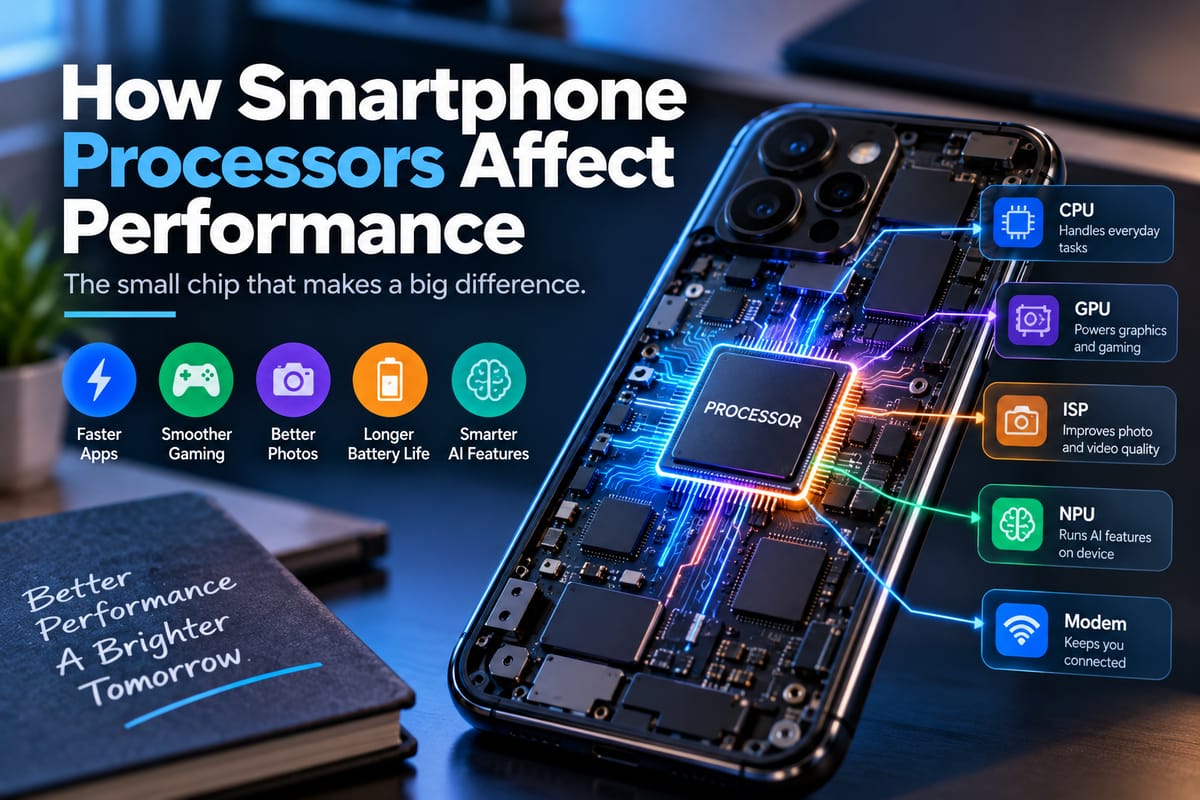
How Smartphone Processors Affect Performance
A smartphone may look like a simple device, but inside its compact body is a sophisticated computing system responsible for handling everything from opening apps and processing photographs to playing games and connecting to wireless networks.
At the center of that system is the processor, often called the system-on-chip (SoC) in modern smartphones. It plays a major role in determining how quickly and efficiently a phone can perform different tasks.
When comparing smartphones, consumers often focus on camera quality, display resolution, battery capacity or storage. Those specifications matter, but the processor can influence how well many of these components work together.
Understanding how smartphone processors affect performance can make it easier to compare devices and determine whether an expensive flagship model or a more affordable phone is the better choice.
What Is a Smartphone Processor?
A smartphone processor is the computing hardware responsible for executing instructions and coordinating many of the operations performed by the device.
Modern smartphone processors are usually integrated into an SoC rather than existing as a single isolated component. An SoC can combine several important components, including:
- CPU cores
- Graphics processing units
- Image signal processors
- Neural processing units
- Memory controllers
- Connectivity components
- Security hardware
This highly integrated design allows manufacturers to fit substantial computing capability into a relatively small device.
For a broader introduction to everyday technology, what are consumer gadgets and how do modern gadgets work? explains how different components work together inside modern electronic devices.
Why the Processor Matters
The processor influences how quickly a smartphone can respond to instructions and how efficiently it can handle demanding workloads.
When a user opens an application, processes a photograph, plays a game or records high-resolution video, the processor and its associated components perform large numbers of calculations.
A capable processor can help a phone:
- Open applications quickly
- Switch between tasks smoothly
- Process photographs faster
- Run demanding games
- Handle artificial intelligence features
- Support advanced camera functions
- Manage high-resolution video
- Maintain responsive performance under heavier workloads
However, processor performance is only one part of the overall smartphone experience.
A fast chip cannot compensate completely for inadequate memory, slow storage, poor software optimization or insufficient cooling.
CPU Cores Handle General Computing
The central processing unit (CPU) is one of the most important parts of a smartphone processor.
Modern mobile CPUs typically contain multiple cores. Different cores can be designed for different performance and efficiency characteristics.
High-performance cores can handle demanding tasks, while efficiency-oriented cores can manage lighter workloads while consuming less power.
This arrangement allows smartphones to balance responsiveness and battery life.
For example, checking an email may require relatively little processing power, while editing video or running a sophisticated game can place substantially greater demands on the CPU.
Clock Speed Is Not Everything
Processor specifications often include a clock-speed figure measured in gigahertz (GHz).
Clock speed indicates how quickly processor cycles occur, but it should not be treated as a simple measurement of overall smartphone performance.
Two processors running at the same clock speed can perform very differently because of differences in architecture, core design, cache, manufacturing technology and software optimization.
A newer processor with a lower advertised clock speed can potentially outperform an older chip with a higher clock speed.
This is why consumers should avoid comparing smartphones based solely on GHz numbers.
Graphics Processing Affects Gaming and Visual Tasks
Smartphone processors typically include a graphics processing unit (GPU).
The GPU is responsible for handling many graphics-related calculations, making it particularly important for mobile gaming and other visually demanding applications.
A capable GPU can contribute to:
- Higher game frame rates
- More detailed graphics
- Smoother animations
- Better visual effects
- Faster graphical processing
- More responsive gaming
The display also matters. A powerful GPU may be necessary to maintain smooth performance on a phone with a high-refresh-rate or high-resolution screen.
AI Processing Is Becoming More Important
Modern smartphone processors increasingly include specialized hardware for artificial intelligence and machine-learning workloads.
This hardware may be called a neural processing unit (NPU), neural engine or another manufacturer-specific name.
AI acceleration can help smartphones perform tasks such as:
- Image recognition
- Voice processing
- Photo enhancement
- Translation
- Background removal
- Generative AI features
- Computational photography
- On-device personalization
Processing some AI workloads directly on the phone can reduce the need to send information to a remote server and can potentially improve response times.
As artificial intelligence becomes increasingly integrated into consumer technology, specialized processing hardware is becoming a more important factor when evaluating smartphone capabilities.
Smartphone Cameras Depend on More Than Megapixels
A smartphone's processor also plays an important role in photography.
The image signal processor (ISP) can process information captured by the camera sensors and help produce the final photograph.
Modern computational photography can involve combining multiple exposures, reducing noise, improving dynamic range and recognizing scenes or subjects.
This means two smartphones with similarly rated camera sensors can produce noticeably different results because their processors and image-processing algorithms differ.
Processor capabilities can therefore influence photography just as much as some of the camera specifications printed on the box.
Video Recording Places Heavy Demands on Hardware
Recording and editing high-resolution video can require substantial computing resources.
The processor may need to handle image processing, video encoding, stabilization, audio processing and other tasks simultaneously.
More powerful chips can support advanced recording capabilities and faster video editing, although the exact features available depend on the phone's cameras, software and thermal design.
Users who frequently record or edit video should therefore consider processor capabilities alongside camera specifications.
RAM Works With the Processor
Processor performance cannot be considered separately from random-access memory (RAM).
RAM provides temporary working space for applications and the operating system.
When users switch between several applications, the phone may keep some of them in memory so they can resume quickly.
A smartphone with a capable processor but insufficient RAM may still struggle with heavy multitasking.
Conversely, adding more RAM does not automatically make a phone faster if its processor or software is poorly optimized.
The best experience comes from a balanced combination of processor performance, memory capacity and software optimization.
Storage Speed Can Affect Responsiveness
Internal storage is another important part of the performance equation.
Modern smartphones increasingly use fast flash-storage technologies that can improve application loading, file transfers and system responsiveness.
When an application needs to retrieve large amounts of data, the processor and storage system work together.
This means two phones with similar processors can still feel different if their storage technologies or configurations differ.
Consumers comparing device specifications should therefore look beyond the processor name.
Thermal Management Limits Performance
Smartphone processors generate heat when performing demanding tasks.
Because smartphones are small and have limited space for cooling systems, managing that heat is a significant engineering challenge.
When temperatures rise too much, a phone may reduce processor speeds to control heat and protect the hardware. This behavior is commonly known as thermal throttling.
A phone may therefore perform extremely well during a short benchmark but deliver lower sustained performance during a long gaming session or extended video-processing workload.
Cooling design can be especially important for users who regularly perform demanding tasks.
Battery Life Is Closely Connected to Processor Efficiency
Performance and battery life are not necessarily opposites.
A modern processor designed for efficiency can complete tasks using less energy than an older chip while delivering similar or greater performance.
Manufacturing technology also matters. Smaller semiconductor manufacturing processes can enable manufacturers to improve efficiency, although the final results depend on architecture and design.
A phone that balances performance and energy consumption effectively can provide both responsive operation and longer battery life.
This is particularly important for users who spend much of the day using navigation, video, gaming, photography or mobile productivity applications.
Software Optimization Makes a Difference
A smartphone processor does not operate independently from the operating system.
Android and other mobile operating systems manage how processor resources are allocated to applications and background processes.
Manufacturers can also optimize their software for particular hardware configurations.
Good optimization can make a device feel responsive even when its raw benchmark scores are not the highest in its class.
Poor optimization can produce the opposite effect.
This is one reason specifications should be considered alongside real-world reviews and long-term software support.
Benchmarks Can Help, But They Are Not the Whole Story
Performance benchmarks provide a standardized way to compare processors.
They can measure areas such as:
- CPU performance
- GPU performance
- Artificial intelligence workloads
- Memory performance
- Overall system performance
Benchmarks are useful when comparing devices, particularly when the same testing conditions are used.
However, benchmark results do not always represent everyday smartphone use.
A phone with an excellent benchmark score may not feel dramatically faster when browsing websites, sending messages or checking email.
Real-world performance depends on the applications being used and how efficiently the entire device is designed.
Flagship Processors Are Not Always Necessary
The fastest smartphone processor is not automatically the best choice for every consumer.
Someone who primarily uses a phone for messaging, social media, web browsing and occasional photography may not benefit significantly from paying for the most powerful chip available.
A mobile gamer, video editor or professional who relies on demanding applications may have a stronger reason to prioritize processor performance.
This is an important consideration when learning how to choose the right technology devices. The best device is generally the one whose capabilities match the user's actual needs rather than simply having the largest numbers.
Processor Generations Can Bring Major Improvements
Processor technology develops continuously.
New generations can introduce improvements in:
- Processing performance
- Energy efficiency
- Graphics capability
- AI acceleration
- Camera processing
- Connectivity
- Security
- Thermal efficiency
These improvements can make newer smartphones more capable even when the differences in headline specifications appear relatively small.
However, upgrading every year is not necessarily necessary. A modern phone with a capable processor can remain useful for several years, particularly if it continues receiving software and security updates.
Connectivity Is Also Part of the SoC
Modern smartphone chips can integrate or work closely with connectivity technologies.
Depending on the device, these can include:
- 5G
- Wi-Fi
- Bluetooth
- GPS-related functions
- Other wireless communication technologies
The exact capabilities vary between processors and devices.
Connectivity hardware can influence download speeds, network responsiveness and energy consumption, particularly when users are connected to demanding mobile networks.
Security Features Are Built Into Modern Chips
Smartphone processors also contribute to device security.
Many modern SoCs include dedicated security components designed to protect sensitive information, encryption keys and authentication processes.
These technologies can help support features such as secure payments, biometric authentication and protected storage.
Security is increasingly important as smartphones become repositories for financial information, personal communications, photographs and work documents.
How Smartphone Processors Compare With Computer Hardware
Although smartphones and computers perform many similar tasks, their processors are designed around different priorities.
Desktop and laptop processors often have greater access to electrical power and physical cooling systems. Smartphones need to deliver substantial performance while operating within strict limits on battery consumption, heat and physical size.
This is why smartphone processor design emphasizes efficiency so heavily.
The same general principles apply when evaluating computers. For a useful introduction, how to understand computer specifications and performance explains why individual specifications should be considered as part of a complete system.
A Smartphone Is More Than Its Processor
Processor performance is important, but it should never be the only factor considered when buying a smartphone.
Other components can have a major impact on everyday use, including:
- Display quality
- RAM capacity
- Storage speed
- Battery capacity
- Charging technology
- Camera sensors
- Software
- Cooling
- Build quality
- Connectivity
- Update support
This is similar to laptops, where how laptop hardware affects performance and everyday use demonstrates how different components work together to determine the overall experience.
A balanced device can often provide a better experience than one with a particularly powerful processor paired with weaker supporting hardware.
Choosing a Processor Based on Your Needs
Different users should prioritize different aspects of processor performance.
For everyday users, efficiency, reliable performance and long-term software support may be more important than maximum benchmark scores.
For mobile gamers, GPU performance, sustained performance and thermal management deserve greater attention.
For photographers, image-processing capabilities and AI acceleration can influence computational photography.
For content creators, CPU and GPU performance, video-processing capabilities and storage speed can make a larger difference.
For AI-focused users, specialized neural-processing hardware may become increasingly important as more AI features move directly onto smartphones.
What Processor Performance Means for the Future
Smartphone processors are becoming increasingly sophisticated as manufacturers attempt to fit more computing capability into smaller and more energy-efficient devices.
AI is likely to remain one of the major forces driving processor development. More workloads can be performed directly on devices, potentially allowing smartphones to offer more intelligent features without relying entirely on cloud computing.
At the same time, improvements in graphics, photography, connectivity and energy efficiency will continue to influence processor design.
For consumers, this means the processor will remain one of the most important components to understand when comparing smartphones.
Looking Beyond the Chip Name
A smartphone processor affects almost every aspect of a device's performance, from application responsiveness and gaming to photography, video processing and AI capabilities.
But the processor is only one part of a larger system. RAM, storage, software, battery efficiency and thermal management all determine how effectively that processing power translates into everyday performance.
The smartest way to compare smartphones is therefore not to choose the processor with the biggest number or newest name automatically. Instead, users should consider what they actually do with their phones and determine which combination of hardware and software best supports those activities.
As smartphones continue evolving into increasingly powerful personal computers, understanding the processor inside the device will become even more useful for making informed technology decisions.



2 thoughts on “How Smartphone Processors Affect Performance”