How Product Return Policies Work
Buying a product does not always mean the transaction is final. Sometimes an item arrives damaged, does not fit as expected, fails to match its description, or simply turns out to be unsuitable for the buyer's needs. Product return policies explain what happens when a customer wants to send an item back.
A return policy can determine how long a customer has to request a return, whether the product must be unused, who pays for shipping, and whether the customer receives a refund, replacement, exchange, or store credit.
Understanding these rules before making a purchase can help shoppers avoid unpleasant surprises and make more informed buying decisions.
What Is a Product Return Policy?
A product return policy is a set of rules explaining the conditions under which a retailer or seller will accept a returned product.
Policies can vary significantly between businesses and products. A retailer might allow most unused items to be returned within 30 days, while another may offer a longer period or impose different requirements.
A typical return policy may address:
- The return window
- Eligible products
- Product condition
- Proof of purchase
- Refund methods
- Exchanges
- Store credit
- Return shipping costs
- Restocking fees
- Damaged or defective products
- Final-sale items
- International returns
The policy establishes expectations for both the buyer and the seller.
Why Return Policies Matter Before Buying
Many shoppers focus on price, features, specifications, and reviews when comparing products. Return conditions can be just as important, particularly when purchasing an unfamiliar product online.
A flexible return policy can reduce the financial risk associated with buying something that cannot be physically examined beforehand.
For example, clothing may look different in photographs or fit differently than expected. Electronics may not work properly with existing equipment. Furniture may not fit comfortably into a room despite appearing suitable online.
Understanding return conditions before purchasing gives shoppers another piece of information to consider alongside the product itself.
How Return Windows Work
The return window is the period during which a customer can usually request or initiate a return.
Common return periods include 14, 30, 60, or 90 days, although policies vary widely.
The starting point can also differ. Some retailers calculate the period from:
- The purchase date
- The shipping date
- The delivery date
- The date the customer receives the product
These differences can matter.
A customer who assumes a return period begins when an item arrives could accidentally miss a deadline if the retailer calculates it from the original purchase date.
Shoppers should therefore check the exact wording of the policy instead of relying on a general assumption about return periods.
The Difference Between Returns, Refunds, and Exchanges
These terms are related but do not mean exactly the same thing.
A return generally refers to sending the product back to the seller.
A refund means the seller returns money to the customer after an eligible return has been processed.
An exchange means the returned product is replaced with another item, which may be the same product in a different size, color, configuration, or model.
Some retailers offer all three options, while others may restrict certain products to exchanges or store credit.
Refunds Can Take Different Forms
A refund does not always mean that the exact amount paid will immediately appear back in the customer's bank account.
Depending on the retailer's policy, refunds may be issued through:
- The original payment method
- Store credit
- A replacement product
- A gift card
- Another approved payment method
The timing can also vary. A retailer may process the refund after receiving and inspecting the returned product, while a payment provider or bank may take additional time to make the funds available.
Customers should check both the retailer's refund policy and the payment method used for the purchase.
Product Condition Can Affect Eligibility
Many return policies distinguish between products that are unused and products that have been used.
A retailer may require items to be:
- Unused
- In original packaging
- Complete with accessories
- Free from damage
- Accompanied by manuals or documentation
- Resalable
However, the rules can differ depending on the type of product.
For example, opening the packaging of a product may be treated differently from actually using it. Some products may also have special return requirements because of hygiene, safety, personalization, or licensing considerations.
Original Packaging May Matter
Some retailers request that returned products be sent back in their original packaging.
Packaging requirements can be especially important for electronics, appliances, fragile products, and items sold as complete sets.
Before throwing away boxes, protective materials, manuals, or accessories, buyers may want to make sure they are no longer needed under the applicable return policy.
Missing accessories can sometimes complicate a return or affect the amount refunded.
Who Pays for Return Shipping?
Return shipping is one of the most important details to check.
Depending on the circumstances, the seller may:
- Provide a prepaid return label
- Deduct shipping costs from the refund
- Require the customer to pay return shipping
- Offer free returns only for certain products
- Cover shipping when the product is defective or incorrect
A policy may also distinguish between a return because the customer changed their mind and a return because the seller sent the wrong or defective product.
This distinction can significantly affect the customer's costs.
Restocking Fees
Some businesses charge a restocking fee when certain products are returned.
A restocking fee is generally deducted from the amount refunded to the customer.
Whether such fees apply can depend on the product, condition, reason for return, or timing of the return.
Shoppers considering expensive products should check for these charges before completing a purchase because a return that appears straightforward could result in a smaller refund than expected.
Damaged Products and Defective Items
Return policies often treat defective or damaged products differently from ordinary change-of-mind returns.
If a product arrives damaged, the customer may be asked to provide photographs or other evidence. The seller may then arrange a replacement, refund, repair, or return shipment.
For products that stop working after use, the relevant process may involve a warranty rather than the standard return policy.
This is why shoppers should understand both the return policy and the product's warranty terms.
Product reliability is another important consideration before purchase. How Product Safety and Reliability Should Be Assessed provides useful context for evaluating these qualities before committing to a product.
Return Policies for Online Purchases
Online shopping can make returns more complicated because the customer and seller may be located far apart.
An online return may involve:
- Requesting a return through the retailer's website.
- Receiving authorization or instructions.
- Packaging the product.
- Printing or receiving a return label.
- Dropping the package with the designated carrier.
- Waiting for the retailer to receive the item.
- Having the product inspected if required.
- Receiving the refund, replacement, or exchange.
The exact process varies by retailer.
Customers should save return confirmations, shipping receipts, tracking information, and other relevant documentation until the transaction is fully resolved.
Marketplace Returns Can Have Additional Rules
Purchasing through an online marketplace can involve multiple parties.
The platform may have its own buyer-protection or return process, while the individual seller may have additional policies within the platform's rules.
This can create more complicated situations when a product is:
- Sold by a third-party merchant
- Shipped by the marketplace
- Imported from another country
- Customized by the seller
- Sold as refurbished or used
Buyers should identify who is actually responsible for the transaction and review the applicable return instructions before making a purchase.
Return Policies for Sale and Clearance Items
Discounted products may have different return conditions from full-price products.
Some sale items can be returned normally, while others may be marked as final sale.
A final-sale designation can mean that the retailer does not accept ordinary returns, although other protections may apply depending on the circumstances and applicable rules.
Customers should not assume that a lower price automatically means the product has the same return rights as a regular-priced item.
Personalized and Custom Products
Products made specifically for an individual customer can have different return conditions.
Examples may include:
- Customized clothing
- Engraved products
- Personalized gifts
- Made-to-order furniture
- Products manufactured to specific specifications
Because these items may not be easily resold, retailers sometimes restrict ordinary returns.
The policy should be checked before placing an order, particularly when customization is involved.
How Customer Support Fits Into Returns
A return policy explains the formal rules, but customer support often determines how easy the process feels in practice.
Customers may need assistance when:
- A return label does not arrive
- A package is marked delivered but cannot be located
- A refund has not appeared
- The wrong product was shipped
- A replacement is unavailable
- The return status has not updated
Good support can make these situations easier to resolve.
The broader relationship between support and purchasing decisions is explored in How Customer Support Affects Product Value.
What Shoppers Should Look for in a Return Policy
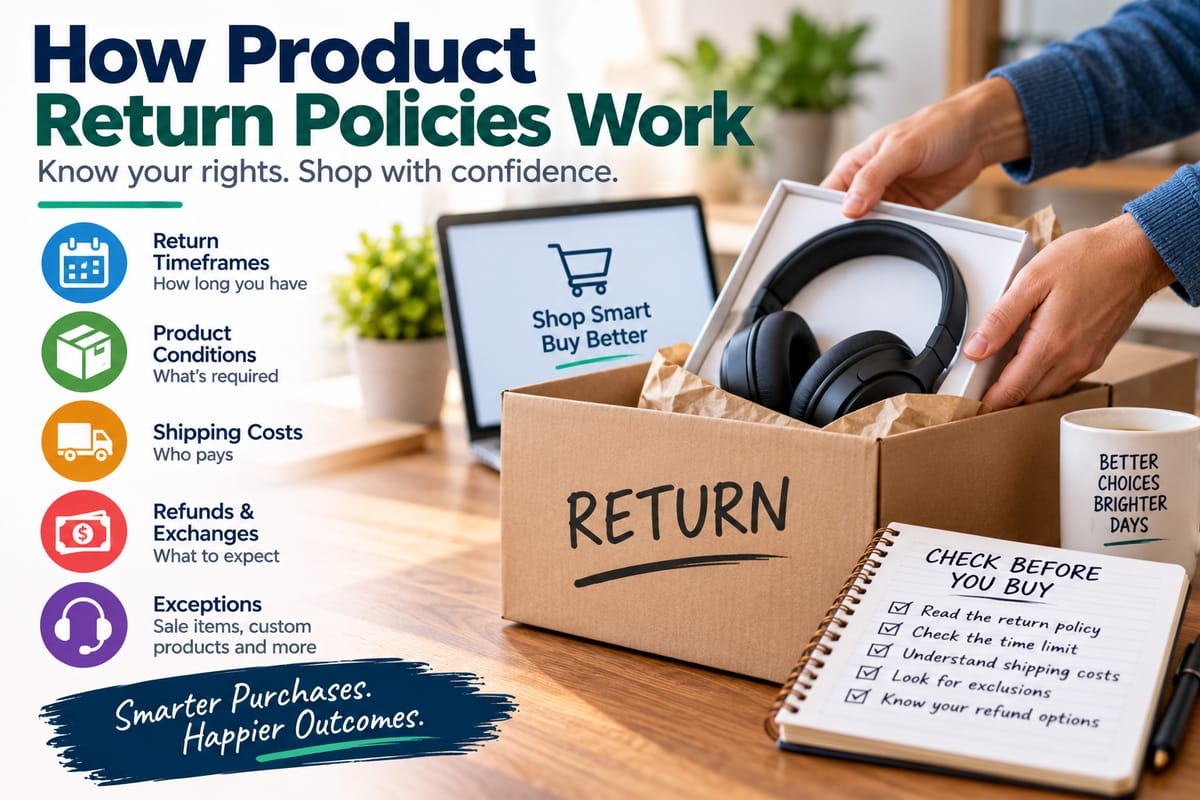
Before purchasing a product, shoppers can quickly review several key details.
Look for:
- How many days are allowed for returns
- When the return period begins
- Whether the item must be unused
- Whether original packaging is required
- Whether return shipping is free
- Whether restocking fees apply
- How refunds are issued
- How long refunds typically take
- Whether exchanges are available
- Which products are excluded
- How defective products are handled
- Whether warranties apply separately
Reading these points can take only a few minutes but may prevent problems later.
Return Policies and Product Selection
A return policy should not be the only factor considered when choosing a product.
Price, quality, features, reliability, safety, compatibility, and expected lifespan can all influence whether a purchase makes sense.
A structured approach to comparing these factors is covered in The Complete Guide to Choosing the Right Products.
The goal is to choose a product that fits the buyer's needs rather than relying on the ability to return it if something goes wrong.
Why Return Policies Can Influence Buying Decisions
Two products with similar prices and features may have very different purchasing risks if their return conditions differ.
Consider a shopper comparing two unfamiliar products. One seller offers a straightforward return process with a reasonable window, while the other has restrictive conditions and expensive return shipping.
That difference may matter if the buyer is uncertain about compatibility, size, quality, or performance.
Return policies therefore form part of the overall value proposition of a purchase.
Common Mistakes Shoppers Make
Several avoidable mistakes can make returns more difficult.
Assuming Every Product Can Be Returned
Different categories may have different rules. Always check the policy for the specific product.
Waiting Until the Last Day
Delaying a return request can create problems if shipping or processing takes time.
Throwing Away Packaging Too Quickly
Some retailers require original packaging or accessories.
Ignoring Return Shipping Costs
A "30-day return" may still involve significant shipping expenses.
Forgetting to Keep Documentation
Receipts, order numbers, tracking information, and return confirmations can become important if a dispute arises.
Confusing a Return With a Warranty Claim
A defective product outside the ordinary return window may need to be handled through a warranty or other support process.
How to Make Returns Easier
Good return habits begin before the purchase.
Shoppers can:
- Read the product-specific return policy.
- Save the order confirmation.
- Keep important packaging until the return period expires.
- Inspect the product soon after delivery.
- Test important features within the allowed period.
- Document visible damage immediately.
- Start the return process as soon as a problem is identified.
- Keep tracking information for returned packages.
- Save communications with customer support.
- Confirm when the refund or replacement has been completed.
These steps can reduce confusion and make it easier to resolve problems.
Return Policies Are Part of the Overall Buying Experience
A product return policy is more than a set of conditions printed at the bottom of a retailer's website. It defines what happens when a purchase does not work out as expected.
Understanding the return window, product-condition requirements, shipping responsibilities, refund process, exclusions, and warranty relationship can help shoppers make better-informed decisions.
A careful buyer considers these details alongside product quality, price, reliability, customer support, and suitability. That broader approach is central to How to Make Better Buying Decisions When Choosing Products.
When shoppers understand return policies before clicking the purchase button, they know what options are available if circumstances change and can approach the buying process with clearer expectations.