Google DeepMind Shake-Up: Why Demis Hassabis Stepping Back Matters for Gemini
Google is changing who is in charge of one of the most important parts of its artificial intelligence strategy.
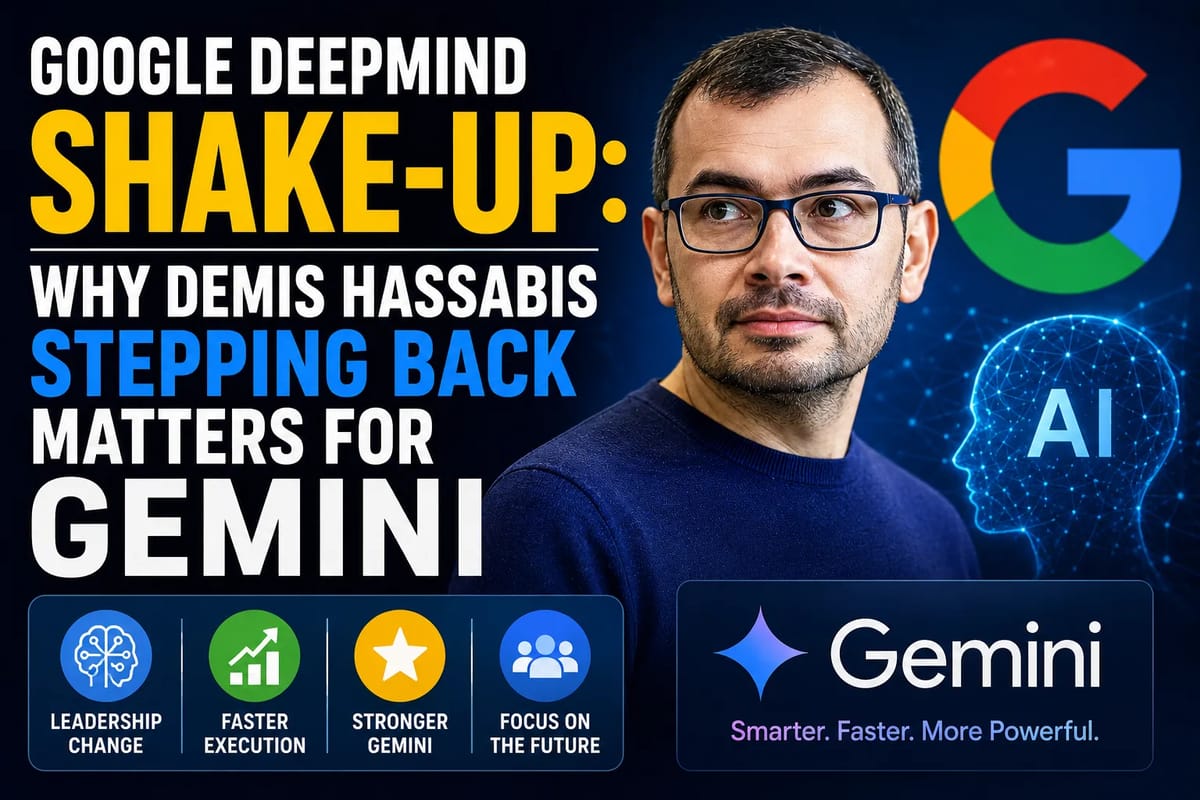
Demis Hassabis, the co-founder and longtime CEO of Google DeepMind, is stepping away from the division's day-to-day leadership and moving into a chairman and senior scientific role. His deputy, Koray Kavukcuoglu, is taking over operational leadership, putting him closer to the center of Google's effort to turn Gemini into a faster-moving commercial AI platform. (Reuters)
The change does not mean Hassabis is leaving Google's AI operation. Instead, it represents a significant shift in responsibilities — and it could have major consequences for how Gemini develops, how quickly Google ships new AI products and how the company balances long-term research with commercial pressure.
What Is Happening at Google DeepMind?
Google DeepMind has spent years combining fundamental AI research with increasingly important consumer and business products.
Hassabis has been at the center of that strategy. Under his leadership, DeepMind became known not only for breakthroughs such as AlphaFold, but also as a crucial part of Google's broader Gemini strategy.
Now, Google is separating scientific leadership from day-to-day operational management.
Kavukcuoglu, who has been a senior technical leader within DeepMind and Google's wider AI organization, will assume responsibility for running the division. Hassabis will remain deeply involved in Google's AI ambitions, particularly longer-term research and artificial general intelligence.
That distinction matters.
This is not simply a story about one executive leaving. It is about who controls the pace, priorities and execution of Google's AI strategy.
Why Demis Hassabis Is So Important to Gemini
Hassabis is more than the CEO of an AI research organization.
He has become one of the most recognizable scientific figures in the artificial intelligence industry and has helped shape Google's long-term approach to advanced AI.
His philosophy has generally emphasized fundamental research and building increasingly capable systems rather than treating AI simply as another software product.
That approach helped DeepMind produce major scientific advances, including AlphaFold. Hassabis has also been increasingly vocal about the potential arrival of artificial general intelligence and the need for society to prepare for increasingly capable AI systems. (Axios)
Gemini, however, operates in a very different environment.
Google is competing directly with companies such as OpenAI and Anthropic, where product launch speed, model performance, developer adoption and consumer engagement are all critical.
That creates a difficult management question:
Should Google prioritize long-term AI research or move faster to turn its research into products that compete in today's market?
The leadership change could be an attempt to address exactly that tension.
The Biggest Change: From Scientist-Led Leadership to Operational Execution
One of the most important implications of the reshuffle is that Gemini's future may become more focused on execution.
Hassabis has helped establish the scientific direction of DeepMind. Kavukcuoglu's expanded responsibilities could put greater emphasis on coordinating teams, allocating resources and getting products and models out the door.
That could be particularly important as Google faces increasing pressure from competitors.
Reuters reported that Google's AI organization has experienced internal tensions, leadership changes and departures while the company has faced pressure to maintain its position in the rapidly developing AI market. (Reuters)
For Gemini users, the question is therefore not simply "Is Demis Hassabis leaving?"
The more important question is:
Will Google's AI division become faster and more focused under a different operating structure?
What This Could Mean for Gemini
1. Faster AI Product Development
One potential benefit is greater emphasis on execution.
Google has enormous AI research capabilities, but having a strong research organization does not automatically guarantee that products reach consumers quickly.
A leadership structure focused more heavily on operations could help Google shorten the distance between research breakthroughs and Gemini features.
That could mean faster improvements to:
- Gemini's reasoning capabilities
- AI agents
- coding tools
- multimodal capabilities
- enterprise AI services
- developer tools
- Google Search integrations
- Android AI features
- productivity applications
The challenge will be making those improvements reliable enough for mass-market use.
2. More Pressure on Gemini to Compete
Gemini is no longer operating in a market where Google can simply experiment at its own pace.
OpenAI and Anthropic have established powerful positions, while other companies are investing heavily in AI models, chips and infrastructure.
Reuters reported that Google had faced concerns about Gemini's competitive position following a period in which the model had briefly led in performance before rivals regained ground. (Reuters)
That creates enormous pressure on Google's leadership.
A more operationally focused DeepMind could be expected to prioritize measurable improvements that users and businesses can actually see.
3. Gemini Could Become More Commercially Focused
Google has billions of users across Search, Android, Gmail, YouTube, Maps and other services.
That gives Gemini an enormous potential distribution advantage.
But turning that advantage into a dominant AI business requires more than building impressive research models.
Google needs to make Gemini useful enough that people use it repeatedly.
That could mean greater emphasis on practical AI capabilities, including:
- completing tasks for users
- working across Google's applications
- helping businesses automate workflows
- writing and debugging software
- analyzing documents
- generating and editing media
- conducting research
- interacting with devices and services
A leadership structure centered more strongly on execution could accelerate that transition.
4. Hassabis May Have More Time for Long-Term AI Research
There is another interpretation that should not be overlooked.
Stepping away from daily management could actually allow Hassabis to spend more time on the scientific problems he cares about most.
Rather than dealing with every operational decision inside DeepMind, he can concentrate on long-term AI research, AGI strategy and scientific applications.
That would be consistent with his public comments about the rapid development of AI.
At Google's 2026 I/O conference, Hassabis described humanity as being at the "foothills of the singularity" and argued that society may have only a few years to prepare for increasingly capable AI systems. (Semafor)
In that sense, the reshuffle could give Hassabis a different kind of influence rather than removing him from Google's AI strategy.
The Gemini 3.5 Question
The timing of the leadership change is particularly significant because Gemini's next generation is facing intense expectations.
Reports have pointed to delays surrounding Gemini 3.5 Pro while Google continues to compete against increasingly capable models from rival AI companies. (MarketWatch)
That puts the new leadership structure under immediate pressure.
The market does not simply want another impressive AI demonstration.
It wants Google to show that Gemini can consistently compete on:
- intelligence
- reliability
- speed
- cost
- coding
- reasoning
- multimodal performance
- agentic capabilities
- enterprise usefulness
If the new structure results in faster development and more consistent releases, the change could eventually be viewed as a strategic advantage.
If delays and internal disruption continue, critics may instead see the reshuffle as evidence that Google is struggling to coordinate its AI operation.
Google's AI Organization Is Getting More Complicated
The leadership change also reflects a broader transformation inside Google.
DeepMind was originally known primarily as a research organization. Today, its work increasingly touches Google's consumer products and commercial AI strategy.
The Gemini app, developer tools and other AI products have increasingly been integrated with DeepMind's research organization over the past several years. Google previously moved the Gemini app team into Google DeepMind as part of an effort to bring research and product development closer together. (Axios)
That strategy makes sense in theory.
The closer researchers and product teams work together, the faster scientific breakthroughs can potentially become useful products.
But it also creates organizational complexity.
Researchers may prioritize ambitious long-term projects while product teams need predictable releases, lower costs and features that millions of people can immediately understand.
The latest leadership change could be Google's attempt to manage that tension more effectively.
A Bigger Issue: Can Google Keep Its AI Talent?
Leadership is only one part of the problem.
Talent is arguably just as important.
Google DeepMind has experienced high-profile departures as competition for AI researchers and engineers has intensified. Hassabis himself argued earlier this year that Google still had an exceptionally broad research bench despite concerns about talent leaving. (Semafor)
The challenge is keeping those researchers motivated while also pushing them toward commercial goals.
If Google's organizational changes improve that balance, Gemini could benefit significantly.
If researchers believe the company is becoming too focused on short-term product competition, however, Google could face additional retention challenges.
The AI Safety Question Has Not Disappeared
There is another reason Hassabis's new role could matter.
Hassabis has increasingly participated in discussions about how increasingly powerful AI systems should be governed.
Before the latest leadership transition, he was reportedly involved in efforts to develop an international framework for AI safety oversight. His proposal called for an organization that could establish standards and evaluate advanced AI systems, drawing comparisons with international institutions created to manage other high-risk technologies. (The Wall Street Journal)
That means his influence may extend beyond Gemini's immediate product roadmap.
As AI systems become more capable, Google will have to balance several competing objectives:
- Building more powerful models.
- Deploying them quickly.
- Keeping them commercially competitive.
- Managing safety risks.
- Maintaining public trust.
- Complying with increasingly complex regulations.
Hassabis moving toward a more scientific and strategic role could allow him to concentrate more heavily on those longer-term questions.
What Users Should Watch Next
The most useful way to judge the DeepMind reshuffle will not be by titles.
It will be by results.
Over the coming months, several signals will reveal whether the new structure is working.
Gemini Release Speed
Are major Gemini upgrades arriving faster?
Model Performance
Can Google maintain or regain leadership across important AI benchmarks and real-world tasks?
Product Integration
Does Gemini become more deeply integrated into Search, Android, Workspace and other Google products?
Developer Adoption
Do developers increasingly choose Gemini's models and tools for building applications?
AI Agents
Can Google turn Gemini from a chatbot into an AI system capable of completing multi-step tasks reliably?
Talent Retention
Can DeepMind continue attracting and retaining top AI researchers?
These factors will matter far more than the organizational chart itself.
Why This Matters Beyond Google
The DeepMind reshuffle is significant because Google is one of the few companies with the resources to compete across almost every layer of the AI stack.
It has:
- enormous computing infrastructure
- custom AI chips
- a global consumer ecosystem
- massive amounts of software distribution
- world-class AI researchers
- the Gemini model family
- billions of existing users
That makes Google's AI strategy important far beyond the company itself.
If Google successfully combines DeepMind's research strength with faster product execution, Gemini could become one of the most deeply integrated AI platforms in the world.
If it fails to execute, competitors may have more time to strengthen their positions.
The Real Test Begins With Execution
Demis Hassabis stepping back from the day-to-day leadership of Google DeepMind is therefore neither a simple retirement story nor proof that Gemini is in trouble.
It is a structural bet.
Google appears to be separating the responsibilities of long-term scientific leadership from the daily management required to compete in an increasingly aggressive AI market. Hassabis remains deeply connected to Google's AI ambitions, while Koray Kavukcuoglu takes on greater responsibility for running the organization. (Reuters)
For Gemini, the outcome will ultimately be measured by what users can see.
Faster releases, stronger models, better AI agents and deeper integration across Google's products would make the reshuffle look strategic. Continued delays, talent losses or inconsistent execution would raise very different questions.
Either way, Google's next phase of the AI race is no longer just about who can build the smartest model. It is about who can turn frontier AI research into products that people actually use — quickly, reliably and at enormous scale.