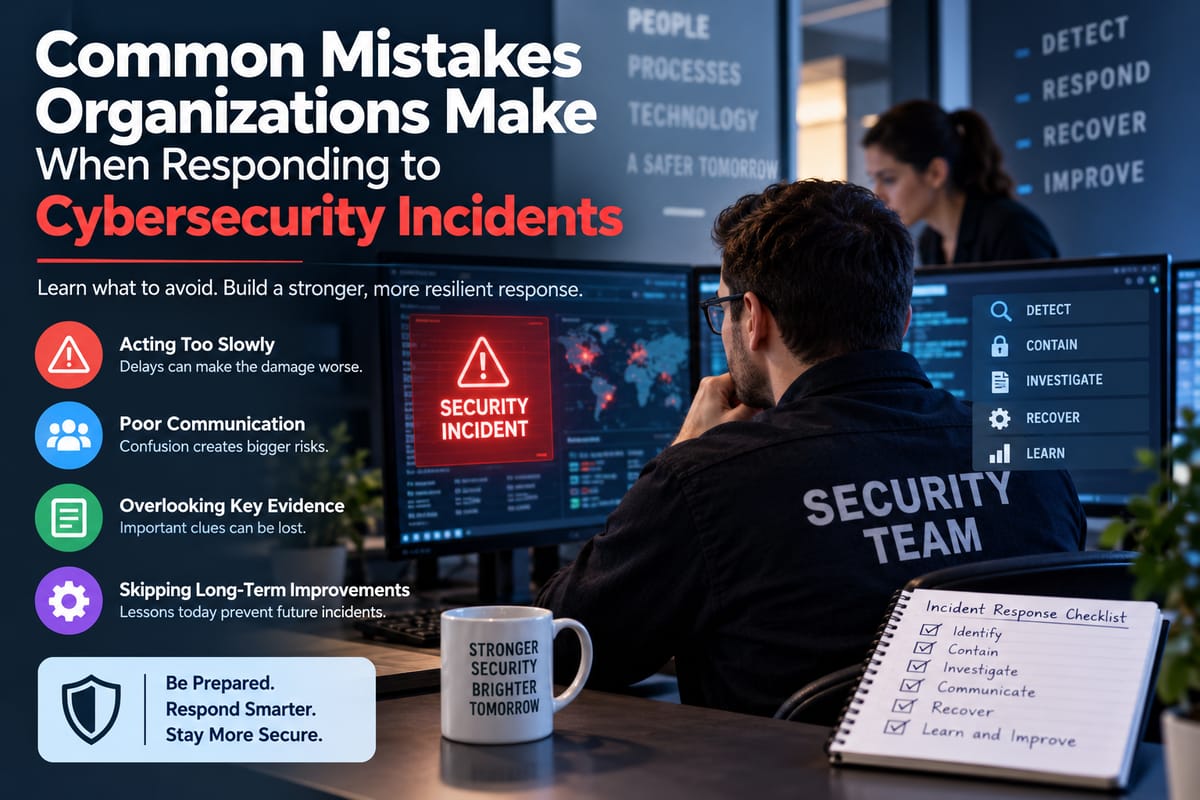
Common Mistakes Organizations Make When Responding to Cybersecurity Incidents
A cybersecurity incident can move quickly from a technical problem to a major business disruption. A compromised account, malware infection, exposed database, ransomware attack, or suspicious network activity can force an organization to make important decisions while information is still incomplete.
The pressure can lead organizations to focus entirely on stopping the immediate threat. While containment is important, the way an organization communicates, investigates, documents, and recovers from an incident can have just as much impact on the eventual outcome.
Many cybersecurity incidents become more difficult to manage because of avoidable response mistakes. Organizations may delay escalation, overlook evidence, communicate inconsistently, or fail to understand the broader risks surrounding the event.
Understanding these common mistakes can help organizations build a more disciplined approach to incident response.
Why Cybersecurity Incident Response Matters
Cybersecurity incident response is the structured process an organization uses to identify, contain, investigate, recover from, and learn from a security incident.
A response may involve security teams, IT administrators, executives, legal professionals, communications staff, human resources, outside specialists, and other stakeholders.
A well-organized response helps answer critical questions:
- What happened?
- When did it happen?
- Which systems or accounts were affected?
- Is the threat still active?
- What information may have been exposed?
- How should the incident be contained?
- Who needs to be informed?
- How can affected systems be safely restored?
- What should change afterward?
Organizations that have already established these processes are generally better positioned to make decisions under pressure.
For a broader explanation of the process, how incident response handles cybersecurity events provides useful context on how organizations can approach security incidents from detection through recovery.
Mistake 1: Waiting Too Long to Escalate an Incident
One of the most damaging mistakes is treating suspicious activity as a minor technical issue for too long.
An employee might notice an unusual login. An administrator might discover an unfamiliar account. A security tool might generate repeated alerts. A workstation might suddenly begin behaving differently.
Not every alert represents a serious breach, but waiting until there is absolute certainty before escalating can give an attacker additional time.
A sensible response process should establish clear escalation criteria.
For example, an organization may require immediate escalation when there is evidence of:
- Unauthorized access
- Privilege escalation
- Suspicious administrator activity
- Malware execution
- Data exfiltration
- Ransomware activity
- Multiple compromised accounts
- Unusual activity across several systems
Early escalation does not necessarily mean declaring a major breach. It means ensuring that appropriate personnel can assess the situation before it grows.
Mistake 2: Failing to Define Who Is in Charge
Cybersecurity incidents can quickly become chaotic when multiple people attempt to direct the response without clear responsibilities.
Security analysts may focus on technical investigation. IT teams may concentrate on restoring services. Executives may need to make business decisions. Legal and communications teams may have separate responsibilities.
Without clearly defined ownership, important tasks can fall through the cracks.
An incident response plan should establish:
- Who coordinates the overall response
- Who makes technical containment decisions
- Who communicates with executives
- Who manages external communications
- Who handles legal or regulatory considerations
- Who coordinates with outside specialists
- Who approves system restoration
The exact structure will differ between organizations, but responsibilities should be established before a serious incident occurs.
Mistake 3: Ignoring Security Alerts Until They Become Obvious
Modern organizations can generate enormous amounts of security data. The challenge is distinguishing routine activity from meaningful warning signs.
Ignoring alerts because there are too many of them can create opportunities for attackers.
Security operations teams play an important role in identifying suspicious activity and determining which events deserve investigation. Organizations can learn more about this process through how security operations teams detect cybersecurity threats.
Common warning signs may include:
- Repeated failed login attempts
- Login activity from unusual locations
- Unexpected administrator changes
- Unusual data transfers
- New software appearing without authorization
- Abnormal network connections
- Unexpected changes to security controls
- Multiple alerts involving the same account or system
The goal is not to investigate every alert as though it were a confirmed breach. It is to ensure that potentially significant signals are correlated and investigated appropriately.
Mistake 4: Containing the Threat Without Preserving Evidence
Stopping an attacker is obviously important, but immediately shutting down or wiping affected systems can sometimes destroy valuable evidence.
Logs, memory contents, system files, authentication records, network information, and other artifacts may help investigators determine what happened.
Before taking disruptive containment actions, organizations should consider whether relevant evidence needs to be preserved.
This does not mean leaving a compromised system online indefinitely. It means coordinating containment and investigation carefully.
Organizations should establish procedures for:
- Preserving relevant logs
- Recording important timestamps
- Documenting affected systems
- Capturing relevant evidence
- Maintaining appropriate chain-of-custody procedures when necessary
- Recording containment actions
- Keeping an incident timeline
The exact requirements depend on the nature of the incident and the organization's legal, regulatory, and operational environment.
Mistake 5: Disconnecting Systems Without Understanding the Consequences
Isolating a compromised device or system can be an important containment measure. However, indiscriminately shutting down systems can create additional operational problems.
For example, disconnecting a critical server without understanding its dependencies could interrupt unrelated business services.
Before taking major containment actions, response teams should consider:
- What systems depend on the affected resource?
- Is the attacker still active?
- Can the system be isolated without affecting essential operations?
- Is there a safer containment method?
- What evidence could be lost?
- Who needs to approve the action?
The objective is controlled containment rather than uncontrolled disruption.
Mistake 6: Focusing Only on the Initial Compromised Device
An incident may begin with one compromised endpoint, account, or application, but the initial point of discovery is not necessarily the full scope of the attack.
Attackers may move laterally through networks, establish additional accounts, create persistence mechanisms, or access multiple systems.
This is why incident responders need to investigate beyond the first known point of compromise.
Questions worth considering include:
- Were other accounts accessed?
- Did the attacker obtain elevated privileges?
- Were additional devices compromised?
- Did suspicious activity occur elsewhere?
- Were cloud services affected?
- Was sensitive data accessed?
- Did the attacker establish persistence?
A narrow investigation can result in an organization declaring an incident contained when unauthorized activity still exists elsewhere.
Mistake 7: Neglecting Identity and Access Controls
Compromised credentials are frequently relevant to cybersecurity incidents, making identity security an important part of incident response.
Organizations sometimes focus heavily on infected computers while overlooking the accounts that may have allowed an attacker to access them.
During an investigation, teams may need to examine:
- Password changes
- Multifactor authentication events
- Privileged accounts
- Suspicious login locations
- Newly created accounts
- Unusual access permissions
- Service accounts
- API keys and access tokens
- Remote access activity
Depending on the incident, response actions may include resetting credentials, revoking sessions, disabling compromised accounts, rotating keys, or strengthening authentication controls.
These actions should be coordinated carefully so that legitimate users and essential services are not unnecessarily disrupted.
Mistake 8: Treating Cybersecurity Risk Management as Separate From Incident Response
Incident response should not exist in isolation from an organization's broader cybersecurity risk strategy.
An incident can reveal weaknesses that were previously unknown or underestimated.
For example, an investigation might reveal:
- An outdated system
- Excessive user privileges
- Poor network segmentation
- Inadequate logging
- Weak authentication controls
- An unprotected third-party connection
- Missing security policies
- Insufficient employee training
These findings should feed back into the organization's wider risk management process.
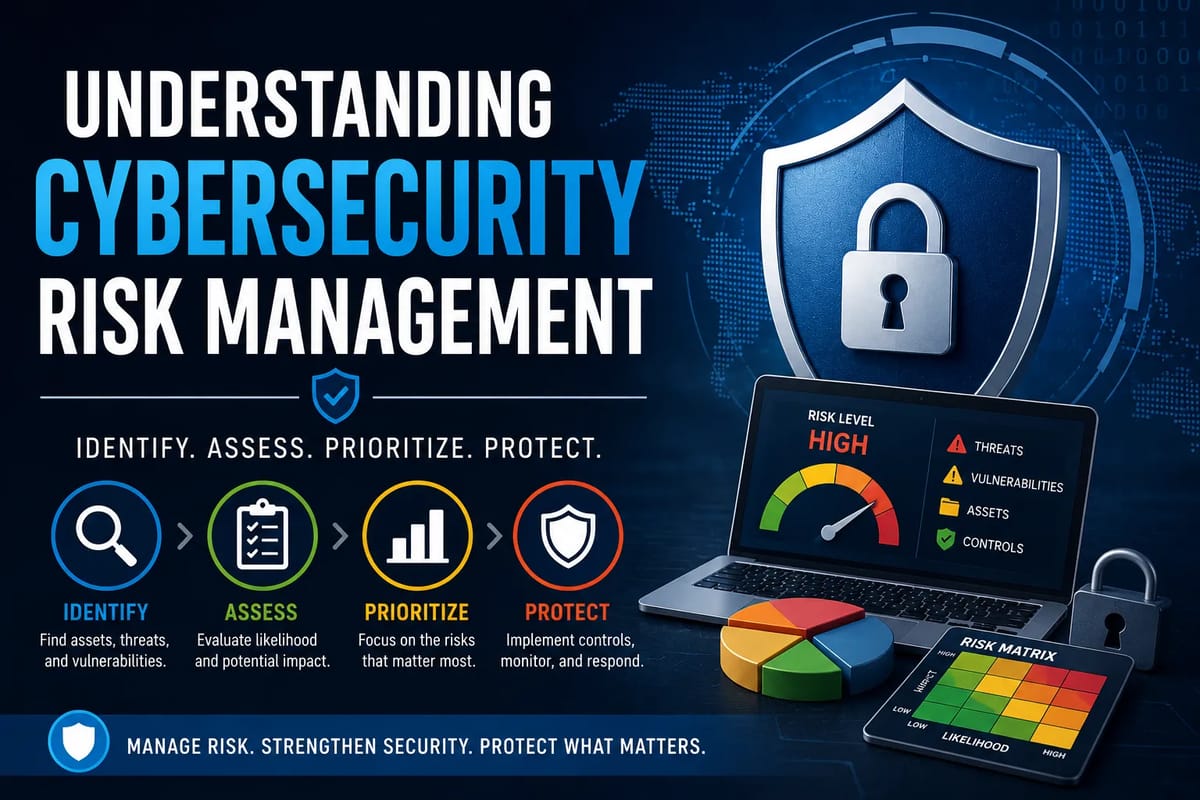
Understanding cybersecurity risk management provides broader context on identifying, assessing, and managing security risks before they develop into serious incidents.
The incident itself can therefore become a source of information for improving future security decisions.
Mistake 9: Forgetting About Network Visibility
Organizations cannot investigate activity they cannot see.
Incomplete network visibility can make it difficult to determine whether an attacker moved between systems, communicated with external infrastructure, or transferred information.
Network security controls can provide important layers of visibility and protection.
A complete guide to network security offers a broader look at the technologies and practices organizations can use to protect networked systems.
During an incident, response teams may examine:
- Firewall activity
- Network connections
- DNS requests
- Remote access
- Traffic between internal systems
- Unusual outbound communications
- Segmentation controls
- Wireless activity
- Virtual and cloud network activity
The quality of available network data can significantly affect an investigation.
Mistake 10: Communicating Too Little or Too Much
Communication can become difficult during a cybersecurity incident because different audiences need different information.
Employees may need instructions about passwords or system access. Executives may need information about business impact. Customers may require appropriate notifications if their information is affected.
At the same time, releasing unverified information can create additional problems.
A strong communication process should emphasize:
- Accuracy
- Consistency
- Timeliness
- Appropriate confidentiality
- Clear ownership
- Documented approval processes
Internal communications should also make it clear where employees should report suspicious activity and which instructions they should follow.
Mistake 11: Allowing Everyone to Investigate Independently
A major incident can attract attention from many parts of an organization. While collaboration is valuable, uncontrolled investigation can make the situation harder to manage.
Employees may accidentally alter evidence, communicate with attackers, delete relevant files, or make unauthorized changes to systems.
Organizations should establish clear instructions for what employees should and should not do during an incident.
For example, personnel who discover suspicious activity may be instructed to report it through the designated security channel rather than attempting to investigate it themselves.
This allows trained responders to coordinate the investigation while reducing the risk of accidental evidence destruction or additional disruption.
Mistake 12: Restoring Systems Too Quickly
Once the immediate threat appears to be under control, organizations may feel pressure to restore normal operations as quickly as possible.
Rapid recovery can be important for business continuity, but restoring a compromised environment before understanding how the attacker gained access can create another incident.
Before restoration, teams should consider whether:
- The initial vulnerability has been addressed
- Compromised credentials have been secured
- Persistence mechanisms have been removed
- Systems have been appropriately checked
- Security controls are functioning
- Monitoring is in place
- Backups are trustworthy
- Relevant evidence has been preserved
Recovery should be treated as a controlled process rather than simply turning systems back on.
Mistake 13: Failing to Test Backups Before They Are Needed
Backups are often discussed as a critical part of ransomware and disaster recovery planning, but simply having backups does not guarantee that an organization can recover successfully.
Backups can be incomplete, corrupted, inaccessible, improperly configured, or compromised during an attack.
Organizations should periodically test whether they can actually restore important systems and data.
Testing can reveal problems involving:
- Missing files
- Incorrect retention periods
- Broken restoration procedures
- Insufficient storage capacity
- Incompatible systems
- Unclear recovery responsibilities
- Excessive recovery times
A tested recovery process gives incident responders a clearer understanding of what can realistically be restored and how long recovery may take.
Mistake 14: Not Documenting Decisions During the Incident
Cybersecurity incidents can involve dozens or hundreds of decisions.
If those decisions are not documented, it may become difficult to reconstruct what happened later.
An incident timeline can record:
- When the incident was discovered
- Who identified it
- Which systems were affected
- When escalation occurred
- What containment actions were taken
- What evidence was collected
- When systems were restored
- When communications were issued
- What major decisions were made
Documentation supports the investigation and can also make the post-incident review considerably more useful.
Mistake 15: Treating the Incident as Over Once Systems Are Restored
System restoration does not necessarily mark the end of the response process.
After recovery, organizations should examine why the incident occurred and what can be changed to reduce the likelihood or impact of a similar event.
A post-incident review may consider:
- What worked well?
- Where did the response slow down?
- Which security controls failed?
- Were alerts detected quickly enough?
- Were responsibilities clear?
- Was communication effective?
- Were recovery procedures adequate?
- What vulnerabilities remain?
- Which improvements should be prioritized?
The goal is not simply to identify who made a mistake. It is to identify weaknesses in systems, processes, technology, training, and decision-making.
How Organizations Can Reduce Response Mistakes
The strongest incident response improvements usually happen before an incident occurs.
Organizations can prepare by developing:
- A documented incident response plan
Define procedures, responsibilities, escalation paths, and communication processes. - Clear incident severity levels
Establish criteria for determining which events require immediate escalation. - Reliable security monitoring
Make sure important systems generate useful and accessible security information. - Regular response exercises
Simulate realistic incidents so teams can practice making decisions under pressure. - Strong identity controls
Protect privileged accounts and implement appropriate authentication safeguards. - Network visibility and segmentation
Make it easier to detect unusual activity and limit lateral movement. - Tested backup and recovery procedures
Verify that critical systems and data can actually be restored. - Documented communication procedures
Establish who communicates what, when, and to whom. - Post-incident improvement processes
Turn lessons from incidents into concrete security improvements.
Building a More Disciplined Cybersecurity Response
Cybersecurity incidents rarely follow a perfectly predictable script. Organizations may have to make decisions with incomplete information while balancing security, business continuity, legal requirements, and the needs of employees and customers.
The most common response mistakes often involve failures of preparation rather than a lack of technical tools. Delayed escalation, poor visibility, unclear responsibilities, weak documentation, incomplete investigation, and rushed recovery can all make an incident harder to contain.
A disciplined response process gives organizations a framework for dealing with that uncertainty. By preparing roles in advance, maintaining useful security visibility, protecting evidence, coordinating communication, and learning from every incident, organizations can make their response more structured and resilient when the next cybersecurity event occurs.