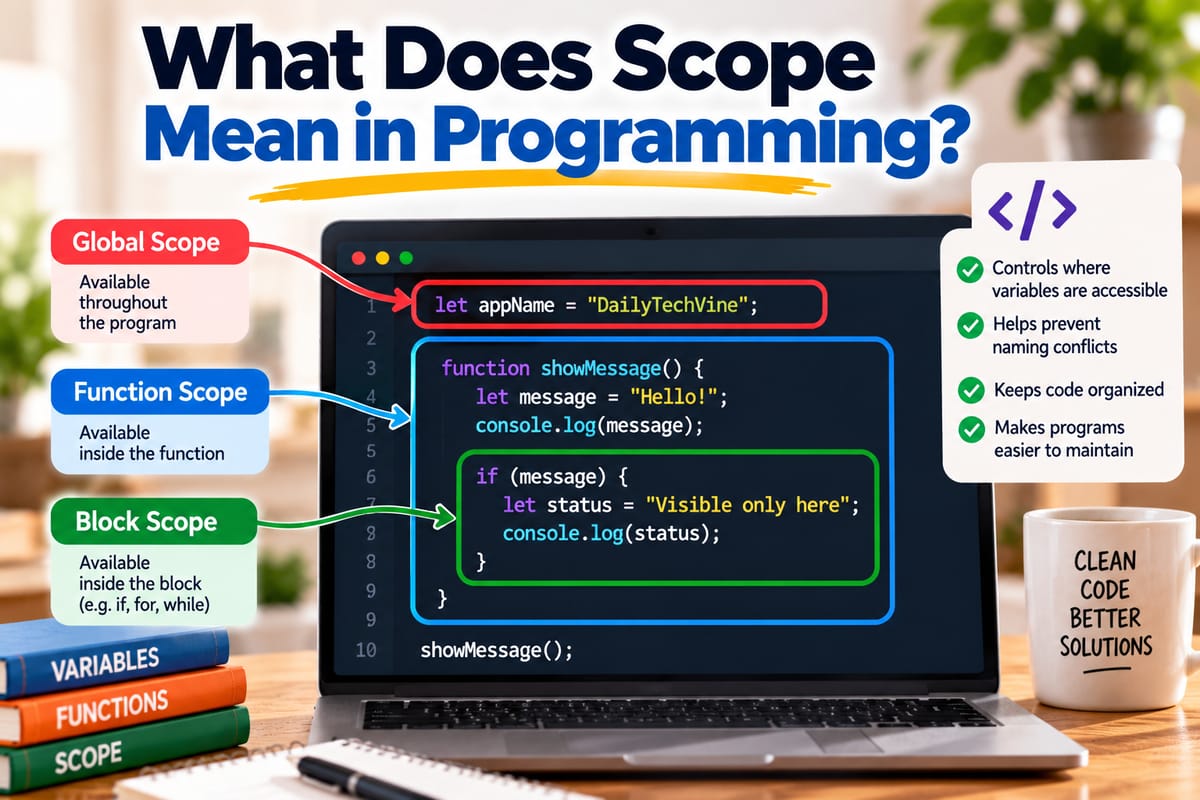
What Does Scope Mean in Programming?
Scope is one of the fundamental concepts in programming. It determines where a variable, function, or other named element can be accessed within a program.
At first, scope can seem like a small technical detail. In practice, it has a major effect on how programs are organized, how data is managed, and how developers prevent different parts of an application from interfering with one another.
When a programmer creates a variable, that variable does not necessarily become available everywhere in the program. Its scope determines where the name can be recognized and used.
Understanding scope makes it easier to read code, write functions, avoid naming conflicts, debug problems, and design software that is easier to maintain.
What Is Scope in Programming?
Scope is the region of a program in which a particular name can be accessed or referenced.
A name might refer to:
- A variable
- A function
- A constant
- A class
- A parameter
- An imported module
- Another programming construct
For example, a variable created inside a function may only be available within that function.
A variable created at a broader level may be accessible from many parts of a program.
The exact rules depend on the programming language, but the underlying idea is similar: scope determines where something is visible to the program.
A Simple Example of Scope
Consider this simplified pseudocode:
function calculateTotal():
price = 50
quantity = 2
total = price * quantity
return total
The variables price, quantity, and total belong to the function's local scope.
They are created for use inside calculateTotal().
Another part of the program cannot necessarily access those variables directly.
This separation helps keep the function's internal details contained.
Why Scope Matters
Scope helps developers control which parts of a program can access particular pieces of data.
It can help:
- Prevent naming conflicts
- Protect local data
- Organize code
- Reduce unintended changes
- Make functions easier to understand
- Improve maintainability
- Make debugging easier
- Limit unnecessary dependencies
Without scope rules, large programs could become extremely difficult to manage because every variable could potentially interact with every other variable.
Scope creates boundaries.
Scope and Variables
Variables are one of the most common programming elements affected by scope.
A variable stores information that a program can use while it runs.
Depending on where a variable is declared, it might be:
- Local
- Global
- Block-scoped
- Module-scoped
- Class-scoped
The terminology varies between programming languages.
For a broader introduction to programming concepts, What Is Programming and How Does It Work? explains how programmers use instructions, data, variables, and other concepts to create software.
Local Scope
A variable has local scope when it is available only within a particular function, method, procedure, or other limited region.
For example:
def greet():
message = "Hello"
print(message)
Here, message is local to the greet() function.
Code outside the function generally cannot directly access that local variable.
This provides a useful boundary around the function's internal data.
Why Local Variables Are Useful
Local variables are valuable because they reduce unnecessary interaction between different parts of a program.
Suppose several functions each need a variable called total.
With local scope, each function can have its own total without necessarily interfering with the others.
For example:
def calculate_order():
total = 100
return total
def calculate_invoice():
total = 250
return total
Both functions use the name total, but the variables belong to different local scopes.
The meaning of total depends on the context in which it is accessed.
Global Scope
A variable in global scope is generally available across a much broader portion of a program.
For example:
tax_rate = 0.15
def calculate_tax(price):
return price * tax_rate
Here, tax_rate is defined outside the function.
The function can access it because the variable exists in a broader scope.
Global variables can sometimes be useful, but they should be handled carefully.
Problems With Excessive Global Variables
Global variables can make software harder to understand when many parts of a program can modify them.
Consider a program with dozens of functions that can change the same global variable.
A developer investigating a problem may need to determine:
- Which function changed it?
- When was it changed?
- What value did it have before?
- Which parts of the application depend on it?
This can make debugging more difficult.
Keeping data closer to the code that actually needs it can reduce these problems.
Local Scope Versus Global Scope
The difference can be summarized simply:
| Local Scope | Global Scope |
|---|---|
| Limited to a particular region | Available across a broader region |
| Reduces unintended access | Can be accessed from many locations |
| Useful for temporary calculations | Useful for shared information in appropriate cases |
| Often easier to reason about | Can create wider dependencies |
| Common inside functions | Often declared outside functions |
Neither concept is inherently good or bad.
The appropriate choice depends on the programming language and design of the application.
Block Scope
Some programming languages support block scope.
A block is a section of code enclosed by a particular structure, such as braces in languages like JavaScript, Java, C++, and C#.
For example:
if (score > 50) {
let result = "Pass";
console.log(result);
}
The variable result is declared using let inside the block.
It is available within that block but not necessarily outside it.
Block scope can help keep temporary variables limited to the section of code where they are needed.
Function Scope
Some languages use function-level scope for particular types of variables.
JavaScript provides a useful example.
Variables declared with var are function-scoped, while variables declared with let and const are block-scoped.
For example:
function example() {
if (true) {
var a = 10;
let b = 20;
}
console.log(a);
}
The variable a can be accessed outside the if block because var is function-scoped.
The variable b is limited to the block in which it was declared.
These distinctions are important when working with languages that support multiple scope rules.
Lexical Scope
Lexical scope, also called static scope, determines variable accessibility based on where code is written in the program.
Languages that use lexical scoping determine the relationship between nested code regions according to the structure of the source code.
Consider:
let name = "Alex";
function greet() {
console.log(name);
}
The function can access name because the function is defined within a context where that variable is available.
The important idea is that scope is determined by the structure of the code rather than simply by where a function happens to be called.
Nested Scope
Scopes can exist inside other scopes.
For example:
Global Scope
|
└── Function Scope
|
└── Block Scope
An inner scope can often access names from an outer scope.
However, the reverse is generally not true.
A variable created inside the inner scope does not automatically become available to the outer scope.
This creates a hierarchy of accessibility.
Scope Chains
When a programming language uses nested lexical scopes, the program may search through a sequence of scopes when resolving a name.
This is often described as a scope chain.
Suppose code contains:
let x = 10;
function outer() {
let y = 20;
function inner() {
    let z \= 30;
    console.log(x);
    console.log(y);
    console.log(z);
}
}
Inside inner(), the program can potentially find:
zin the inner scopeyin the outer function's scopexin the global scope
The program searches outward when resolving names.
Shadowing
Shadowing occurs when a variable in an inner scope has the same name as a variable in an outer scope.
For example:
let name = "Alex";
function greet() {
let name = "Jordan";
console.log(name);
}
Inside greet(), the local name shadows the outer name.
The function therefore uses "Jordan" when referring to name.
Shadowing can be useful, but excessive use can make code confusing.
Why Variable Names Matter
Scope does not eliminate the importance of clear naming.
Consider:
let price = 100;
function calculate() {
let price = 50;
}
This is technically possible, but a developer reading the code must understand which price is being referenced at each location.
Clear and meaningful names can reduce confusion.
For example, using names such as:
productPrice
discountedPrice
shippingCost
may make the code easier to understand.
Scope and Functions
Functions are closely connected to scope.
A function often creates its own local environment for variables and parameters.
For example:
def calculate_area(width, height):
area = width * height
return area
The parameters width and height belong to the function's local context, as does area.
This makes functions useful organizational units.
The article How Functions Organize Program Logic explores how functions break larger programs into smaller, reusable units.
Parameters Have Scope
Function parameters are also variables with a defined scope.
Consider:
def multiply(number, factor):
result = number * factor
return result
Here:
numberis a parameterfactoris a parameterresultis a local variable
All three are available inside the function.
They are part of the function's local execution context.
Scope and Function Calls
When a function is called, the programming language typically creates an execution context in which its parameters and local variables can exist.
For example:
def add(a, b):
total = a + b
return total
result = add(5, 10)
During the execution of add(), the function has access to:
abtotal
After the function finishes, those local variables are no longer directly accessible from the surrounding code.
This helps isolate one function's internal state from another.
Scope and Memory
Scope and memory are related, but they are not exactly the same thing.
A variable's scope determines where the program can refer to it by name.
Memory management determines how the computer stores and manages the underlying data.
A local variable may exist in memory while a function is running, but the precise behavior depends on the programming language and its runtime system.
In languages with garbage collection, objects may remain in memory as long as something still references them.
Therefore, scope is primarily about accessibility and name visibility rather than simply describing where data physically exists in memory.
Scope and Closures
A closure occurs when a function retains access to variables from an enclosing scope even after the enclosing function has finished executing.
For example, in JavaScript:
function createCounter() {
let count = 0;
return function () {
    count++;
    return count;
};
}
const counter = createCounter();
console.log(counter());
console.log(counter());
The returned function continues to access count.
The inner function forms a closure over the surrounding variable.
Closures are useful in many programming patterns, including data encapsulation, callbacks, and functional programming.
Scope and Modules
Modern software is often divided into modules.
A module can contain related functions, variables, classes, and other definitions.
Module systems can help control which elements are exposed to other parts of an application.
For example, a module might contain several internal helper functions but export only one public function.
Conceptually:
Module
├── publicFunction
├── helperFunction
├── internalVariable
└── privateImplementation
Other modules may only be able to access the explicitly exported elements.
This helps create boundaries between components.
Scope and Encapsulation
Scope contributes to encapsulation, the practice of keeping related data and implementation details together while limiting unnecessary external access.
For example, a function might manage its own internal variables and expose only its return value.
This allows other parts of the application to use the function without needing to know every detail of how it works.
Encapsulation can make software easier to modify because internal implementation details can change without necessarily affecting every caller.
Scope in Object-Oriented Programming
Object-oriented languages introduce additional concepts related to scope and visibility.
A class can contain:
- Fields
- Properties
- Methods
- Constructors
- Other members
Different access mechanisms may determine whether these members can be used from:
- Inside the class
- From subclasses
- From other classes
- From other modules
Access modifiers such as public, private, and protected are related to visibility and encapsulation, although they are not exactly the same concept as lexical variable scope.
Understanding both ideas helps developers design clearer object-oriented software.
Scope and Programming Languages
Different programming languages implement scope in different ways.
Some support:
- Global scope
- Function scope
- Block scope
- Module scope
- Class scope
- Lexical scope
- Dynamic scope
Others may use different terminology or rules.
The details can also vary depending on the language version.
Because scope is a language feature, developers should understand the rules of the particular language they are using.
The article What Are Programming Languages and How Do Different Languages Work? provides broader context on how programming languages differ and how they translate instructions into executable behavior.
Static Scope and Dynamic Scope
Two broad approaches to scope are often discussed: static scope and dynamic scope.
Static Scope
With static or lexical scope, the accessibility of names is determined primarily by the structure of the source code.
This is common in many modern programming languages.
Dynamic Scope
With dynamic scope, name resolution can depend more heavily on the sequence of function calls during program execution.
Dynamic scoping is less common in mainstream modern programming languages, but the concept is important when studying programming-language design.
The distinction illustrates that scope is not simply a universal rule. It is part of a language's design.
Scope and Algorithms
Scope can also affect how algorithms are implemented.
An algorithm may use temporary variables, counters, collections, and other values that only need to exist during a particular calculation.
Keeping those variables within an appropriate scope can prevent unrelated parts of a program from depending on implementation details.
For example:
def find_largest(numbers):
largest = numbers[0]
for number in numbers:
    if number \> largest:
        largest \= number

return largest
The variables largest and number are implementation details of the function.
Other parts of the program generally do not need direct access to them.
Algorithms are structured sets of instructions for solving problems, and Algorithms Explained: Complete Programming Guide provides broader context on how algorithms are designed and implemented.
Scope and Name Resolution
When a programmer writes a name such as:
total
the programming language needs to determine which total the code is referring to.
It may search the relevant scopes according to the language's rules.
If the name cannot be found, the program may produce an error.
For example:
def calculate():
price = 50
print(price)
Here, price exists inside calculate() but is not necessarily available where print(price) is executed.
This is a scope-related error.
Scope Errors
Scope-related errors can occur in several ways.
Referencing a Local Variable Outside Its Scope
def example():
message = "Hello"
print(message)
The outer code cannot directly access the local variable.
Using a Name Before It Is Available
A language may produce an error when code attempts to access a variable before its declaration or initialization according to that language's rules.
Accidentally Shadowing a Variable
An inner variable may unintentionally hide an outer variable with the same name.
Modifying Shared State
A function may unexpectedly change a variable that other parts of a program depend on.
These problems can often be reduced through careful scope management.
Scope and Debugging
Scope is particularly important when debugging.
Suppose a developer sees an unexpected variable value.
They need to determine:
- Which variable is being referenced?
- Which scope contains it?
- Was another variable with the same name created elsewhere?
- Is the code accessing an outer scope?
- Has a variable been shadowed?
- Is a function using the expected value?
Understanding scope can make these questions much easier to answer.
Scope and Code Readability
Well-managed scope can make code easier to read because variables are located near the operations that use them.
For example:
def calculate_discount(price):
discount = price * 0.10
return price – discount
The variable discount exists only where it is needed.
A reader does not have to search an entire application to determine where the value comes from.
This is especially valuable in large software projects.
Scope and Maintainability
Maintainable software should be understandable enough that developers can modify it without unnecessarily creating new problems.
Appropriate scope helps by limiting the number of places that can interact with a variable.
If a value is used only by one function, keeping it local can reduce dependencies.
If information genuinely needs to be shared, developers can expose it through a controlled interface.
This creates clearer boundaries between components.
Scope and Reusability
Functions with well-contained state can often be easier to reuse.
Consider:
def calculate_total(price, quantity):
return price * quantity
The function does not depend on a global price or quantity.
Instead, it receives the values it needs as parameters.
That makes the function easier to reuse with different inputs.
Scope and Side Effects
A side effect occurs when a function changes something outside its immediate local context.
For example, a function might modify a global variable.
This can sometimes be appropriate, but excessive side effects can make programs harder to reason about.
A function that receives inputs and produces an output without unexpectedly changing unrelated state is often easier to understand.
Scope can therefore be part of designing predictable software.
How Developers Can Manage Scope Effectively
Several practices can help developers use scope thoughtfully.
Keep Variables Close to Where They Are Used
If a variable is needed only inside a function, consider keeping it local.
Avoid Unnecessary Global State
Global variables can create dependencies between unrelated parts of an application.
Use Clear Names
Good names reduce confusion when scopes overlap.
Keep Functions Focused
Smaller functions can make local scope easier to understand.
Be Careful With Shadowing
Using the same name in nested scopes can sometimes make code harder to read.
Pass Values Explicitly
Function parameters make dependencies visible.
Understand the Language's Scope Rules
Different languages handle declarations and visibility differently.
A Practical Scope Example
Imagine a program that calculates the price of an online order.
It might contain:
tax_rate = 0.15
def calculate_subtotal(items):
subtotal = 0
for item in items:
    subtotal \+= item.price

return subtotal
def calculate_tax(subtotal):
tax = subtotal * tax_rate
return tax
Here:
tax_ratehas broad scope.subtotalis local tocalculate_subtotal().itemis used within the loop.taxis local tocalculate_tax().
Each variable has a role and a corresponding scope.
The functions can work together without exposing every internal calculation to the rest of the program.
Scope Is a Boundary for Program Logic
One useful way to think about scope is as a boundary.
Inside the boundary, a name may be available.
Outside the boundary, it may not be.
For example:
Program
│
├── Global Scope
│
├── Function A
│ ├── localVariable
│ └── parameter
│
└── Function B
├── localVariable
└── parameter
The two functions can each have a variable with the same name without necessarily referring to the same value.
That separation is one of the reasons scope is so useful.
Common Misunderstandings About Scope
"Every Variable Can Be Used Everywhere"
Not necessarily. Accessibility depends on where the variable is declared and the language's scope rules.
"Local Variables Always Disappear From Memory Immediately"
Scope describes accessibility, not necessarily the exact lifetime of an object in memory.
"Global Variables Are Always Bad"
Global state can be appropriate in some situations. The issue is usually unnecessary or poorly controlled global dependencies.
"Scope Is the Same as Lifetime"
Scope concerns where a name can be referenced. Lifetime concerns how long an object or value exists during program execution. The two concepts can be related without being identical.
"All Programming Languages Handle Scope the Same Way"
They do not. Scope rules vary between languages.
Why Scope Becomes More Important as Programs Grow
A small program may contain only a few variables and functions.
A large application can contain:
- Thousands of variables
- Hundreds of functions
- Multiple modules
- Numerous classes
- External libraries
- Several development teams
Without clear boundaries, the relationships between these elements can become difficult to understand.
Scope helps create structure.
It limits where names can be accessed and reduces unnecessary connections between unrelated parts of a program.
Learning Scope Through Practice
One of the best ways to understand scope is to experiment.
Try creating:
- A global variable.
- A function with a local variable.
- A nested block.
- Two variables with the same name in different scopes.
- A function that receives parameters.
- A closure that accesses an outer variable.
Then observe which variables can be accessed from each location.
Different programming languages can produce different results, making these experiments especially useful for understanding language-specific rules.
Building Better Programs With Scope
Scope may appear to be a narrow programming concept, but it influences many aspects of software design.
It affects how variables are organized, how functions communicate, how modules expose functionality, how developers debug code, and how applications prevent unrelated components from interfering with each other.
The basic principle is straightforward:
A name should generally be accessible where it is needed and kept out of places where it does not belong.
By understanding local, global, block, function, module, and nested scopes, developers can write code with clearer boundaries and fewer unintended dependencies.
Scope is therefore not simply a rule about where variables can be used. It is one of the mechanisms that helps turn collections of instructions into organized, understandable software.