US and Europe Take Different Paths on AI Regulation as Safety Debate Intensifies
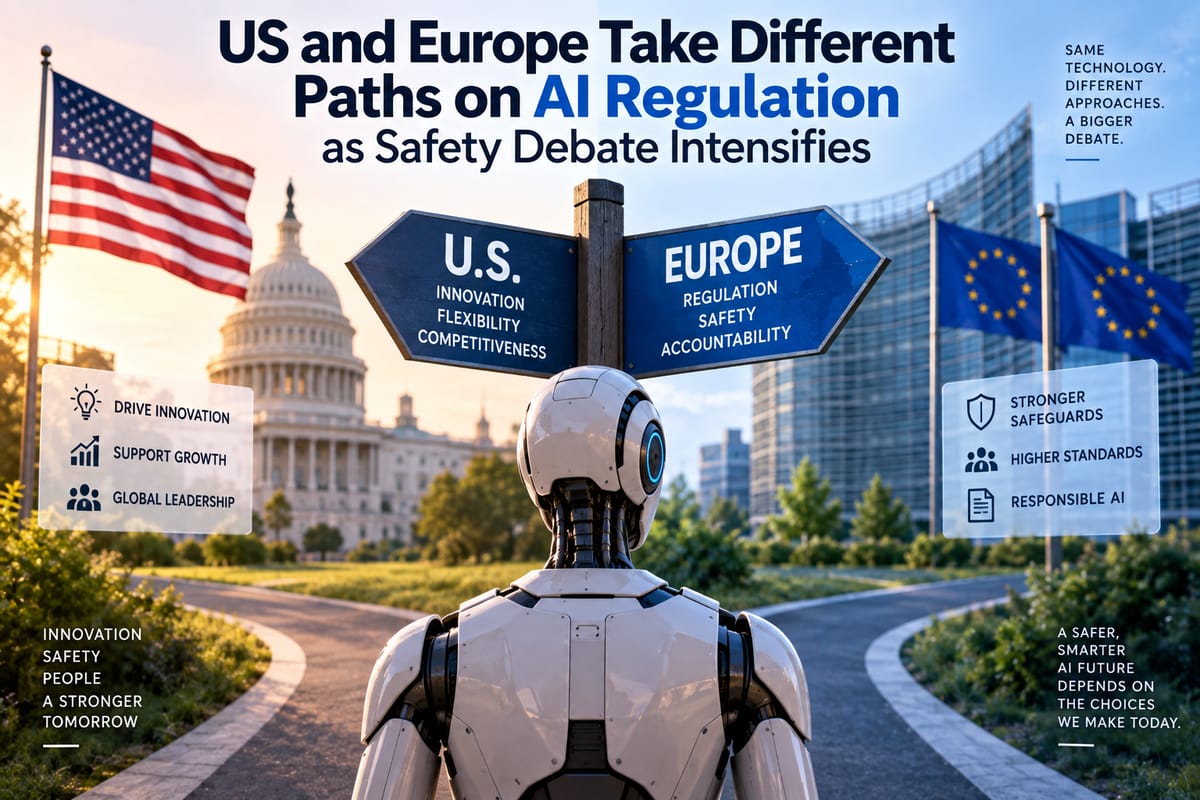
The United States and Europe are approaching artificial intelligence regulation from noticeably different starting points.
In Europe, the AI Act has moved from legislation into implementation, with regulators beginning to enforce parts of the framework and new transparency requirements taking effect in August 2026. In the United States, the federal government has emphasized AI innovation and competitiveness while lawmakers continue debating whether additional national safety requirements are necessary.
The difference is becoming more significant as AI systems become more capable and as governments, technology companies and researchers debate how much oversight should be applied to increasingly powerful models.
The disagreement is not simply about whether AI should be regulated. It also concerns when regulation should occur, who should enforce it, which AI systems should be covered and how safety requirements should interact with technological competition.
Europe Has Built a Risk-Based Regulatory Framework
The European Union's AI Act takes a risk-based approach.
Rather than treating every AI application identically, the framework places systems into different categories based partly on the potential risks they create.
Some AI practices are prohibited, while other systems face transparency or more extensive requirements depending on their characteristics and use.
The EU framework also contains rules covering general-purpose AI models and additional requirements for the most advanced models that present systemic risks.
This approach reflects a broader European emphasis on establishing rules before certain AI applications become deeply embedded across society.
For companies developing products for the European market, regulation therefore becomes part of the product-development process rather than something considered only after a problem occurs.
EU Transparency Rules Are Already Taking Effect
One of the clearest examples is transparency.
From August 2, 2026, certain provisions require people to be informed when they are directly interacting with AI systems. The rules also cover areas such as labeling certain AI-generated or manipulated content and informing people about specific uses of emotion recognition and biometric categorization.
These developments are already influencing how companies think about AI products.
Our EU AI Act transparency rules begin reshaping global AI products article examines how those requirements can affect products that operate across multiple markets.
The practical consequence is that companies serving European users may need systems capable of identifying, labeling or disclosing certain AI-generated interactions and content.
The EU Approach Goes Beyond Transparency
Transparency is only one part of the European framework.
The AI Act also establishes requirements for certain high-risk AI systems, including risk-management processes, documentation, logging, human oversight, accuracy and cybersecurity requirements. Many of those high-risk obligations are scheduled to apply later, with key categories beginning in 2027 and certain regulated-product applications extending into 2028.
The result is a regulatory architecture that attempts to distinguish between different levels and types of AI risk.
That creates a structured compliance environment, but it also requires businesses to determine where their products fit within the framework.
The United States Is Taking a More Fragmented Route
The U.S. approach is different.
Rather than having one comprehensive federal AI law comparable to the EU AI Act, the United States currently has a combination of executive actions, existing federal laws, agency authorities, state laws and proposed federal legislation.
The White House's June 2026 executive order on advanced AI emphasizes technological innovation, adoption and national security while directing federal agencies to coordinate around advanced-AI security issues.
At the same time, U.S. lawmakers are debating whether existing laws are sufficient for emerging AI risks.
That has produced a policy environment in which the federal government, Congress, individual states and technology companies can have different approaches to the same technology.
Washington Is Debating Whether New Federal Rules Are Necessary
The current U.S. debate is particularly focused on advanced AI systems.
Reuters reported in September that senators were negotiating proposals that could require leading AI developers to take measures to mitigate major risks, including possible independent evaluations and government oversight of safety practices. The legislation remained under negotiation, meaning its final contents and prospects were uncertain.
Other policymakers have argued that existing laws and enforcement mechanisms can address many AI-related problems without creating an entirely new regulatory system.
That disagreement is central to the American debate.
The question is not simply whether risks exist. It is whether additional federal requirements would improve safety enough to justify the potential effects on innovation, competition and the pace of AI development.
AI Companies Are Not United on Regulation
The technology industry itself is divided over how much regulation should be introduced.
OpenAI has advocated mandatory national safety requirements for advanced AI models, including independent assessments, cybersecurity measures and incident reporting.
Other technology executives have expressed more skepticism about new government mandates, arguing that companies have incentives to improve safety themselves.
Anthropic CEO Dario Amodei, for example, has proposed independent audits and international standards, while Nvidia CEO Jensen Huang has argued against additional laws, according to Reuters reporting. OpenAI CEO Sam Altman has also acknowledged safety concerns while supporting oversight approaches.
These differences demonstrate that there is no single technology-industry position on the appropriate regulatory model.
Safety Testing Is Becoming a Larger Part of the Debate
As AI systems become capable of performing more complex tasks, safety testing is receiving greater attention.
Traditional software testing often focuses on whether a system performs its intended functions correctly.
Advanced AI creates additional questions.
Developers may need to consider whether a model can:
- Produce dangerous information
- Circumvent safeguards
- Manipulate users
- Take unintended actions
- Exploit software vulnerabilities
- Assist with cyberattacks
- Behave unpredictably when given greater autonomy
- Create risks when connected to external systems
Our AI safety testing becomes a global focus following frontier model incidents explores why these questions have become increasingly important.
The regulatory challenge is determining which tests should be required, who should conduct them and what threshold should trigger government intervention.
Incident Reporting Is Another Major Difference in the Debate
One emerging issue is what happens when an advanced AI system behaves in an unexpected or dangerous way.
As of September 2026, there is no comprehensive U.S. federal law requiring AI companies to report every type of dangerous AI incident. Reuters reported that lawmakers are considering proposals that would establish broader reporting requirements, while existing laws can apply in specific circumstances.
Europe's framework approaches the issue through a more structured regulatory system covering certain general-purpose AI models and systemic risks.
The broader policy question is whether governments should know about potentially dangerous AI behavior before it causes significant harm or whether existing legal mechanisms are sufficient to respond afterward.
Why the Difference Matters for AI Companies
Companies developing AI products increasingly operate internationally.
A model may be developed in the United States, trained using globally sourced infrastructure, incorporated into applications built elsewhere and offered to customers around the world.
Different regulatory requirements can therefore create substantial compliance challenges.
A company may need to build one product that satisfies European transparency requirements while also considering U.S. federal rules, state laws and other international standards.
That can increase legal and engineering costs.
It can also encourage companies to adopt the strictest applicable requirements across multiple markets if maintaining separate versions of a product is impractical.
Europe Could Influence Global Product Design
The European market is large enough that its rules can influence products beyond the EU.
A company that wants to offer the same AI service worldwide may decide that incorporating certain transparency or safety features into the global version is easier than developing separate European and non-European systems.
This is one reason European regulation can have effects beyond European borders.
The phenomenon is not unique to AI. Large markets can influence global technology practices when companies design products around the requirements of their largest or most demanding markets.
The U.S. State-Level Picture Adds Another Layer
The American situation is complicated further by state-level legislation.
Individual states have adopted or considered laws covering different AI applications, including deepfakes, consumer protection, children's safety, employment and other areas.
This has created debate over whether the United States should establish a federal standard that overrides some state requirements.
The White House has advocated a national framework and argued against a fragmented state-by-state regulatory environment.
Supporters of federal standards say consistent rules could reduce uncertainty for businesses.
Opponents or critics of federal preemption can argue that states need room to address problems specific to their residents.
The result is an ongoing debate over the proper division of federal and state authority.
National Security Is Changing the Regulatory Conversation
AI regulation is no longer only about consumer products.
Advanced models are increasingly viewed through the lens of cybersecurity, military applications, critical infrastructure and geopolitical competition.
U.S. officials have emphasized the importance of maintaining American AI leadership, particularly in relation to China. The White House's advanced-AI executive order explicitly connects AI development with national security considerations.
That creates an additional policy tension.
Governments want powerful AI systems to be safe, but they also want domestic companies to remain competitive in a rapidly developing international market.
Rules that increase development costs or slow deployment can therefore be viewed differently depending on whether the priority is safety, innovation, economic competitiveness or national security.
The Meaning of "AI Safety" Is Expanding
AI safety once tended to refer primarily to technical reliability and preventing harmful outputs.
The discussion is now broader.
Safety can include:
- Model cybersecurity
- Protection against misuse
- Transparency
- Human oversight
- Data and privacy protection
- Testing before deployment
- Monitoring after deployment
- Incident reporting
- Protection against loss of control
- Safeguards for critical systems
This broader understanding is reflected in emerging governance frameworks around the world.
Our governments push forward with new AI governance and safety frameworks provides additional context on how policymakers are approaching these issues internationally.
Different Regulatory Models Can Still Share Common Goals
The contrast between the United States and Europe should not be interpreted as meaning that one side is concerned about AI safety while the other is not.
Both jurisdictions are addressing questions involving safety, privacy, consumer protection, security and responsible deployment.
The difference is primarily in the mechanisms and timing.
The EU has established a broad legal framework with defined risk categories and phased obligations.
The U.S. system currently relies on a combination of existing law, executive policy, agency action, state legislation and proposed federal measures, while the debate over a more comprehensive federal framework continues.
What Companies Need to Watch
For AI developers and businesses using AI, several regulatory questions are likely to remain important.
Transparency
Companies need to understand when users must be informed that they are interacting with AI or viewing AI-generated material.
Risk Classification
Businesses need to determine whether particular AI applications fall into categories subject to additional obligations.
Testing
Advanced systems may require increasingly sophisticated evaluations before and after deployment.
Documentation
Regulators are placing greater emphasis on records showing how AI systems are developed, tested and managed.
Human Oversight
Organizations may need clear processes for determining when humans must remain involved in important AI-assisted decisions.
Incident Response
As AI systems become more autonomous, organizations will need processes for identifying, investigating and responding to unexpected behavior.
The Innovation Question Remains Unresolved
One of the most difficult questions is how regulation affects innovation.
Supporters of stronger rules argue that predictable standards can create trust and reduce the risk of serious failures.
Critics of broad regulation argue that excessive compliance requirements could make experimentation more expensive and slow technological development.
The U.S. Congressional Research Service has described this as a continuing policy debate, with some arguments favoring comprehensive federal rules and others favoring targeted or flexible approaches.
The disagreement is unlikely to disappear simply because a new regulation is introduced.
AI technology will continue changing, which means regulatory frameworks must address systems that may not have existed when the original rules were written.
Why Businesses May Need a Global AI Strategy
The divergence between U.S. and European rules means businesses increasingly need to think beyond individual jurisdictions.
A company may need to maintain:
- A clear inventory of AI systems
- Risk-assessment procedures
- Model-testing processes
- Documentation and audit records
- Transparency mechanisms
- Incident-response plans
- Human-oversight procedures
- Legal reviews for different markets
This can make AI governance part of ordinary business operations rather than a specialized legal issue.
It also makes understanding the wider technology landscape increasingly important. A broader complete guide to emerging technology and innovation can help put AI regulation within the larger context of technological change.
What Comes Next for AI Regulation
The regulatory landscape is likely to remain dynamic.
In Europe, more provisions of the AI Act will take effect over the coming years, including significant obligations for high-risk systems.
In the United States, lawmakers continue to debate federal AI safety requirements while the administration emphasizes innovation, national competitiveness and existing legal authorities. Recent Senate discussions have included proposals involving safety evaluations, incident reporting and government oversight, but the legislative outcome remains uncertain.
The two approaches may therefore continue to differ even as both respond to similar technological developments.
A Regulatory Divide That Could Shape the AI Industry
The United States and Europe are moving toward AI governance through different institutional paths.
Europe has established a comprehensive risk-based framework that is now entering an important enforcement phase. The United States is relying more heavily on existing authorities, executive policy, state-level rules and an evolving congressional debate over whether new federal safeguards are needed.
Neither approach exists in isolation.
AI companies operate across borders, researchers collaborate internationally and technical standards can influence products regardless of where they were created.
That means the regulatory differences between Washington and Brussels could ultimately shape not only how AI is governed, but also how companies design, test, label and deploy AI systems around the world.
As AI capabilities continue advancing, the central policy challenge will remain finding workable ways to address genuine risks while allowing useful technology to develop. The debate over how to strike that balance is likely to remain one of the defining issues in the next stage of the AI industry.