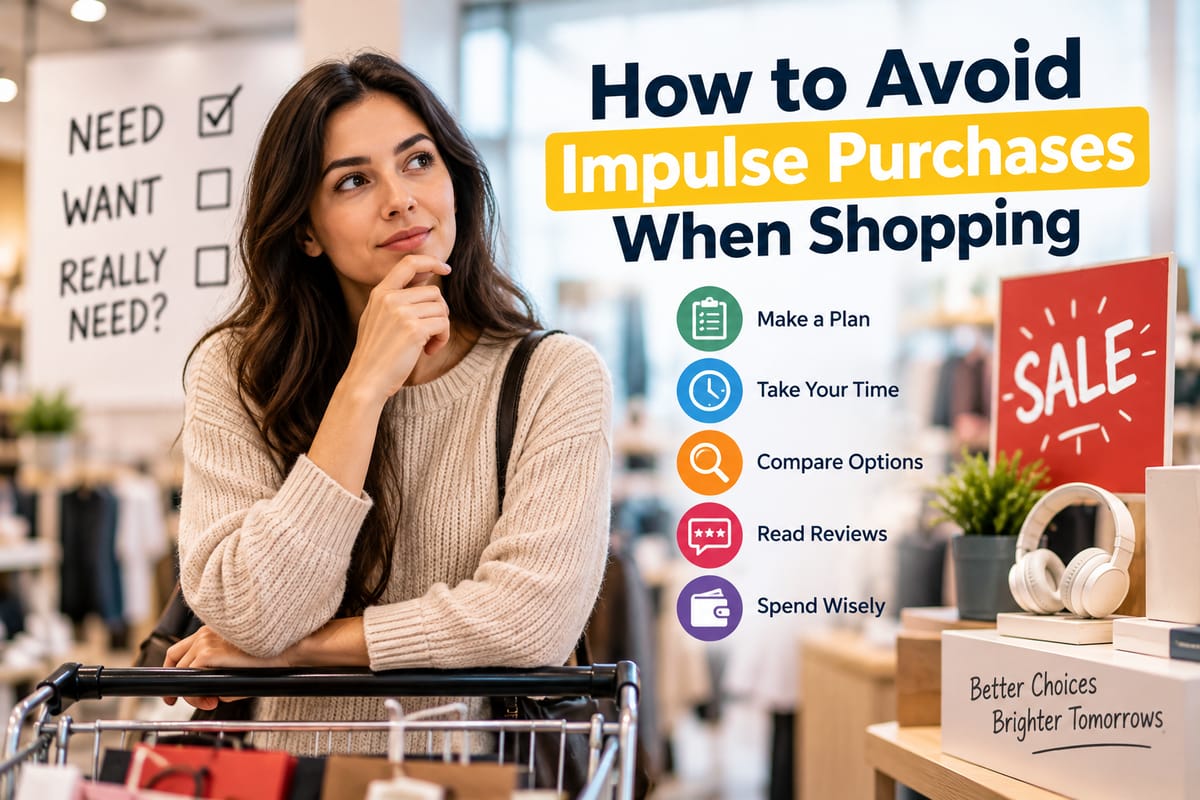
**How to Avoid Impulse Purchases When Shopping
Impulse purchases can turn an ordinary shopping trip into an unexpectedly expensive one. A product catches your attention, a limited-time offer creates a sense of urgency, or a recommendation makes something seem impossible to resist. Before long, an item that was never part of the original plan ends up in the shopping cart.
Occasional spontaneous purchases are not necessarily a problem. The difficulty begins when unplanned spending becomes a regular habit or when purchases provide only brief satisfaction before being followed by regret.
Learning how to slow down the buying process can make shopping more intentional. Simple techniques such as creating a list, comparing alternatives, checking the real cost, and waiting before purchasing can help shoppers distinguish between something they genuinely need and something that simply looks appealing in the moment.
Why Impulse Purchases Are So Tempting
Modern shopping environments are designed to make purchasing easy. Online stores can remember previous searches, recommend related products, display countdown timers, and place checkout buttons only a few clicks away.
Physical stores use different techniques. Products may be positioned near checkout areas, while prominent displays and promotional signs can draw attention to items shoppers did not originally intend to buy.
Emotions can also influence purchasing decisions. Someone who is tired, bored, stressed, excited, or celebrating may be more likely to make a spontaneous purchase.
Recognizing these influences is useful because impulse buying often happens quickly. The shorter the time between seeing a product and paying for it, the less opportunity there is to consider whether the purchase actually makes sense.
Start Shopping With a Clear Plan
One of the simplest ways to reduce impulse purchases is to decide what you are looking for before you start shopping.
A shopping list provides a practical boundary. Instead of browsing without a specific purpose, you have a defined set of products or categories to consider.
For larger purchases, the plan can be more detailed. Write down:
- What product you need
- Why you need it
- The features that matter
- Your maximum budget
- When you actually need it
- Which alternatives you are willing to consider
This approach shifts shopping from spontaneous browsing toward deliberate decision-making.
For technology and other consumer products, a broader framework can be useful. The Complete Guide to Choosing the Right Products provides a useful way to think about product selection before committing to a purchase.
Give Yourself a Waiting Period
A waiting period is one of the most effective ways to separate genuine interest from temporary excitement.
For inexpensive items, waiting a few hours may be enough. For more expensive purchases, consider waiting at least a day or several days before deciding.
During that time, ask yourself whether you still want the product when the excitement surrounding the initial discovery has faded.
If the desire disappears, the purchase probably was not as important as it initially seemed. If the product remains relevant after the waiting period, you can return to the decision with a clearer perspective.
A waiting period is particularly useful for online shopping because digital stores make immediate purchases extremely convenient.
Calculate the Real Cost
A low price does not automatically make a purchase worthwhile.
Before buying something, consider the full cost rather than focusing only on the advertised price. Additional expenses might include delivery charges, accessories, subscriptions, maintenance, replacement parts, installation, or financing costs.
A discounted product can still be expensive if it is something you do not need.
Understanding how product pricing works and what determines whether a product is worth its price can also help shoppers look beyond labels such as "sale," "deal," or "limited offer."
The important question is not simply whether the price has been reduced. It is whether the product provides enough value to justify spending the money.
Be Careful With Discounts and Limited-Time Offers
Sales can create a powerful sense of urgency.
A message such as "only today" or "last few remaining" can make shoppers feel that they must act immediately. But urgency does not necessarily mean the purchase is a good decision.
Before responding to a promotion, ask:
- Would I want this product at its normal price?
- Was I already planning to buy it?
- Do I have a specific use for it?
- Is the discount meaningful?
- Can I afford it without changing other financial priorities?
If the answer to several of these questions is no, the promotion may be influencing the decision more than the product itself.
A discount on something unnecessary is still unnecessary spending.
Compare Before You Buy
Impulse purchases often happen when shoppers focus on the first product that catches their attention.
Comparison creates distance between discovery and purchase. Looking at several products can reveal differences in price, specifications, quality, durability, warranty coverage, and suitability for your needs.
Comparison does not mean spending hours researching every inexpensive purchase. The amount of research should generally reflect the importance and cost of the decision.
For significant purchases, however, taking time to compare alternatives can prevent the common mistake of buying something simply because it was the first appealing option.
Read Reviews Carefully
Product reviews can be useful, but they should not automatically be treated as proof that a product is right for you.
A five-star rating does not necessarily mean that every buyer will have the same experience. Different reviewers may have different needs, expectations, budgets, and use cases.
Look for recurring patterns rather than focusing on one enthusiastic or negative review. Pay attention to comments about durability, performance, usability, limitations, and long-term ownership.
Learning how to read product reviews like an expert can help you extract useful information without allowing reviews or ratings to make the purchasing decision for you.
Remove Temptation From Your Shopping Environment
Sometimes the easiest way to avoid an impulse purchase is to reduce exposure to products that encourage one.
For online shopping, this might mean unsubscribing from promotional emails, turning off unnecessary shopping notifications, or removing stored payment information from retailers you frequently browse.
You can also avoid opening shopping apps simply because you are bored.
In physical stores, consider shopping with a list and avoiding sections that are unrelated to what you need. If you find yourself repeatedly buying items near checkout, make a deliberate decision to ignore those displays.
Small environmental changes can reduce the number of unnecessary decisions you have to make.
Avoid Shopping When Emotions Are Running High
Emotions can strongly influence spending behavior.
Shopping may temporarily feel rewarding when someone is frustrated, lonely, bored, anxious, or celebrating. The problem is that the emotional motivation may disappear while the financial cost remains.
If you notice that you frequently shop when experiencing a particular emotion, try creating a different response. Going for a walk, talking with someone, exercising, reading, or taking a break may provide enough distance to decide whether the purchase is actually necessary.
This does not mean emotions should never influence purchases. Enjoyment is a legitimate part of spending. The goal is to recognize when an emotional reaction is making the decision for you.
Ask Whether You Already Own Something Similar
Before purchasing a product, check what you already have.
This is especially useful for clothing, kitchen equipment, electronics, home accessories, beauty products, and hobbies.
Ask yourself:
Do I need this because I lack something, or do I simply want a different version of something I already own?
There may be legitimate reasons to replace an existing item. It may be damaged, outdated, uncomfortable, inefficient, or unsuitable for a new need.
But if the existing product performs the same function effectively, buying another one may not add much value.
Set a Personal Spending Limit
A shopping budget can make impulse purchases easier to identify.
Instead of deciding whether you can afford each item individually, establish broader spending limits for categories such as clothing, entertainment, technology, dining, or household purchases.
You can also create a small discretionary spending allowance. This allows room for spontaneous purchases without letting them interfere with essential expenses or longer-term financial goals.
The purpose of a spending limit is not to eliminate enjoyment. It is to make spontaneous spending predictable and manageable.
Use a "Why Do I Want This?" Test
Before checking out, pause for a moment and identify the reason behind the purchase.
You might want something because:
- You genuinely need it
- It solves a specific problem
- Your existing item needs replacement
- You have researched it and decided it offers good value
- You simply like it
- It is discounted
- Other people are buying it
- You are afraid the deal will disappear
There is nothing inherently wrong with wanting something simply because you like it. The important distinction is whether you understand the reason for the purchase and are comfortable with its cost.
A conscious choice is different from a purchase made without thinking.
Make Larger Purchases Harder to Complete Immediately
For expensive products, adding friction to the buying process can be helpful.
Instead of saving your payment details and completing a purchase immediately, leave the product in your cart and return later. Write down the model and compare it with alternatives. Check whether the purchase fits your budget.
For particularly expensive purchases, consider setting a minimum waiting period before buying anything above a certain amount.
The goal is not to make shopping unnecessarily difficult. It is to create enough time for rational consideration before a substantial amount of money leaves your account.
Learn From Past Purchases
Past spending can reveal patterns that are difficult to notice while shopping.
Review purchases you later regretted and look for common characteristics. Perhaps they were made late at night, during sales, after seeing social media recommendations, or when you were experiencing a particular emotion.
You may also discover that certain categories consistently lead to unnecessary spending.
Once you understand your personal triggers, you can create specific rules around them. Someone who frequently buys discounted clothing, for example, might decide not to purchase anything that was not already on their shopping list.
Make Shopping About Value, Not Just Price
The cheapest product is not always the best choice, just as the most expensive product is not automatically the highest-value option.
Value depends on factors such as quality, durability, usefulness, performance, reliability, and how well a product matches the buyer's needs.
A slightly more expensive product that lasts substantially longer may provide better value than repeatedly replacing a cheaper alternative.
This is why thoughtful shopping involves more than searching for the lowest possible price. The goal is to spend money on products that genuinely serve a purpose.
Create a Simple Pre-Purchase Checklist
A short checklist can turn a rushed purchase into a deliberate decision.
Before buying an unplanned item, ask:
- Do I need it?
- What problem will it solve?
- Do I already own something that does the same thing?
- Have I compared reasonable alternatives?
- Have I checked the total cost?
- Have I looked at trustworthy reviews?
- Would I still want it if there were no sale?
- Can I afford it without disrupting my other priorities?
- Have I waited long enough to make a clear decision?
If the answers give you confidence, you can make the purchase knowing that it was considered rather than purely spontaneous.
Turning Better Shopping Habits Into a Routine
Avoiding impulse purchases does not require eliminating spontaneous shopping altogether. Instead, it involves creating enough space between temptation and action to make conscious decisions.
Lists, waiting periods, product comparisons, careful review reading, realistic budgets, and awareness of emotional triggers can all make that space larger.
Over time, these habits can change the way shopping feels. Instead of constantly asking whether you can buy something, you begin asking whether buying it actually makes sense.
That small shift—from "Do I want this right now?" to "Is this worth spending my money on?"—can make everyday shopping considerably more intentional.