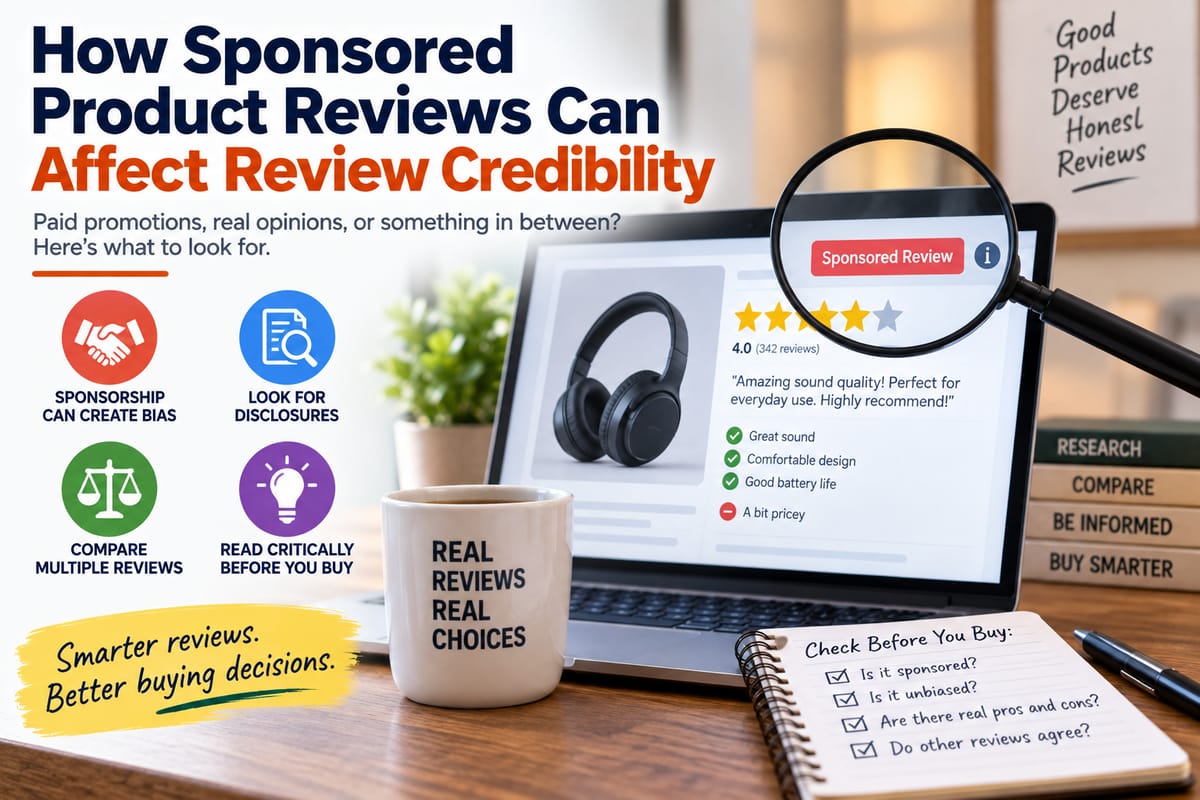
How Sponsored Product Reviews Can Affect Review Credibility
Product reviews can play an important role in helping consumers decide what to buy. Before purchasing a phone, appliance, software subscription, piece of furniture, or other product, shoppers often turn to reviews to learn about performance, quality, usability, durability, and potential problems.
But not every review is created under the same circumstances.
Some reviewers receive payment, free products, commissions, or other benefits from brands. Sponsored content can provide useful information, but it can also create questions about whether the reviewer's opinions are completely independent.
The presence of sponsorship does not automatically make a review unreliable. A sponsored review can still contain accurate observations and useful criticism. The important issue is transparency and whether financial or commercial relationships influence how the product is presented.
Understanding how sponsorship can affect credibility helps consumers interpret reviews more carefully and make better purchasing decisions.
What Is a Sponsored Product Review?
A sponsored product review is content created with some form of financial or commercial relationship between the reviewer and a brand or seller.
Depending on the arrangement, the reviewer might receive:
- Direct payment
- A free or discounted product
- Commission from sales
- Free access to a service
- Advertising revenue
- Early access to a product
- Other compensation or benefits
The exact arrangement can vary significantly.
Some sponsored reviews are explicitly commissioned by companies, while others involve affiliate relationships in which the reviewer earns a commission when readers purchase through a special link.
These relationships do not necessarily determine the review's conclusions, but they can create potential conflicts of interest.
Why Sponsorship Can Affect Perceived Credibility
Credibility depends partly on whether readers believe the reviewer is providing an honest and independent assessment.
When a reviewer receives compensation from the company whose product is being evaluated, readers may reasonably wonder whether the financial relationship affects the review.
For example, a reviewer might be less willing to emphasize serious weaknesses if doing so could damage a relationship with a brand that provides future sponsorship opportunities.
This does not prove that the reviewer is being dishonest. It illustrates why disclosure and independent judgment matter.
Sponsorship Does Not Automatically Mean a Review Is Biased
It is important to distinguish between potential influence and actual bias.
A sponsored review can still be carefully researched and balanced. A reviewer may disclose the relationship, test the product independently, identify shortcomings, and reach conclusions that are not dictated by the sponsor.
Likewise, an unpaid review is not automatically objective. A reviewer can have personal preferences, brand loyalties, expectations, or other biases even without receiving compensation.
The useful question is therefore not simply:
"Was this review sponsored?"
It is:
"How was the review produced, what relationship does the reviewer have with the brand, and does the content provide evidence that supports its claims?"
Disclosure Helps Readers Understand the Relationship
Clear disclosure is one of the most important factors in sponsored content.
Readers should be able to determine whether the reviewer received compensation, a free product, affiliate commissions, or another benefit.
A disclosure does not eliminate potential bias, but it gives readers information they can use when interpreting the review.
Vague statements can be less informative than specific disclosures.
For example, there is an important difference between simply indicating that a review is "sponsored" and explaining that the reviewer received a free product and may earn a commission from purchases.
The more clearly the relationship is explained, the easier it is for readers to understand the context.
How Brand Relationships Can Influence Reviews
Long-term relationships between reviewers and companies can create additional considerations.
A reviewer who regularly receives products from a particular brand may have an incentive to maintain a positive relationship.
Again, this does not demonstrate that a specific review is inaccurate. It means readers may want to pay attention to whether the reviewer consistently avoids discussing weaknesses or gives unusually positive treatment to the same brands.
Patterns can sometimes reveal more than one individual review.
Positive Reviews Can Still Contain Useful Information
A sponsored review that is generally positive is not necessarily misleading.
Some products genuinely perform well.
A credible review should explain why the reviewer reached a positive assessment.
Useful details might include:
- Specific performance observations
- Test results
- Product specifications
- Comparisons with alternatives
- Real-world usage
- Identified limitations
- Information about who the product may or may not suit
A simple statement such as "This is an excellent product" provides less useful information than a detailed explanation of its strengths and weaknesses.
Negative Information Can Strengthen Credibility
One useful characteristic of a credible review is the willingness to discuss limitations.
Even a high-quality product usually has trade-offs.
A reviewer might identify:
- A high price
- Limited battery life
- Difficult setup
- Missing features
- Build-quality concerns
- Compatibility restrictions
- Expensive accessories
- Poor software support
Mentioning weaknesses does not automatically make a review objective, but a detailed discussion of both advantages and disadvantages can give readers more information than uniformly positive promotional language.
How Sponsored Content Can Become Advertising
The distinction between a product review and advertising can sometimes become unclear.
Advertising is designed primarily to promote a product or service. A review, by contrast, should provide information that helps readers evaluate the product.
Sponsored content can move toward advertising when it focuses almost exclusively on promotional claims, omits meaningful limitations, or simply repeats the manufacturer's marketing language.
Readers should pay attention to whether the content contains independent analysis or primarily functions as an extended advertisement.
Manufacturer Claims Are Not the Same as Independent Findings
Product pages and marketing materials can provide useful specifications, but manufacturers naturally present their products in a favorable way.
A reviewer can add value by testing those claims or explaining how the product performs in real-world use.
For example, a manufacturer might advertise a particular battery capacity or performance level. A reviewer can provide additional context by explaining how that specification translates into everyday use.
The difference between repeating a claim and independently examining it is important when assessing credibility.
Testing Methods Matter
The quality of a review can depend heavily on how the product was evaluated.
A reviewer who spends several weeks using a product may discover issues that are not apparent during a brief demonstration.
Useful reviews may explain:
- How long the product was tested
- What conditions were used
- Which features were evaluated
- What comparisons were performed
- Whether performance changed over time
- Which observations are subjective
Detailed methodology allows readers to better understand the limits of the review.
Watch for Excessive Promotional Language
Language can provide clues about whether a review is primarily informative or promotional.
Phrases such as "must-have," "perfect," "game-changing," or "best ever" do not necessarily make a review unreliable, but repeated marketing-style language without supporting evidence should encourage readers to look more closely.
Strong claims should ideally be accompanied by explanations.
Instead of simply saying a product is "the best," a credible review should explain which characteristics make it suitable for particular users and where it falls short.
Affiliate Links Can Create Another Incentive
Affiliate marketing is common in product reviews.
A reviewer may receive a percentage of a sale when a reader purchases through a tracking link.
Affiliate relationships can help fund review websites, but they can also create a financial incentive to encourage purchases.
This is particularly relevant when a review includes numerous purchase links but provides limited information about disadvantages or competing products.
Readers should therefore consider both the content of the review and the commercial structure behind it.
Compare Reviews From Multiple Sources
One of the simplest ways to reduce reliance on a potentially biased review is to examine several sources.
Look for agreement and disagreement between reviewers.
If multiple independent reviewers identify the same strength or weakness, that information may be more useful than a single person's assessment.
Differences can also be informative. One reviewer may prioritize performance while another focuses on durability, design, price, or ease of use.
Comparing perspectives provides a broader picture of the product.
Learn How to Identify Biased Reviews
Bias is not always obvious.
A review can appear professional while selectively presenting information that supports a particular conclusion.
Warning signs may include:
- Excessive promotional language
- Few or no criticisms
- Unexplained superlatives
- Repetition of manufacturer claims
- Lack of testing details
- Unclear sponsorship disclosures
- Strong pressure to purchase
- Failure to discuss alternatives
- Claims unsupported by evidence
The guide on How to Identify Biased Product Reviews provides a broader framework for recognizing these patterns.
Read the Entire Review, Not Just the Verdict
Many readers skip directly to a review's final rating or recommendation.
That can cause important information to be overlooked.
A reviewer may give a product a positive overall assessment while identifying limitations that make it unsuitable for a particular type of buyer.
For example, a product might perform exceptionally well but cost substantially more than alternatives.
Another product might be inexpensive but lack features required by advanced users.
Reading the supporting analysis makes it easier to determine whether the review actually applies to your circumstances.
Learn to Read Reviews Critically
Good review analysis involves separating facts, observations, opinions, and marketing claims.
A useful approach is to ask:
- What did the reviewer actually test?
- Which statements are measurable?
- Which conclusions are subjective?
- What evidence supports the claims?
- Were competing products considered?
- Were disadvantages discussed?
- Was the product provided free?
- Is there a financial relationship with the seller?
- Does the review explain who should buy the product?
For more guidance, How to Read Product Reviews Like an Expert explores ways to extract useful information from reviews while recognizing their limitations.
Consider the Reviewer's Expertise
The reviewer's experience can also affect how useful the content is.
Someone who regularly tests professional cameras may be able to evaluate advanced photographic features in greater depth than a casual technology reviewer.
Similarly, a reviewer with extensive experience using power tools may notice durability or usability issues that a first-time user could overlook.
Expertise does not guarantee objectivity, but it can influence the quality and relevance of the analysis.
Look for Evidence of Long-Term Testing
Some product problems only become apparent after extended use.
Battery degradation, wear, software issues, mechanical failures, customer support experiences, and durability problems may not appear during a short test.
Long-term reviews can therefore provide information that an initial review cannot.
For expensive products, consumers may benefit from looking for both initial testing and longer-term ownership experiences.
Check Whether Competing Products Are Considered
A review becomes more useful when it places a product in context.
A product may be good on its own but less attractive when a competing product offers similar performance at a lower price.
Reviewers can add value by explaining differences between alternatives.
However, comparisons should also be examined critically. A reviewer may selectively choose competitors that make the featured product look favorable.
Looking at several comparison sources can help provide additional context.
Consider the Brand's Reputation Separately
A product review should not be the only source of information about a company.
Buyers can also consider the brand's history, warranty policies, customer support, product durability, and treatment of customers.
The guide on How to Evaluate Brand Reputation Before Buying a Product provides a broader framework for assessing a company before making a purchase.
This is particularly useful when buying products that require long-term support.
Product Selection Should Start With Your Needs
A review can tell you whether a product performs well, but that does not necessarily mean it is appropriate for you.
Before relying heavily on reviews, identify what you actually need.
Consider:
- Your budget
- Intended use
- Important features
- Desired lifespan
- Compatibility requirements
- Maintenance needs
- Available alternatives
The Complete Guide to Choosing the Right Products provides a broader approach to evaluating products based on individual needs rather than simply following popularity or ratings.
Ratings Can Hide Important Differences
A numerical score can make reviews easy to compare, but ratings can oversimplify complex decisions.
Two products might both receive four out of five stars while having very different strengths.
One might offer better performance, while another might be easier to use or less expensive.
A rating also cannot tell you whether the reviewer's priorities match your own.
The written explanation is often more useful than the number itself.
Sponsored Reviews Can Still Be Valuable
Sponsored content should not automatically be dismissed.
Companies can provide reviewers with products that consumers otherwise would not have access to test. Sponsorship can also help fund detailed review work that requires time and equipment.
The key issue is maintaining a meaningful separation between compensation and editorial judgment.
A sponsored review can remain useful when the reviewer clearly discloses the relationship, conducts meaningful testing, provides evidence, discusses limitations, and maintains control over the final assessment.
Questions to Ask When Reading a Sponsored Review
Before relying on a sponsored product review, consider asking:
- Was the product provided free of charge?
- Did the reviewer receive payment?
- Does the reviewer earn affiliate commissions?
- Is the commercial relationship clearly disclosed?
- Does the reviewer describe how the product was tested?
- Are both strengths and weaknesses discussed?
- Are manufacturer claims independently examined?
- Are competing products considered?
- Does the reviewer explain who the product is suitable for?
- Does the review provide enough evidence to support its conclusions?
These questions can help distinguish useful sponsored content from material that is primarily promotional.
Credibility Depends on More Than Sponsorship
Sponsorship is one factor to consider when evaluating a product review, but it is not the only one.
A review's credibility can also depend on transparency, methodology, evidence, expertise, independence, consistency, and willingness to discuss limitations.
Likewise, an unpaid review is not automatically unbiased.
Consumers can make better decisions by examining the relationship between reviewer and brand while also looking critically at the actual substance of the review.
Making Reviews Work for Better Buying Decisions
Product reviews are most useful when they provide information rather than simply telling readers what to purchase.
Sponsored reviews can contribute meaningful information when commercial relationships are disclosed and reviewers retain the ability to discuss both strengths and weaknesses. Problems arise when sponsorship becomes difficult to distinguish from advertising or when financial incentives appear to influence the substance of the evaluation.
For consumers, the most practical approach is to look beyond a review's headline, star rating, or enthusiastic recommendation. Check how the product was tested, examine the evidence, identify potential conflicts of interest, compare multiple sources, and consider whether the reviewer's priorities match your own.
Used this way, product reviews become one piece of a larger decision-making process rather than the sole reason to buy something.