**What Enterprise Technology Is and How Large Organizations Use Integrated Technology Systems
Enterprise technology refers to the hardware, software, networks, data systems, and digital platforms that large organizations use to operate their businesses at scale. Unlike technology designed primarily for individual users or small teams, enterprise systems are built to support thousands of employees, large volumes of information, complex operations, multiple locations, and demanding security requirements.
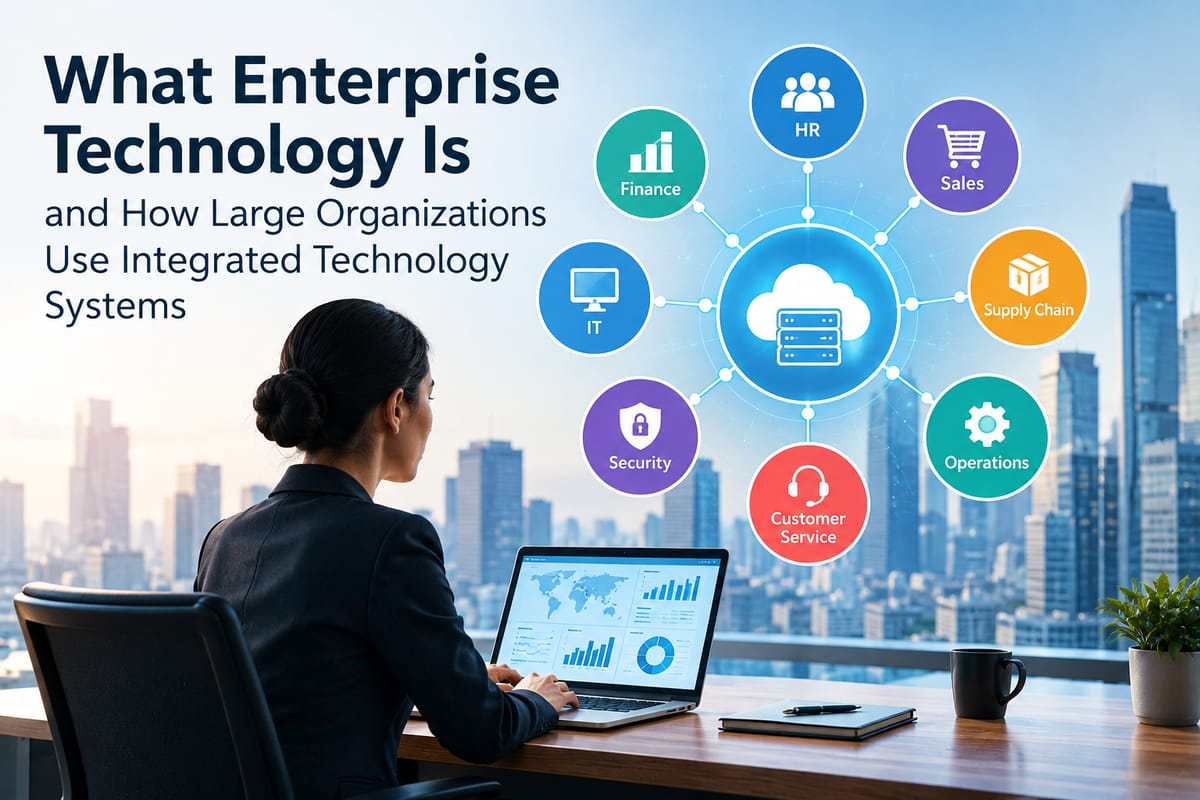
Modern enterprises rarely rely on one technology platform. Instead, they use interconnected systems that allow departments such as finance, human resources, sales, operations, marketing, customer service, and supply chain management to share information and coordinate activities.
This integration has become increasingly important as organizations manage larger amounts of data and conduct more of their operations digitally.
What Enterprise Technology Means
Enterprise technology is the collection of digital tools and infrastructure used to support an organization's core operations.
It can include:
- Servers and data centers
- Cloud computing platforms
- Business applications
- Enterprise resource planning systems
- Customer relationship management software
- Databases
- Corporate networks
- Cybersecurity systems
- Data analytics platforms
- Collaboration and communication tools
- Identity and access management systems
- Automation technologies
- Artificial intelligence applications
The defining characteristic is not simply the size of the technology. Enterprise technology is designed around organizational requirements such as scalability, reliability, integration, security, governance, and centralized management.
A small company might be able to manage its operations using a handful of cloud applications. A multinational organization may need hundreds of interconnected systems operating across offices, factories, warehouses, stores, and cloud environments.
Why Large Organizations Need Integrated Technology
Large organizations generate enormous amounts of information every day.
A retailer may process customer transactions, inventory movements, supplier orders, employee schedules, payments, and marketing interactions simultaneously. A manufacturer may need to coordinate production, procurement, logistics, quality control, maintenance, and financial reporting.
If every department operates completely independently, information can become fragmented.
For example, a sales department might have one customer record while the finance department maintains another. Employees could spend time transferring information manually between systems, creating opportunities for delays and errors.
Integrated technology attempts to connect these processes so that information can move between systems more efficiently.
The Role of IT Infrastructure
Technology applications need a foundation on which to operate. That foundation includes computing resources, networks, storage, cloud services, devices, security systems, and other technical components.
Organizations therefore need carefully planned infrastructure to support their applications and data.
The Complete Guide to IT Infrastructure for Businesses provides broader context on the systems that form this technical foundation.
Enterprise infrastructure must also accommodate growth. As an organization adds employees, customers, locations, applications, and data, its technology environment needs to scale without causing unacceptable disruptions.
Business Software Connects Everyday Operations
Enterprise technology also includes the software employees use to perform their jobs.
Different departments may require specialized applications. Finance teams need accounting and financial management systems, human resources departments use workforce platforms, sales teams rely on customer management tools, and operations teams may use scheduling, inventory, or logistics software.
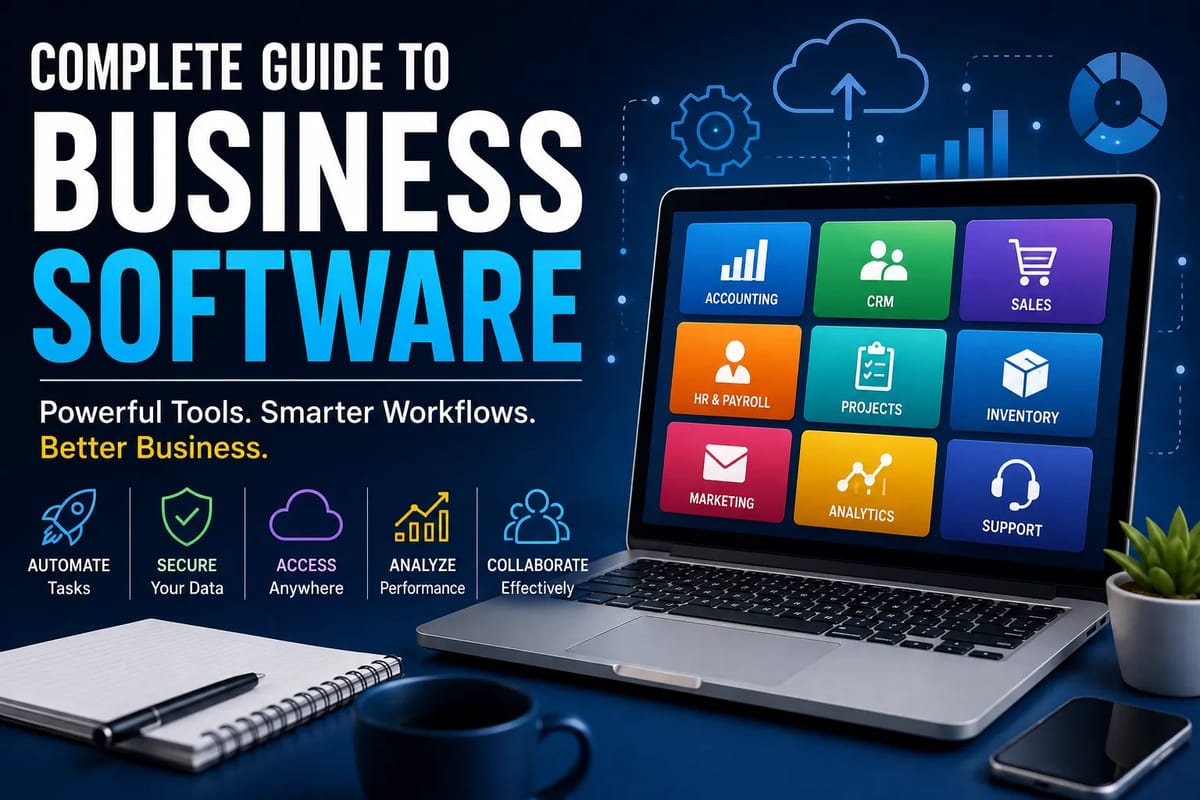
The Complete Guide to Business Software explains how different software categories support organizational activities.
The challenge for large companies is making these applications work together.
An organization can have excellent individual applications but still experience operational problems if those systems cannot exchange information effectively.
ERP Systems Bring Core Business Data Together
Enterprise resource planning, or ERP, is one of the most important examples of integrated enterprise technology.
An ERP system can connect areas such as:
- Finance
- Procurement
- Inventory
- Manufacturing
- Human resources
- Supply chain management
- Sales
- Project management
Instead of maintaining completely separate databases for every business function, an ERP platform can provide a more coordinated environment for managing shared organizational information.
ERP Technology Explained provides a closer look at how these systems work and why organizations use them.
ERP does not necessarily eliminate every other application within a company. Large organizations often use ERP alongside specialized systems for customer management, analytics, manufacturing, e-commerce, communication, and other functions.
How Enterprise Systems Share Data
Integration allows information from one system to become useful in another.
Consider a customer placing an order through an online store. That transaction could trigger several connected processes.
The order system might send information to an inventory platform to check available stock. The warehouse system could receive instructions to prepare the shipment. The finance system could record the transaction. A customer relationship management platform could update the customer's history.
Employees may not need to enter the same information into every system manually.
This type of connectivity can be achieved through application programming interfaces, integration platforms, shared databases, event-driven architectures, and other technical approaches.
Cloud Computing Has Changed Enterprise Technology
Cloud computing has significantly changed how organizations build and operate technology environments.
Instead of maintaining every computing resource inside company-owned facilities, businesses can use cloud infrastructure and software services provided through remote data centers.
Cloud environments can offer organizations access to computing power, storage, databases, analytics, security services, and applications without requiring every resource to be physically managed on-site.
Many large companies use a combination of cloud and traditional infrastructure. This approach is often described as a hybrid environment.
The resulting technology architecture can be highly distributed, with applications and data operating across corporate facilities, public clouds, private clouds, and specialized service providers.
Data Becomes a Shared Enterprise Resource
Integrated technology systems create another important advantage: organizations can use information from different parts of the business to understand broader patterns.
A company might combine sales information with inventory data, customer activity, financial results, and operational metrics.
Analytics platforms can then help managers identify trends and monitor performance.
For example, declining sales in one region might become more meaningful when viewed alongside inventory shortages, changes in customer behavior, or supply chain disruptions.
The value comes not merely from collecting more data but from connecting relevant information and making it accessible to people who need it.
Enterprise Technology Supports Automation
Integration also creates opportunities for automation.
When systems can exchange information automatically, organizations can reduce repetitive manual tasks.
A procurement workflow, for instance, might automatically generate an approval request when inventory falls below a predefined threshold. A financial system could then receive the approved purchase information without requiring employees to re-enter the same details.
Automation can also support customer communications, employee onboarding, reporting, compliance processes, and operational monitoring.
The objective is not necessarily to remove people from business processes. In many cases, automation allows employees to spend less time on repetitive administrative work and more time on activities requiring judgment and expertise.
Digital Transformation Goes Beyond Buying New Technology
Enterprise technology is closely connected to digital transformation, but the two concepts are not identical.
Simply purchasing new software does not automatically transform an organization.
Digital transformation generally involves changing how an organization operates, delivers value, uses information, and interacts with customers or employees through digital capabilities.
The Complete Guide to Digital Transformation for Businesses explores this broader relationship between technology and organizational change.
A transformation project might involve replacing outdated systems, redesigning business processes, introducing automation, improving customer experiences, or creating new digitally enabled services.
Technology is therefore one component of a much larger organizational change.
Security Is Central to Enterprise Systems
Large organizations hold valuable information, including financial records, customer information, intellectual property, employee data, and operational information.
As systems become more interconnected, protecting them becomes increasingly important.
Enterprise security can involve:
- Identity and access management
- Multi-factor authentication
- Network security
- Endpoint protection
- Encryption
- Security monitoring
- Data loss prevention
- Vulnerability management
- Backup and recovery
- Incident response
Access controls are particularly important in integrated environments. Employees generally need access to the information required for their roles, but unrestricted access can increase security risks.
Organizations therefore use permissions, authentication systems, policies, and monitoring to control how technology resources are accessed.
Why Integration Can Be Difficult
Connecting enterprise systems is not always straightforward.
Large organizations often have technology environments that have developed over many years. Some systems may be modern cloud applications, while others may be older platforms that remain essential to daily operations.
Different systems can use different data formats, authentication methods, architectures, and interfaces.
There can also be organizational challenges.
Departments may have different priorities, budgets, workflows, and technology requirements. A system that works well for one part of an organization may not meet the needs of another.
Successful integration therefore requires both technical planning and organizational coordination.
Legacy Technology Still Matters
Many large organizations continue to rely on legacy systems because replacing them can be expensive, risky, or disruptive.
A legacy system may contain decades of business logic and historical data. Employees may also have extensive experience using it.
Rather than immediately replacing every older platform, organizations may connect legacy systems to newer applications through integration technologies.
This allows companies to modernize gradually while maintaining important existing capabilities.
However, older technology can create challenges involving security, maintenance, compatibility, staffing, and scalability.
Enterprise Architecture Provides the Bigger Picture
Enterprise architecture helps organizations understand how their technology components fit together.
Instead of looking at individual applications in isolation, architecture considers relationships between business processes, applications, data, infrastructure, security, and organizational goals.
A well-designed enterprise architecture can help answer questions such as:
- Which systems perform similar functions?
- Where is important business data stored?
- How does information move between departments?
- Which applications depend on older platforms?
- Where are security controls required?
- Which systems need to scale?
- Which technologies should eventually be replaced?
This broader perspective becomes increasingly valuable as technology environments grow more complex.
Artificial Intelligence Is Becoming Part of Enterprise Technology
Artificial intelligence is increasingly being incorporated into enterprise systems.
Organizations can use AI for activities such as document processing, forecasting, customer service, fraud detection, software development, search, data analysis, and workflow automation.
AI systems can also be integrated into existing enterprise applications rather than operating as completely separate tools.
For example, an analytics platform might use machine learning to identify unusual patterns, while a customer service system could use AI to help employees find relevant information.
However, enterprise AI introduces additional considerations involving data quality, security, privacy, governance, reliability, and human oversight.
Employees Remain at the Center of Enterprise Technology
Technology systems ultimately support people and business processes.
An organization can invest heavily in advanced infrastructure and still struggle if employees cannot use the systems effectively.
Training, usability, change management, documentation, and support therefore play important roles in enterprise technology projects.
When companies introduce a new integrated platform, employees may need to change established workflows. Successful adoption depends partly on whether people understand why the system is being introduced and how it affects their work.
How Integrated Technology Changes Decision-Making
Integrated systems can give managers a more connected view of organizational performance.
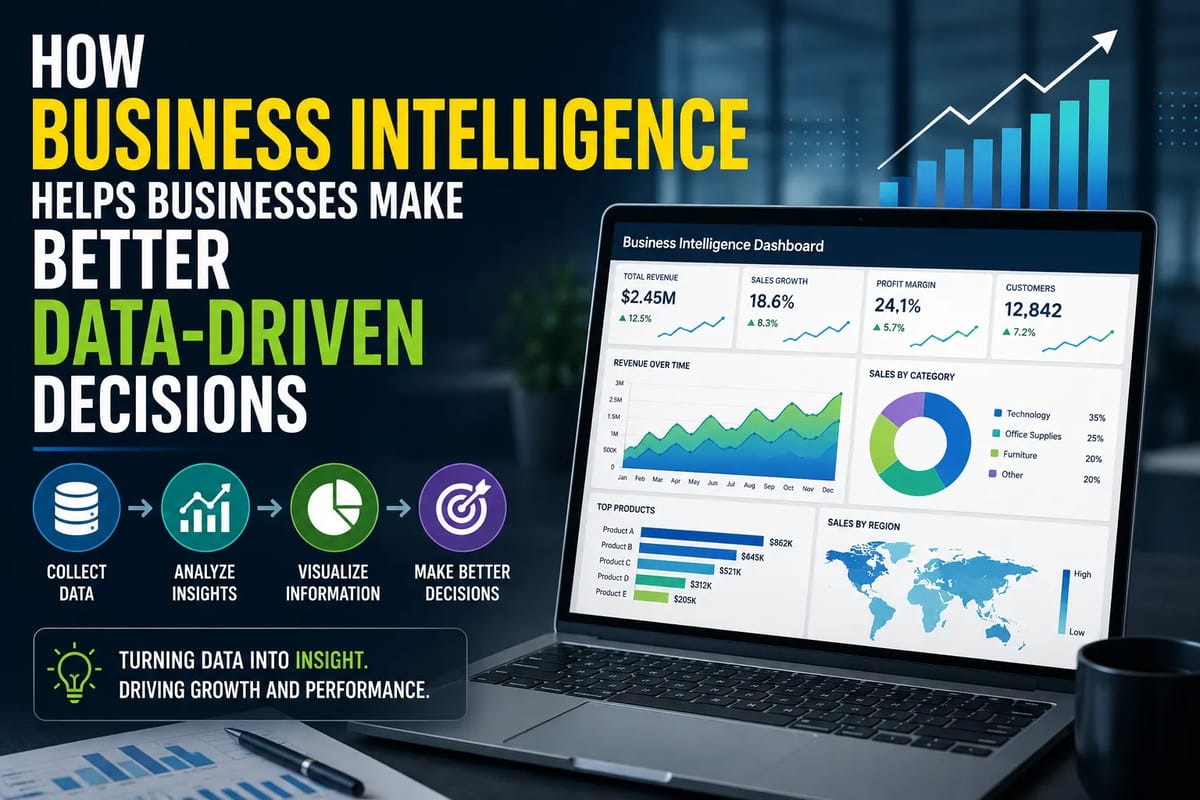
Instead of relying exclusively on manually compiled reports, leaders can potentially access dashboards and analytics that draw information from multiple business systems.
A manager could examine revenue, expenses, customer activity, inventory levels, and operational performance together.
This does not eliminate the need for human judgment. Data can be incomplete, delayed, incorrectly entered, or interpreted in different ways.
Instead, integrated technology provides decision-makers with a broader information base from which to evaluate business conditions.
Enterprise Technology Will Become More Connected
Large organizations are likely to continue combining cloud platforms, business applications, automation, analytics, artificial intelligence, cybersecurity systems, and connected devices.
The direction of enterprise technology is not simply toward having more applications. It is increasingly about creating systems that can exchange information and support coordinated business processes.
That creates both opportunities and responsibilities.
Organizations must balance integration with security, flexibility with standardization, innovation with reliability, and automation with human oversight.
Building Technology Around the Organization
Enterprise technology is ultimately less about individual devices or applications and more about how an entire organization functions as a connected system.
Infrastructure provides the foundation. Business software supports specific activities. ERP platforms can connect major operational functions. Cloud services provide scalable computing resources. Data systems help organizations understand their operations, while automation and AI can support increasingly sophisticated workflows.
When these components are planned and integrated effectively, technology can become part of the operating structure of the business rather than a collection of disconnected tools.
For large organizations, that integrated approach is increasingly important as operations become more distributed, data-driven, and digitally dependent.