How to Develop a Business Technology Strategy Aligned With Organizational Goals
Technology has become a central part of how modern organizations operate, compete, serve customers, and make decisions. From business software and cloud platforms to data systems, cybersecurity tools, artificial intelligence, and automation, technology can influence almost every part of an organization.
Yet investing in technology does not automatically create business value. Organizations can spend heavily on new systems and still struggle with inefficient processes, disconnected data, poor adoption, rising costs, or unclear priorities.
The difference often comes down to strategy.
A strong business technology strategy connects technology decisions directly to organizational goals. Instead of asking which technology is newest or most impressive, leadership teams can focus on a more useful question: How can technology help the organization achieve what it is trying to accomplish?
What Is a Business Technology Strategy?
A business technology strategy is a structured plan for using technology to support an organization's broader objectives.
It connects business priorities with decisions about systems, software, infrastructure, data, security, people, processes, and technology investments.
Depending on the organization, strategic goals might include:
- Increasing revenue
- Reducing operating costs
- Improving customer experiences
- Expanding into new markets
- Increasing employee productivity
- Improving decision-making
- Strengthening cybersecurity
- Supporting regulatory compliance
- Developing new products and services
- Improving operational efficiency
The technology strategy should support these goals rather than exist as a separate plan created solely by the IT department.
Why Technology Strategy Must Start With Business Goals
A common mistake is to begin technology planning by looking at available products.
An organization might see a new artificial intelligence platform, cloud service, analytics system, or collaboration tool and immediately consider purchasing it. But the existence of an interesting technology does not establish a business need.
Strategic planning should work in the opposite direction.
The organization should first identify what it wants to achieve and then determine whether technology can help accomplish those objectives.
For example, a company focused on reducing customer service costs might investigate automation, self-service platforms, customer relationship management systems, or improved data integration.
A company focused on international expansion might prioritize scalable cloud infrastructure, multilingual digital platforms, cybersecurity, and systems that can support operations across multiple regions.
The business objective provides the starting point.
Identify the Organization's Strategic Priorities
Before developing a technology roadmap, leadership should establish the organization's most important business priorities.
These priorities should be specific enough to guide investment decisions.
For example, instead of saying that the organization wants to "improve technology," a more useful objective might be to reduce order-processing time by 30 percent, improve customer retention, or expand operations into three additional markets.
Useful strategic questions include:
- What does the organization need to accomplish over the next one to five years?
- Which business processes are limiting growth?
- Where are customers experiencing friction?
- Which costs need to be reduced?
- What capabilities will the organization need in the future?
- Which risks could prevent strategic objectives from being achieved?
- Where could technology create a measurable advantage?
Technology initiatives can then be evaluated according to how strongly they contribute to these priorities.
Assess the Current Technology Environment
An organization cannot create a realistic technology strategy without understanding what it already has.
A technology assessment should examine existing hardware, software, cloud services, applications, networks, data platforms, security controls, integrations, and technology-related processes.
It should also identify weaknesses such as:
- Outdated systems
- Duplicate software
- Disconnected applications
- Manual processes
- Poor data quality
- Security vulnerabilities
- High maintenance costs
- Limited scalability
- Low employee adoption
- Unclear ownership
This assessment creates a baseline for future planning.
It can also reveal that the organization does not necessarily need more technology. In some cases, the better strategy is to simplify the existing technology environment.
Understand the Role of Business Software
Business applications often form the foundation of an organization's technology environment.
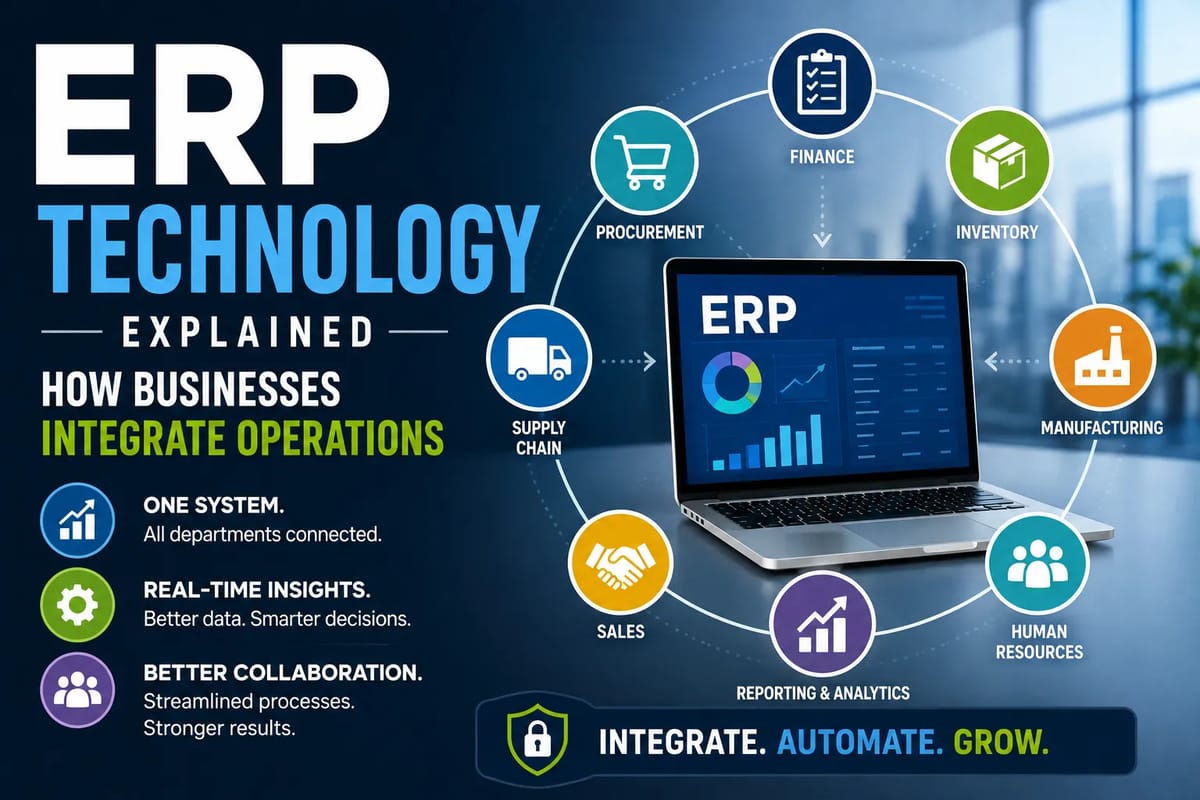
Accounting systems, customer relationship management platforms, enterprise resource planning software, project management tools, communication platforms, human resources systems, analytics applications, and industry-specific software can all affect business performance.
Organizations should understand how these systems support particular processes and objectives rather than treating software as a collection of independent tools.
The Complete Guide to Business Software provides broader context on the role different types of business software can play in organizational operations.
Map Technology Capabilities to Business Needs
Once the current environment and organizational priorities are understood, the next step is to identify where technology capabilities align with business needs.
A simple mapping exercise can be useful.
| Business Goal | Business Need | Potential Technology Capability | Expected Outcome |
|---|---|---|---|
| Reduce operating costs | Automate repetitive work | Workflow automation | Lower manual workload |
| Improve customer retention | Better customer insights | CRM and analytics | More targeted engagement |
| Expand operations | Scalable infrastructure | Cloud services | Easier expansion |
| Improve decision-making | Faster access to data | Business intelligence | Better management decisions |
| Strengthen security | Reduce cyber risk | Security monitoring and controls | Greater resilience |
| Improve productivity | Simplify collaboration | Collaboration platforms | Faster communication |
This approach keeps technology discussions connected to measurable organizational outcomes.
Involve Business and Technology Leaders Together
Technology strategy should not be developed in isolation.
IT leaders understand systems, infrastructure, security, architecture, and technical constraints. Business leaders understand customers, operations, revenue, markets, employees, and organizational priorities.
Bringing these perspectives together produces stronger decisions.
Finance teams can provide insight into budgets and expected returns. Operations teams can identify process problems. Marketing teams can explain customer and market requirements. Human resources can identify workforce needs. Executive leadership can establish strategic priorities.
The result should be a shared technology strategy rather than an IT strategy that the rest of the organization is expected to follow.
Prioritize Technology Investments
Organizations rarely have unlimited budgets or resources.
This makes prioritization essential.
Technology projects can be ranked according to factors such as:
- Strategic importance
- Expected business value
- Cost
- Implementation complexity
- Risk reduction
- Customer impact
- Employee impact
- Time to value
- Scalability
- Regulatory requirements
A project that is technically impressive but has little connection to strategic priorities may deserve a lower priority than a less exciting initiative that solves a major operational problem.
Evaluate Technology Solutions Carefully
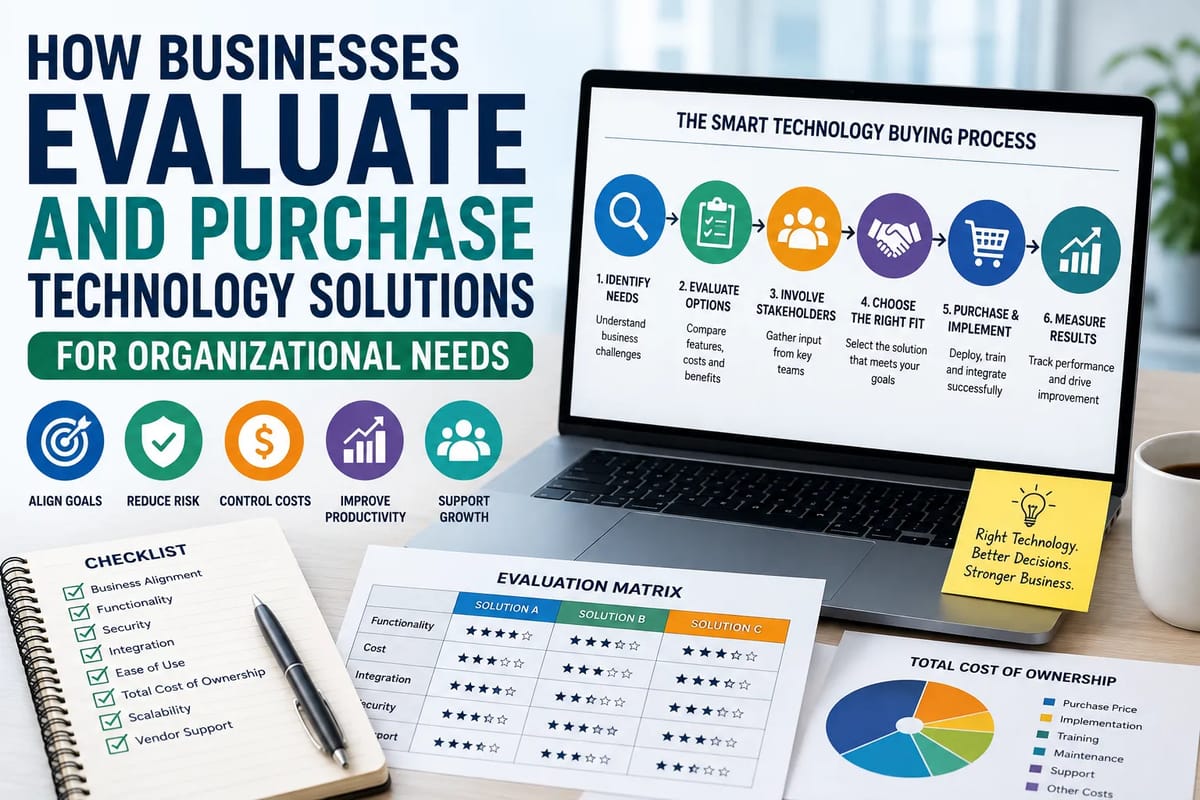
Choosing a technology solution should involve more than comparing product features.
Organizations should examine whether a solution fits their existing environment, processes, workforce, budget, security requirements, and long-term strategy.
Important considerations can include:
- Total cost of ownership
- Integration capabilities
- Scalability
- Vendor reliability
- Security
- Data ownership
- Implementation requirements
- Training needs
- Support arrangements
- Contract terms
- Exit options
- Future development plans
Organizations can also benefit from establishing a consistent evaluation process. The guide to how businesses evaluate and purchase technology solutions for organizational needs explores this decision-making process in greater detail.
Build a Technology Roadmap
A technology strategy becomes more actionable when it is translated into a roadmap.
The roadmap should show what needs to happen, when it should happen, and how different initiatives relate to one another.
A simple roadmap might include:
Short-Term Priorities
These could involve urgent security improvements, replacing unsupported systems, fixing major integration problems, or implementing relatively simple tools with immediate business benefits.
Medium-Term Initiatives
These might include application modernization, data platform improvements, process automation, or larger software implementations.
Long-Term Capabilities
Long-term planning could involve advanced analytics, artificial intelligence, extensive automation, new digital business models, or major infrastructure changes.
The roadmap should remain flexible because business conditions and technology requirements can change.
Consider Digital Transformation
For some organizations, aligning technology with business goals requires more than replacing individual applications.
Digital transformation involves broader changes to how organizations operate and create value using digital technologies.
It can affect processes, organizational structures, customer interactions, data management, employee experiences, and business models.
Organizations considering major technology-led changes can explore the Complete Guide to Digital Transformation for Businesses to better understand how digital transformation extends beyond simply purchasing new technology.
Make Data Part of the Strategy
Data should be treated as a strategic resource rather than merely something generated by business systems.
Organizations often collect information from sales, customer service, finance, marketing, operations, websites, applications, and other sources.
If those systems cannot communicate effectively, decision-makers may struggle to obtain a reliable view of the business.
A technology strategy should therefore consider:
- Where important data is stored
- Who owns different datasets
- How systems exchange information
- Data quality
- Data security
- Data governance
- Reporting requirements
- Analytics capabilities
- Retention requirements
Better data infrastructure can help organizations make faster and more informed decisions.
Include Cybersecurity From the Beginning
Security should not be added after technology decisions have already been made.
Every major technology initiative can introduce security considerations involving accounts, devices, applications, networks, vendors, data, and integrations.
A technology strategy should address areas such as:
- Identity and access management
- Data protection
- Endpoint security
- Network security
- Application security
- Security monitoring
- Backup and recovery
- Incident response
- Employee awareness
- Vendor risk
Security investments should also be connected to organizational risk rather than treated solely as technical expenses.
Establish Strong IT Governance
Organizations need a clear framework for deciding who can approve technology investments, who owns systems, how risks are managed, and how technology performance is evaluated.
This is where IT governance becomes important.
Effective governance can define:
- Decision-making responsibilities
- Technology standards
- Investment approval processes
- Risk management
- Security requirements
- Data responsibilities
- Vendor management
- Compliance expectations
- Performance measurement
The guide to what IT governance is and how organizations manage technology decisions, accountability and risk provides additional context on these responsibilities.
Plan for Employee Adoption
Even an excellent technology solution can fail if employees cannot or will not use it effectively.
Technology strategy therefore needs to account for the human side of implementation.
Employees may require:
- Training
- Clear instructions
- Ongoing support
- Time to adapt
- Process changes
- Leadership communication
- Opportunities to provide feedback
Organizations should explain why a new system is being introduced and how it will affect employees.
Adoption should be treated as part of the project rather than something that happens automatically after implementation.
Measure Technology Performance
A technology strategy needs measurable outcomes.
Instead of simply tracking whether a project was completed on schedule, organizations should examine whether the technology actually delivered the intended business value.
Potential metrics include:
- Revenue generated
- Costs reduced
- Processing time
- Employee productivity
- Customer satisfaction
- Customer retention
- System availability
- Adoption rates
- Security incidents
- Data quality
- Return on technology investment
The appropriate metrics depend on the organization's goals.
For example, a customer service automation project might measure resolution time and customer satisfaction, while a cybersecurity initiative might focus on risk reduction, detection capabilities, and incident response performance.
Manage Technology Costs Over Time
The initial purchase price is only part of the cost of technology.
Organizations may also incur expenses related to implementation, integration, customization, training, maintenance, support, upgrades, security, data migration, and eventual replacement.
This is why technology planning should consider total cost of ownership.
A solution that appears inexpensive initially may become costly if it requires extensive customization or creates dependence on additional systems.
Conversely, a more expensive platform may produce greater long-term value if it reduces complexity and supports future growth.
Avoid Technology for Technology's Sake
One of the simplest principles of business technology strategy is also one of the most important: technology should solve a meaningful business problem or create a meaningful business opportunity.
Organizations do not need to adopt every emerging technology.
Artificial intelligence, automation, cloud computing, advanced analytics, and other technologies can create significant opportunities, but their value depends on how effectively they address actual organizational needs.
Strategic discipline means knowing when to invest, when to improve existing systems, and when to wait.
Review the Strategy Regularly
A technology strategy should not be treated as a document that is created once and forgotten.
Business priorities change. Customer expectations evolve. Competitors introduce new capabilities. Vendors change their products. Security risks develop. Regulations can change. New technologies can create opportunities that did not previously exist.
Organizations should periodically review their technology strategy to determine whether it remains aligned with current priorities.
A regular review can ask:
- Are our technology investments producing the expected value?
- Have business priorities changed?
- Are existing systems still appropriate?
- Have new risks emerged?
- Are employees using systems effectively?
- Are technology costs under control?
- What capabilities will the organization need next?
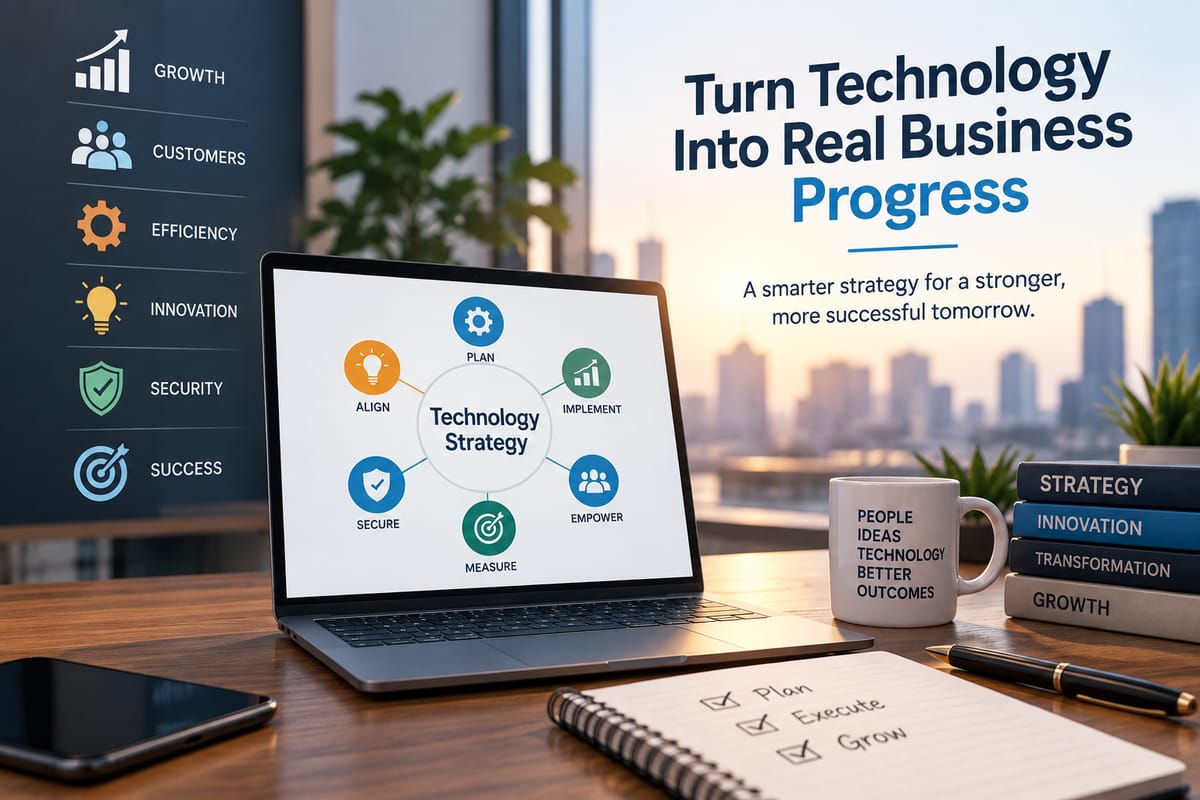
This creates a continuous cycle of planning, implementation, measurement, and adjustment.
Turning Technology Into a Strategic Advantage
A well-designed business technology strategy is ultimately about connecting two things that are sometimes managed separately: what the organization wants to achieve and how technology can help it get there.
The strongest strategies begin with business objectives, assess the existing technology environment, prioritize investments, involve stakeholders, address security and governance, support employees, and measure outcomes.
Technology then becomes more than a collection of applications and infrastructure. It becomes an organizational capability that can support growth, efficiency, resilience, customer experiences, and long-term competitiveness.
When every major technology decision can be traced back to a meaningful organizational goal, businesses are better positioned to invest with purpose rather than simply keep up with technological change.