How Businesses Measure Software Value
Businesses invest heavily in software to improve productivity, manage operations, serve customers, analyze information, automate repetitive work, and support growth. But buying software is only the beginning.
The more important question is whether the technology is actually creating value for the organization.
Software value can be difficult to measure because the benefits are not always visible on a balance sheet. Some applications directly increase revenue, while others save employees time, reduce errors, strengthen security, improve customer experiences, or make it possible for a business to operate more efficiently.
Measuring software value therefore requires more than looking at the purchase price. Businesses need to consider the total cost of ownership, measurable business outcomes, employee adoption, operational improvements, and the software's contribution to broader organizational goals.
What Does Software Value Mean?
Software value is the overall business benefit an organization receives from a software investment compared with the resources required to acquire, implement, operate, and maintain it.
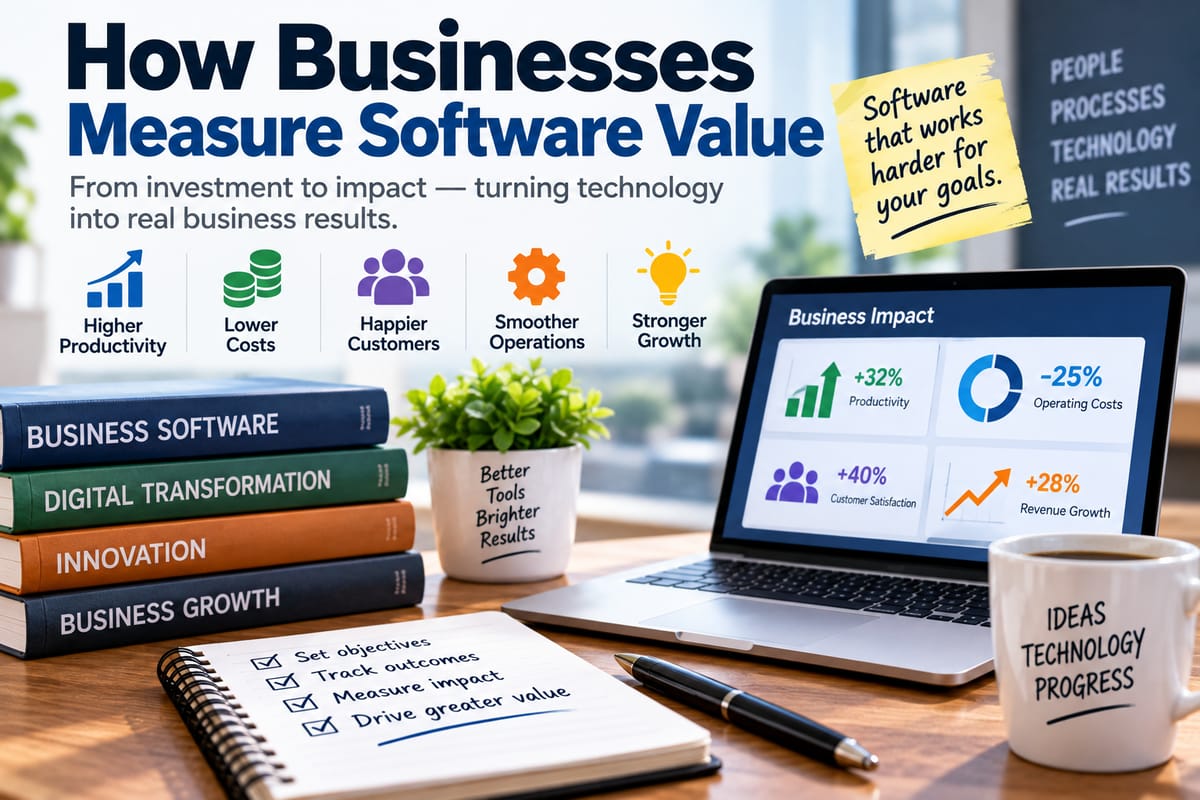
The value of software can come from several areas, including:
- Increased revenue
- Lower operating costs
- Higher employee productivity
- Faster business processes
- Improved customer experiences
- Better decision-making
- Reduced errors
- Improved security
- Greater compliance
- More efficient use of resources
- Greater ability to scale
The same software can also have different levels of value for different organizations.
A customer relationship management platform, for example, may be extremely valuable to a growing sales organization but less important to a small company with very few customers.
Understanding the different categories of business software is a useful starting point, which is why the Complete Guide to Business Software can help put software investments into a broader context.
Why Software Value Is Difficult to Measure
Software often affects multiple areas of an organization at the same time.
An application might reduce the amount of time employees spend on administrative tasks while also improving data accuracy and customer response times.
Some benefits are easy to calculate.
If software eliminates a $50,000 annual manual process, the potential financial benefit is relatively straightforward to estimate.
Other benefits are more difficult to convert into a precise monetary figure.
For example:
- How much is faster customer service worth?
- What is the financial value of fewer data errors?
- How much productivity is gained when employees have better tools?
- What is the value of reducing cybersecurity risk?
- How much future growth does a scalable platform enable?
These questions require businesses to combine financial measurements with operational and strategic indicators.
Start With the Business Problem
Software value should generally be measured against the problem the software was intended to solve.
Before evaluating a technology investment, a business can establish a baseline.
For example, suppose employees currently spend 20 hours each week manually entering information into several systems.
If a new application is intended to automate that work, the business can measure:
- Time spent before implementation
- Time spent after implementation
- Number of employees involved
- Error rates
- Processing speed
- Cost of the existing process
This creates a basis for evaluating whether the software actually improved the situation.
Without a baseline, it becomes difficult to determine how much change the software produced.
Define Software Objectives Before Purchase
Businesses can make software evaluation easier by defining expected outcomes before purchasing a product.
Objectives might include:
- Reduce processing time by 30%
- Increase sales conversion rates
- Reduce customer response times
- Lower administrative costs
- Improve reporting accuracy
- Reduce manual data entry
- Increase employee productivity
- Improve system availability
- Reduce security incidents
These objectives turn a vague goal such as "modernize our technology" into measurable outcomes.
They also create criteria that can be revisited after implementation.
Software Cost Goes Beyond the Purchase Price
One of the most common mistakes businesses make is measuring software cost only by its subscription or license price.
The total cost of ownership, or TCO, can include many additional expenses.
These may include:
- Licensing or subscription fees
- Implementation
- Data migration
- Integration
- Customization
- Employee training
- Consulting
- Support
- Maintenance
- Security controls
- Infrastructure
- Administration
- Upgrades
- Additional user licenses
A software platform with a low initial price can become expensive if it requires extensive customization or ongoing support.
Likewise, a more expensive platform may provide stronger value if it significantly reduces other costs or produces larger business benefits.
Calculate Return on Investment
One of the most familiar ways to measure software value is return on investment, or ROI.
A simplified ROI calculation is:
ROI = (Financial Benefits − Software Costs) ÷ Software Costs × 100
For example, suppose a business spends $100,000 implementing a software system and estimates that it produces $150,000 in measurable financial benefits.
The simplified ROI would be:
($150,000 − $100,000) ÷ $100,000 × 100 = 50%
This provides a useful financial indicator, but it should not be treated as the only measure of software value.
Some technology investments produce benefits that are difficult to convert into direct revenue.
Measure Payback Period
Another useful financial measurement is the payback period.
Payback period estimates how long it takes for the financial benefits of an investment to recover its initial cost.
For example, if a software project costs $120,000 and produces approximately $20,000 in measurable savings each month, the simple payback period would be about six months.
Businesses can use payback analysis to compare investments with different cost structures and expected benefit timelines.
However, the calculation depends heavily on the quality of the underlying estimates.
Measure Productivity Improvements
Software can create value by helping employees accomplish more work in less time.
Productivity measurements might include:
- Tasks completed per employee
- Processing time
- Cases handled per hour
- Transactions processed
- Time spent on administrative work
- Manual steps eliminated
- Response times
- Project completion rates
Suppose an employee previously spent three hours processing a report and new software reduces that time to one hour.
The two hours saved may be valuable if employees can use that time for higher-value work.
The business should measure whether the saved time actually translates into productive activity rather than assuming that every time saving automatically creates financial value.
Measure Process Efficiency
Software can also improve the efficiency of business processes.
For example, a workflow application might reduce the number of steps required to approve an expense or process a customer request.
Useful measurements can include:
- Process cycle time
- Number of approval steps
- Number of manual interventions
- Error rates
- Processing volume
- Delays
- Rework
- Bottlenecks
A process that previously required five days might take two days after implementation.
That improvement can create value even if there is no immediate increase in revenue.
Measure Revenue Impact
Some software investments have a direct relationship with revenue.
Examples include:
- E-commerce platforms
- Sales automation software
- Customer relationship management systems
- Subscription management platforms
- Marketing automation tools
- Pricing systems
- Sales analytics software
Businesses can examine whether technology contributes to:
- Higher conversion rates
- Larger average transaction values
- Increased customer retention
- More sales opportunities
- Faster sales cycles
- Increased repeat purchases
It is important to avoid assuming that software alone caused an increase in revenue.
Other factors such as pricing, market conditions, advertising, product changes, and sales performance can influence the same outcome.
Measure Customer Experience
Software can create value by improving how customers interact with a company.
For example, an organization may introduce software that makes it easier for customers to:
- Place orders
- Track deliveries
- Contact support
- Manage accounts
- Receive personalized information
- Complete payments
- Find information
Businesses can measure changes in:
- Customer satisfaction
- Response time
- Resolution time
- Customer retention
- Complaint rates
- Abandonment rates
- Repeat purchases
Customer experience measurements can provide evidence of value even when the connection to revenue is not immediate.
Measure Employee Adoption
A software platform cannot create its expected value if employees do not use it effectively.
This makes adoption one of the most important technology metrics.
Businesses can examine:
- Percentage of employees actively using the software
- Frequency of use
- Feature utilization
- Completion of required workflows
- Training completion
- User satisfaction
- Support requests
- Workarounds
A company may purchase an advanced platform but receive limited value if employees continue relying on spreadsheets or older systems.
Low adoption can indicate problems with training, usability, process design, leadership support, or the software itself.
Measure Time to Value
Time to value measures how long it takes for a software investment to begin producing meaningful benefits.
A technology project may take months to implement.
However, implementation completion does not necessarily mean the organization has realized value.
Businesses should consider when employees begin using the system effectively and when measurable improvements start appearing.
A platform that reaches useful adoption quickly may provide value sooner than another platform with a longer implementation cycle.
Measure Software Utilization
Many business applications contain features that organizations rarely use.
Low utilization can indicate that a business is paying for capabilities it does not need.
Useful measurements include:
- Active users
- Login frequency
- Feature usage
- Transaction volume
- Workflow completion
- API utilization
- Storage usage
However, high utilization is not automatically good.
Employees could use a system frequently because the process is inefficient or because they are required to perform unnecessary steps.
Usage metrics need to be interpreted alongside business outcomes.
Measure Error Reduction
Software automation can reduce mistakes caused by manual processes.
For example, a business might introduce software to automatically transfer customer information between systems.
Before implementation, the organization might experience frequent data-entry errors.
After implementation, it can compare:
- Number of errors
- Number of corrections
- Customer complaints
- Failed transactions
- Rework hours
A reduction in these problems can represent measurable business value.
Measure Risk Reduction
Some software investments are designed primarily to reduce risk rather than generate revenue.
Cybersecurity software is a clear example.
Security tools may prevent incidents, detect suspicious activity, protect sensitive information, or improve compliance.
The value can be difficult to calculate because the business may never know exactly what would have happened without the software.
Nevertheless, organizations can monitor indicators such as:
- Security incidents
- Detection time
- Response time
- Vulnerability exposure
- Compliance findings
- System availability
- Unauthorized access attempts
Risk reduction can be a significant part of software value even when it does not appear as additional revenue.
Measure System Reliability
Software problems can interrupt business operations.
Businesses can therefore track technical performance indicators such as:
- System availability
- Downtime
- Response time
- Error rates
- Failed transactions
- Recovery time
- Service interruptions
Improved reliability can reduce lost productivity and customer frustration.
For critical business applications, reliability may be one of the most important measures of whether the software is delivering its intended value.
Measure Data Quality
Modern businesses depend heavily on data.
Software that improves data collection, organization, validation, or integration can create significant value.
Organizations can track:
- Duplicate records
- Missing information
- Data-entry errors
- Inconsistent values
- Processing accuracy
- Data completeness
- Reporting discrepancies
Better data can support better decisions, although businesses should avoid assuming that simply having more data automatically improves decision-making.
The quality, relevance, accessibility, and interpretation of the information all matter.
Measure Decision-Making Improvements
Some software investments are designed to give managers better information.
Business intelligence and analytics platforms, for example, can bring data together into dashboards and reports.
Businesses can measure whether these tools improve:
- Reporting speed
- Information availability
- Forecasting
- Planning
- Decision cycles
- Visibility into performance
It can also be useful to track whether employees actually use the information when making decisions.
A dashboard that nobody uses may have limited practical value regardless of how sophisticated it looks.
Measure Scalability
Software can create value by allowing a business to grow without increasing costs at the same rate.
For example, an automated platform might allow a company to process twice as many customer transactions without doubling the administrative workforce.
Scalability can be measured through relationships such as:
- Transactions per employee
- Customers per support representative
- Orders per operations employee
- Revenue per employee
- Processing capacity
- Infrastructure cost per transaction
This can help businesses understand whether technology is supporting growth efficiently.
Compare Software Performance With the Original Business Case
Before purchasing major software, organizations often create a business case.
That document may contain assumptions about:
- Expected costs
- Expected savings
- Revenue opportunities
- Productivity improvements
- Implementation time
- Adoption
- Risk reduction
After implementation, the organization can compare actual results with those original assumptions.
This is one of the most effective ways to determine whether the project delivered what was promised internally.
If expected savings were $500,000 but actual savings were $200,000, management can investigate why.
Perhaps adoption was lower than expected, implementation took longer, or the original estimate was overly optimistic.
Technology Evaluation Should Continue After Purchase
Software evaluation should not end when a contract is signed.
Organizations should periodically ask:
Is this software still providing enough value to justify its cost?
Circumstances can change.
A business may grow, shrink, acquire another company, change its strategy, or adopt another technology that makes an existing platform less useful.
The software itself may also change through new features, pricing models, or product updates.
Regular reviews help businesses identify whether technology investments continue to support current needs.
Compare Software Value With Alternatives
Measuring software value also means considering what the organization could do instead.
Possible alternatives may include:
- Keeping the existing system
- Building software internally
- Buying another product
- Using a simpler application
- Automating only part of a process
- Outsourcing the activity
- Delaying the investment
A software product may provide positive value while still being inferior to another available approach.
This is why software evaluation should consider alternatives rather than looking only at whether a particular product works.
The broader process of comparing technology options is covered in How Businesses Evaluate and Purchase Technology Solutions for Organizational Needs.
Measure Integration Value
Modern organizations rarely operate with one software application.
CRM systems, accounting platforms, marketing tools, inventory systems, HR applications, analytics platforms, and other technologies often need to exchange information.
Integration can create value by eliminating duplicate data entry and reducing disconnected workflows.
Businesses can measure:
- Number of manual transfers eliminated
- Data synchronization speed
- Integration failures
- Duplicate entry
- Processing time
- Data consistency
Integration value is particularly important when a new platform is intended to connect several existing systems.
Measure Automation Value
Automation is one of the most common reasons businesses adopt software.
Automated workflows can handle repetitive activities such as:
- Data entry
- Notifications
- Invoice processing
- Scheduling
- Reporting
- Customer communications
- Approval workflows
- Document generation
Businesses can calculate potential value by comparing the time and cost of manual processes with the automated process.
However, automation should be measured according to outcomes rather than simply the number of tasks automated.
Automating an unnecessary process does not necessarily create meaningful value.
Measure Strategic Value
Some software investments support long-term strategic objectives rather than immediate financial returns.
For example, a company may invest in a modern technology platform because it wants to:
- Enter new markets
- Offer new digital services
- Support remote operations
- Build new customer experiences
- Create scalable infrastructure
- Develop new products
- Improve organizational agility
These benefits can be difficult to capture through traditional ROI calculations.
Businesses can instead define strategic indicators that show whether the technology is helping advance the underlying objective.
Digital Transformation Makes Software Measurement More Important
Software is increasingly part of broader organizational transformation.
A business may introduce new technology across multiple departments rather than purchasing one isolated application.
In these situations, measuring individual software products may not be enough.
Organizations may need to evaluate how multiple systems work together to improve processes and business capabilities.
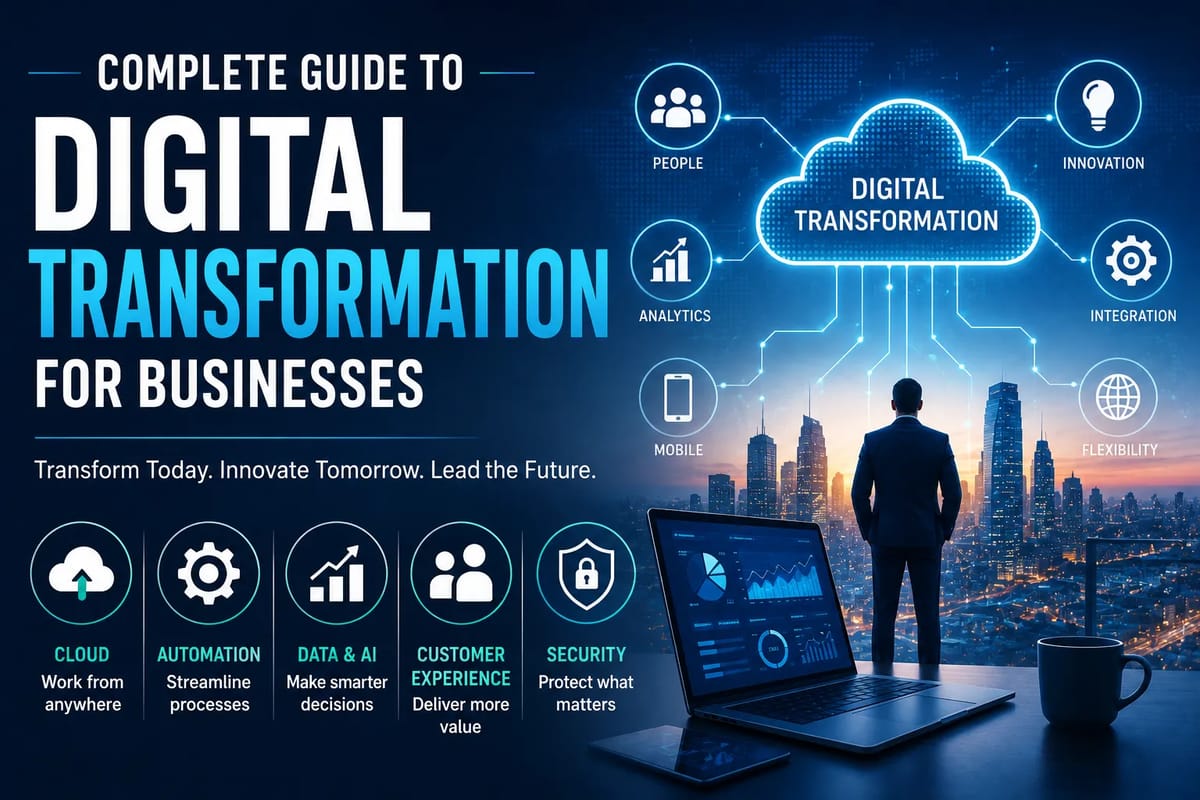
The broader relationship between technology, processes, and organizational change is explored in the Complete Guide to Digital Transformation for Businesses.
Software Value Can Change Over Time
The value of software is not necessarily fixed.
A system may provide substantial benefits during its first few years and gradually become less valuable as the business changes.
Alternatively, a platform may become more valuable as employees become more proficient and additional integrations are introduced.
Several factors can change software value:
- Business growth
- Employee adoption
- New features
- Changing prices
- New competitors
- Regulatory requirements
- New technologies
- Changing customer expectations
- Organizational restructuring
This is why software investments should be reviewed periodically rather than evaluated only once.
Common Mistakes When Measuring Software Value
Businesses can make several mistakes when evaluating technology investments.
Measuring Only Purchase Price
A low license fee does not necessarily mean low total cost.
Measuring Only Revenue
Some software creates value through productivity, risk reduction, compliance, or better customer experiences.
Ignoring Adoption
Unused software cannot deliver its full potential value.
Using Too Many Metrics
A huge collection of KPIs can make it difficult to determine what actually matters.
Ignoring the Baseline
Without knowing the starting position, measuring improvement becomes difficult.
Taking Vendor Claims as Business Results
A vendor's expected outcomes are not the same as the organization's actual results.
Never Reviewing the Investment Again
Business needs and technology markets change.
A Practical Software Value Scorecard
A business can create a simple scorecard for each major software investment.
| Category | Example Measurement |
|---|---|
| Financial | ROI, cost savings, revenue impact |
| Productivity | Hours saved, tasks completed |
| Adoption | Active users, feature utilization |
| Operations | Processing time, error rates |
| Customer | Satisfaction, retention, response time |
| Security | Incidents, detection time |
| Reliability | Downtime, availability |
| Data | Accuracy, completeness |
| Strategic | Progress toward business objectives |
| Scalability | Capacity and cost per transaction |
The exact metrics should reflect the purpose of the software.
A cybersecurity platform and a sales application should not be evaluated using identical measurements.
How to Build a Software Measurement Framework
A practical framework can follow several steps.
1. Define the Business Objective
Determine what problem the software is expected to solve.
2. Establish a Baseline
Measure the relevant process before implementation.
3. Identify Key Metrics
Choose a small number of indicators that directly relate to the objective.
4. Calculate Total Costs
Include implementation, training, integration, support, and ongoing expenses.
5. Measure Adoption
Determine whether employees are actually using the software.
6. Track Results
Compare post-implementation performance with the original baseline.
7. Review the Business Case
Compare actual results with the original expectations.
8. Reassess Periodically
Determine whether the software continues to provide sufficient value as circumstances change.
Software Value Is About Outcomes, Not Features
Modern software products can contain hundreds of features.
But businesses do not create value simply by owning features.
A feature creates value when it helps the organization accomplish something useful.
A dashboard matters if it improves visibility. Automation matters if it reduces unnecessary work. Integration matters if it improves the flow of information. Analytics matters if it helps people understand important business questions.
This distinction can prevent organizations from confusing technological sophistication with business value.
How Digital Innovation Can Increase Software Value
Software can also become more valuable when organizations rethink how work is performed rather than simply replacing an old application with a new one.
Digital innovation may involve redesigning processes, connecting systems, using data differently, or creating new ways for customers and employees to interact with the business.
This broader relationship between technology and organizational change is discussed in How Digital Innovation Is Transforming Modern Companies.
The most valuable technology investments are often those that enable meaningful changes in how the organization operates.
The Questions Businesses Should Keep Asking
Software value should ultimately be connected to a few fundamental questions:
- Is the software solving the problem it was purchased to solve?
- Are employees using it effectively?
- Are measurable outcomes improving?
- Is the total cost justified by the benefits?
- Has the business case been achieved?
- Does the software still fit the organization's needs?
- Could another solution deliver greater value?
- Is the technology helping advance broader business objectives?
These questions keep the focus on outcomes rather than technology for its own sake.
Turning Software Spending Into Measurable Business Value
Software is an investment in business capability, not simply an expense on an IT budget.
The strongest measurement approaches combine financial metrics with operational, customer, employee, technical, and strategic indicators. Businesses can examine ROI and payback while also tracking productivity, adoption, reliability, data quality, customer outcomes, risk reduction, and progress toward strategic goals.
The process begins before the software is purchased. Organizations need clear objectives, realistic assumptions, baseline measurements, and defined success criteria.
After implementation, those measurements provide a way to determine whether the technology is delivering what the business expected.
When software value is measured continuously, companies gain a clearer understanding of which technology investments are producing meaningful results, where improvements are needed, and whether their technology portfolio continues to support the way the organization wants to operate and grow.