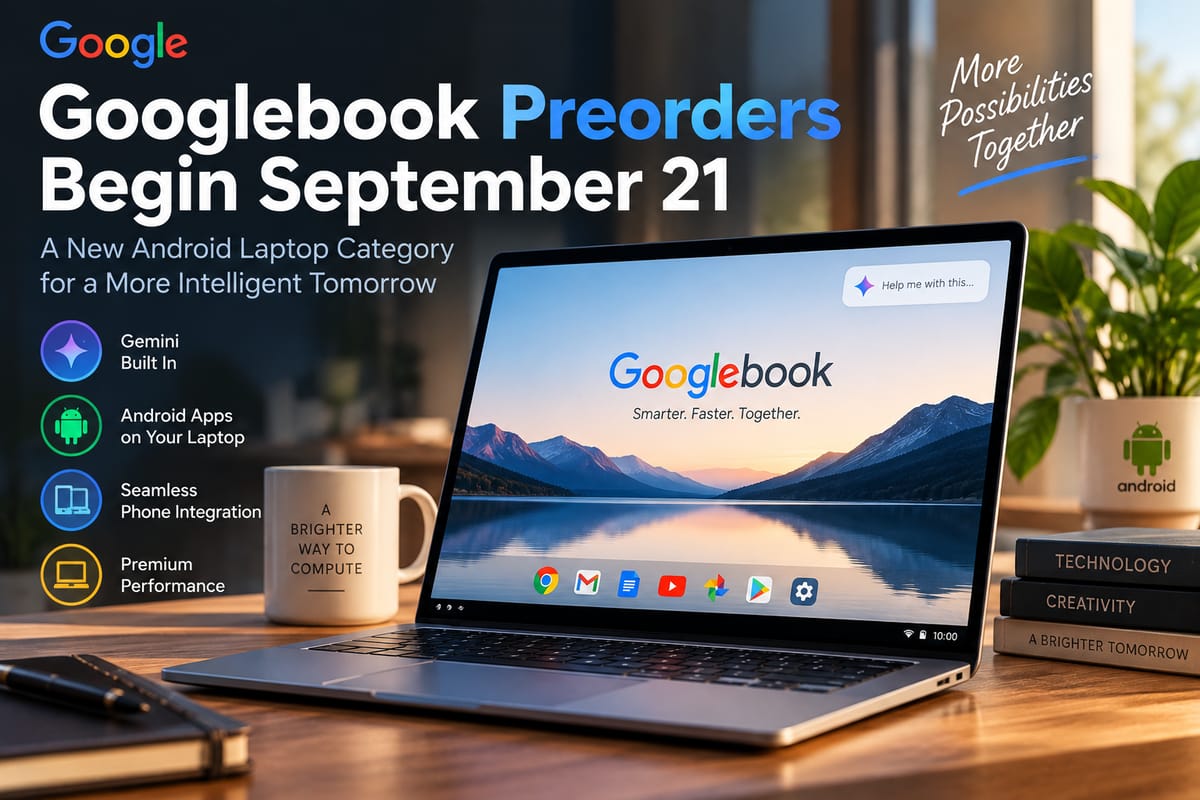
Googlebook Preorders Begin September 21 as Google Prepares a New Android Laptop Category
Google is preparing to open preorders for Googlebook, a new category of premium laptops designed around Gemini and a closer connection with the Android ecosystem.
Preorders are scheduled to begin on September 21, 2026, at 9 a.m. Eastern Time, giving consumers the first firm opportunity to order the devices since Google introduced the platform earlier this year. Google has not yet publicly confirmed final pricing or a specific shipping date.
The launch represents a significant change in Google's approach to personal computing. Rather than positioning Googlebook simply as another Chromebook, Google describes it as a new category that combines elements of Android and ChromeOS with premium hardware and Gemini-powered intelligence.
The first wave of hardware is being developed with major laptop manufacturers including Acer, ASUS, Dell, HP and Lenovo.
Googlebook Is Designed as a New Kind of Laptop
Google introduced Googlebook in May 2026 as part of its broader effort to rethink the laptop around AI.
The company described the new devices as moving beyond a traditional operating-system-first approach toward what it calls an “intelligence system.” Googlebook brings together Android's app ecosystem with the Chrome browser and adds Gemini capabilities directly into the computing experience.
That positioning puts Googlebook somewhere between the company's existing Chromebook strategy and the broader premium laptop market.
For consumers trying to understand the evolution of portable computers, What Is Portable Computing and How Do Modern Mobile Computers Work? provides useful background on how laptops have developed from conventional personal computers into increasingly connected mobile devices.
Googlebook is effectively an attempt to push that evolution another step by making AI a more central part of everyday computer interaction.
Preorders Are the First Major Test
September 21 is important because it moves Googlebook from announcement and preview material into the purchasing phase.
Google has been teasing the platform for months, but many practical details remain unclear. The company's official Googlebook website confirms the September 21 preorder date while highlighting the product's Gemini integration, Android connectivity and premium positioning.
The preorder launch should provide more information about individual models, pricing and configurations.
For shoppers, those details will matter considerably.
A laptop can look impressive in promotional material, but buyers ultimately need to know how much it costs, what processor it uses, how much memory and storage it offers, how long its battery lasts and what ports and display options are available.
That is why a detailed understanding of Everything You Need to Know Before Buying a Laptop can be useful before committing to a new device category.
Five Major Laptop Makers Are Joining the Launch
Googlebook is not a single laptop manufactured entirely by Google.
The first generation is being produced through partnerships with Acer, ASUS, Dell, HP and Lenovo, giving manufacturers an opportunity to build different hardware designs around Google's new platform.
That approach could make the Googlebook ecosystem more diverse than a single-device launch.
Different manufacturers can target different audiences through screen sizes, processors, materials, keyboards, connectivity options and pricing.
It also means the Googlebook experience could vary considerably from one model to another even though the underlying software and AI features are shared.
For consumers, comparing the hardware will therefore be just as important as evaluating Google's software.
Gemini Is at the Center of the Experience
Artificial intelligence is one of the main reasons Google is positioning Googlebook as a new category rather than simply another Chromebook.
The company calls the broader experience Gemini Intelligence, with features designed to bring AI assistance directly into everyday laptop activities.
One of the most prominent features is Magic Pointer.
Instead of requiring users to open a separate chatbot, Magic Pointer is designed to let them select something on the screen and immediately ask Gemini for relevant assistance. Google says users can use the feature to ask questions, compare content or create something based on what they have selected.
That approach could make AI feel less like a separate application and more like part of the computer's basic interface.
Create My Widget Brings AI Into the Desktop
Googlebook will also introduce a feature called Create My Widget, which allows users to build custom desktop widgets by describing what they want.
Google's example shows a user asking Gemini to create a live tracker for a trip, producing a widget containing information such as flights, accommodations and dining plans.
The idea reflects a larger change in software design.
Traditionally, users choose from features that developers have already built. AI-generated interfaces could allow users to describe what they need and have the computer create a customized tool.
If the technology works reliably, that could make the desktop more adaptable without requiring users to install separate applications for every task.
Android Phones Become Part of the Laptop
Another major part of Google's strategy is closer integration between Googlebooks and Android smartphones.
Google says Googlebooks will support Cast My Apps, allowing users to open phone applications on the laptop without separately installing them. The platform will also include Quick Access, which provides access to files from an Android phone through the laptop.
This could make the transition between phone and computer considerably smoother.
Instead of thinking about the smartphone and laptop as two independent devices, users could increasingly treat them as parts of one connected computing environment.
Google says these phone-integration features require an Android 17-or-newer phone.
Hardware Will Still Matter
Despite the emphasis on AI, Googlebook remains a laptop, meaning traditional hardware specifications will continue to influence the everyday experience.
Processor performance, memory, storage, display quality, battery capacity, cooling systems and connectivity can all affect how a computer handles demanding workloads.
That makes How Laptop Hardware Affects Performance and Everyday Use particularly relevant for consumers comparing the upcoming Googlebook models.
A powerful AI experience cannot compensate for inadequate hardware in every situation.
Users who edit video, work with large files, run demanding applications or frequently multitask will still need to pay close attention to the underlying specifications.
Specifications Could Determine Which Googlebooks Stand Out
The first generation of Googlebooks is expected to cover multiple manufacturers, which means hardware differences could become a major part of the buying decision.
A lightweight model could appeal to students and mobile professionals. A larger model with a more powerful processor might be aimed at creators and demanding productivity users.
Display technology could also become an important differentiator. Premium panels, high refresh rates, touch support and higher resolutions can make a significant difference depending on the user's priorities.
Battery life will be another critical consideration.
AI-powered features can require additional processing, so the efficiency of the underlying hardware will matter if Google wants Gemini capabilities to become a routine part of laptop use rather than something consumers activate only occasionally.
Understanding How to Understand Computer Specifications and Performance can help buyers separate meaningful specifications from marketing language.
Googlebook Will Not Simply Replace Chromebooks
Google has positioned Googlebook as a new category rather than an immediate replacement for Chromebooks.
The official Googlebook website describes Chromebooks as devices that continue to focus on simplicity, speed and efficiency, while Googlebooks are positioned as a higher-end category featuring premium materials, stronger performance, Gemini-powered intelligence and deeper Android connectivity.
That distinction could allow Google to maintain different tiers of hardware.
Chromebooks can continue serving consumers who primarily want affordable, straightforward computing, while Googlebooks can target users willing to pay more for higher-end hardware and advanced AI features.
The approach also gives Google's hardware partners room to compete across multiple segments.
The Biggest Unknowns Are Still Important
Despite the growing amount of information surrounding Googlebook, several major questions remain unanswered.
Pricing is one of the biggest.
Google has confirmed the preorder date but has not publicly provided final pricing across the lineup.
Shipping dates are another uncertainty. Preorders will begin September 21, but Google has not yet confirmed exactly when customers will receive their devices.
The exact specifications of every launch model also remain incomplete.
Those details could significantly influence how consumers perceive the new category once actual purchasing decisions begin.
Google Is Betting That AI Can Redefine the Laptop
The most interesting part of Googlebook may not be its hardware at all.
Google is betting that AI can change the way people interact with computers.
The traditional laptop interface revolves around applications, files, menus and websites. Googlebook introduces a different idea in which Gemini can sit across those experiences and help users act on whatever is currently on the screen.
Magic Pointer represents that philosophy particularly clearly.
Rather than asking users to decide which application or AI tool they need first, Google wants the computer to understand the context of what they are doing and suggest useful actions.
That could make everyday computing faster and more intuitive, although the quality of the experience will ultimately depend on how accurately and consistently those AI features work.
September 21 Marks the Start of the Real Test
Googlebook's September 21 preorder date is an important milestone for Google's attempt to establish a new category of Android-centered laptops.
The company has brought together Android applications, ChromeOS technology, Gemini Intelligence, smartphone integration and premium hardware in an effort to create a different kind of laptop experience.
But the real test begins when consumers can compare actual machines, prices and specifications.
Googlebook will enter a laptop market where buyers already have established choices from Windows PCs, MacBooks, Chromebooks and other premium computers. Its success will therefore depend on whether Gemini-powered features and Android integration provide enough practical value to justify choosing a new platform.
For consumers, September 21 should provide a much clearer picture of what Googlebook actually offers—and whether Google's vision of an AI-first laptop can translate from an intriguing concept into a compelling everyday computer.